China's getting back into AI trade

Morning Observers,
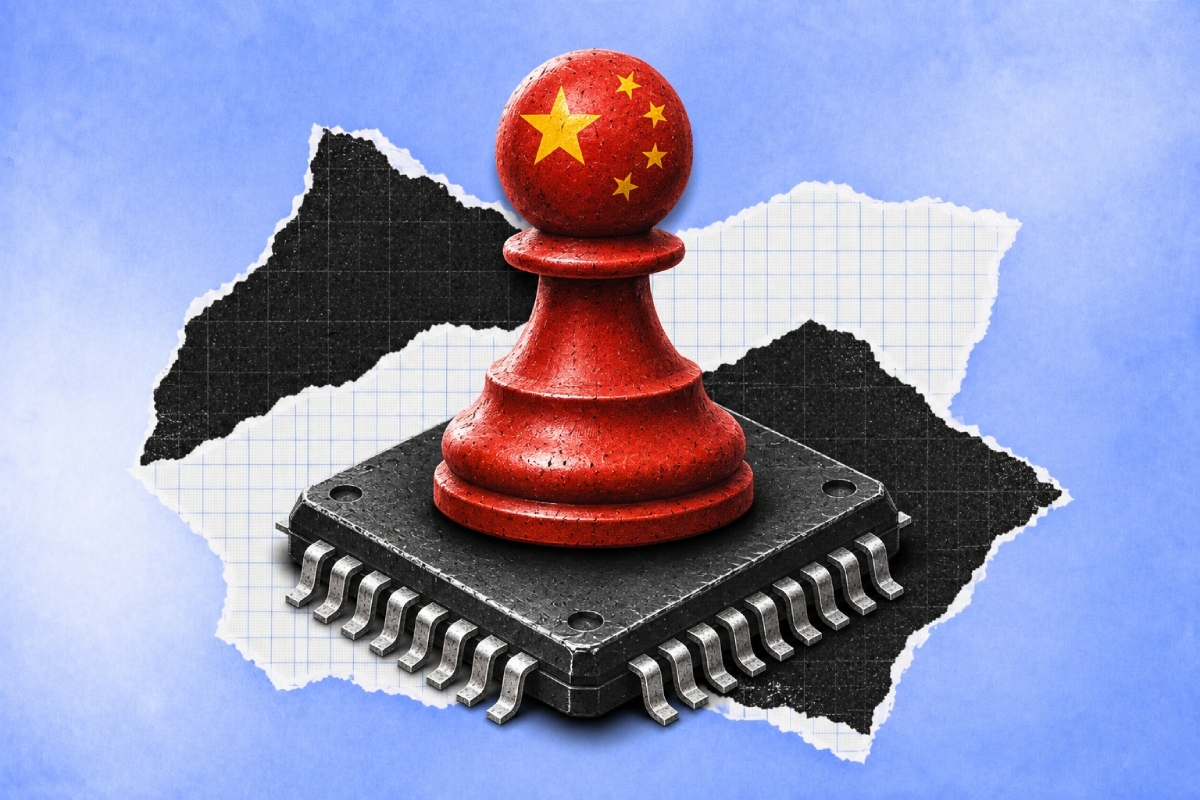
Beijing pledged yesterday to channel more money into the stock market through what's known as the "national team" (more on that in a moment) and help tech companies go public.
In response, the CSI 300, China's S&P 500, jumped 4%, and the chip-heavy STAR 50 surged 15%.
Viewed in isolation, particularly through the lens of Western capitalism, the announcement looks like a straightforward state-sponsored backstop. But that interpretation misses a big part of the national team's role.
Back in 2013, China set out to fund more of its innovation through capital markets and rely less on state support.
The problem was that China's stock market was too volatile and illiquid. So after the 2015 crash, Beijing mobilized a group of state investors dubbed the "national team" to stabilize the market. It includes China's sovereign wealth fund, along with pension funds, insurers, and other state investors.
Most of the time, the national team makes the news when it steps in to backstop the stock market. And it's easy to get the impression that's its entire job.
The lesser-known part of its mandate is to keep rallies in check by tempering demand when valuations get out of hand.
For example, the national team was selling into China's tech rally earlier this year. And it wasn't until October when China entered a bear market that it started buying again.
Earlier this month, an unusually large share of state-backed buying had gone into ETFs tracking the STAR 50 and ChiNext indexes. And yesterday, Beijing pledged even more support.
Vague as that pledge was, there are two things worth keeping in mind.
First, China is a centrally planned economy. National priorities and broader economic stability take precedence over bailing out an overvalued industry, even if pursuing those priorities incurs short-term economic pain.
Second, Beijing doesn't care about stock prices because it has little political stake in the stock market itself. What it cares about is whether that market can help China go from the world's factory to an innovator that can beat Washington at its own game without breaking the economy.
If the "invisible hand" of the world's biggest planned economy thinks now is the time to put more money into tech, maybe it's a sign the AI sell-off has gone far enough, at least in China.
- Dan Runkevicius, Editor

🛡️ Investors are buying insurance against AI debt
Investors are buying protection against the risk that AI companies will struggle to repay the billions they've borrowed to build data centers. Trading volume in U.S. corporate credit default swap (CDS) indexes has reached a record $9.6 trillion so far in 2026, according to Bloomberg data. That trend extends to individual companies. CDS trading tied to Oracle, SpaceX, Alphabet, Amazon, Meta, Broadcom, and Nvidia averaged $9.5 billion a week in September, up 425% from June and July levels.
🇨🇦 Bank of Canada adjusts inflation targeting
Bank of Canada Governor Tiff Macklem strongly hinted at another interest rate hike next month following October's quarter-point increase, but the bigger story was a subtle change in how the central bank assesses inflation. Policymakers will now use two trimmed-mean inflation measures, which exclude items with the biggest price swings. In practice, sudden increases in gasoline prices, home heating, and mortgage payments would carry less weight in the central bank's interest rate decisions.
📉 Tech's worst month since 2008
Even after Nvidia's 30% rally in a single session, the technology sector is nowhere near recovering most of November losses. The S&P 500 Information Technology Index is on track for a 16% monthly decline, its worst performance since October 2008. Meanwhile, utilities, consumer staples, real estate, healthcare, and consumer discretionary are all up at least 2% over the past month.
🏀 Collectibles are vastly outperforming stocks
The S&P 500 has given up most of its 2026 gains and is up just 20% over the past two years. Some rare sports collectibles have done considerably better. Shark Tank star Kevin O'Leary says his 1997-98 Michael Jordan trading card is now worth $2.1 million, more than triple the $690,000 he paid for it. Other collectibles haven't fared as well. Read our exclusive report to see how art stacks up against traditional investments.
Hedge funds are abandoning the AI trade
If you're looking for a culprit in the latest tech-driven selloff, hedge funds belong on the list of suspects.
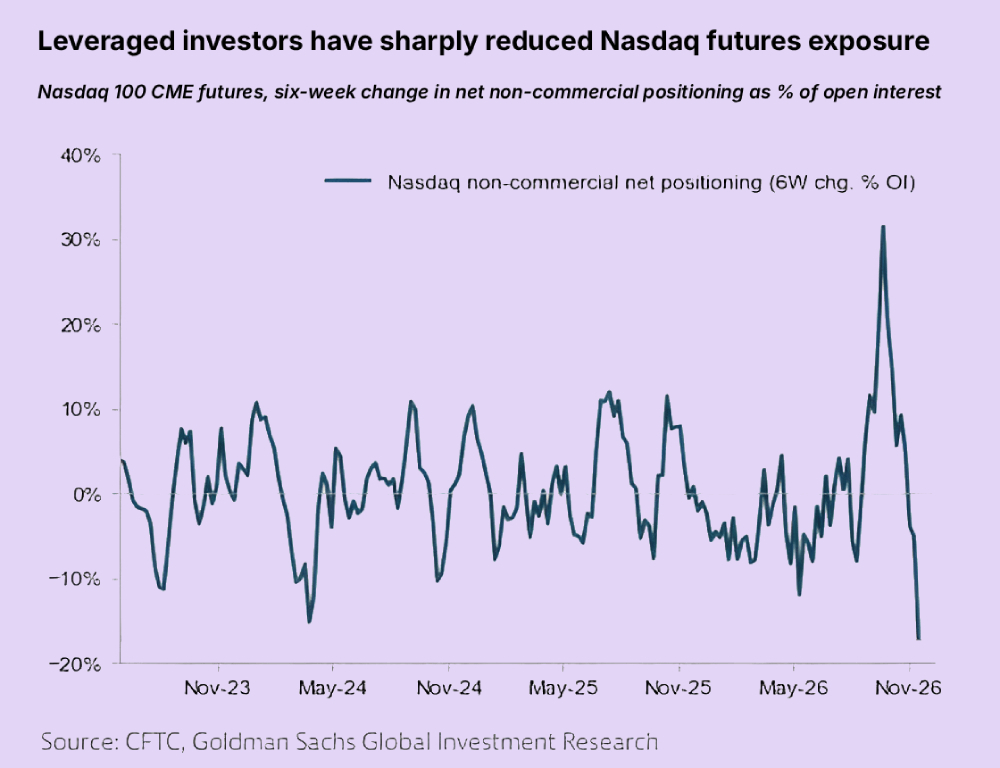
Data from Goldman Sachs show that speculative investors are reducing their bets on the Nasdaq 100 at the fastest pace since the 2022 bear market.
Hedge funds are cutting their stock holdings
One of the best ways to gauge the selling is through the Nasdaq 100 futures market, where hedge funds can make leveraged bets on the index.
Goldman Sachs tracks changes in speculative net positioning (long positions minus short positions) relative to open interest, which is the total number of outstanding futures contracts.
Goldman's data show a major reversal in speculative trading this year.
- At the height of this year's AI rally, the six-week increase in net speculative positioning exceeded 30% of open interest
- The latest six-week decline amounts to 17% of open interest, the largest drop since 2022
The five trading days through Nov. 20 also marked the worst week for hedge funds since April 2025.
Meanwhile, trend-following funds popular with hedge fund managers sold $57 billion worth of stocks in the month through Nov. 20, according to Goldman data.
Goldman Sachs estimates that trend-following funds could sell another $80.6 billion worth of stocks this week if the market continues to fall.
An unlikely dip buyer
Retail investors, meanwhile, continue to buy the dip.
They bought nearly $3 billion worth of Nvidia stock over the past two weeks, according to Vanda Research.
Net retail buying of the Direxion Daily Semiconductor Bull 3X ETF (SOXL) reached $1.25 billion over the past month, the highest level in nine years of data and seven times the 2026 average.
📌 Bottom line: Retail investors are using leverage to bet on an AI recovery, while hedge funds are unwinding leveraged bets tied to the sector.
Bitcoin's four-year cycle faces its biggest test yet
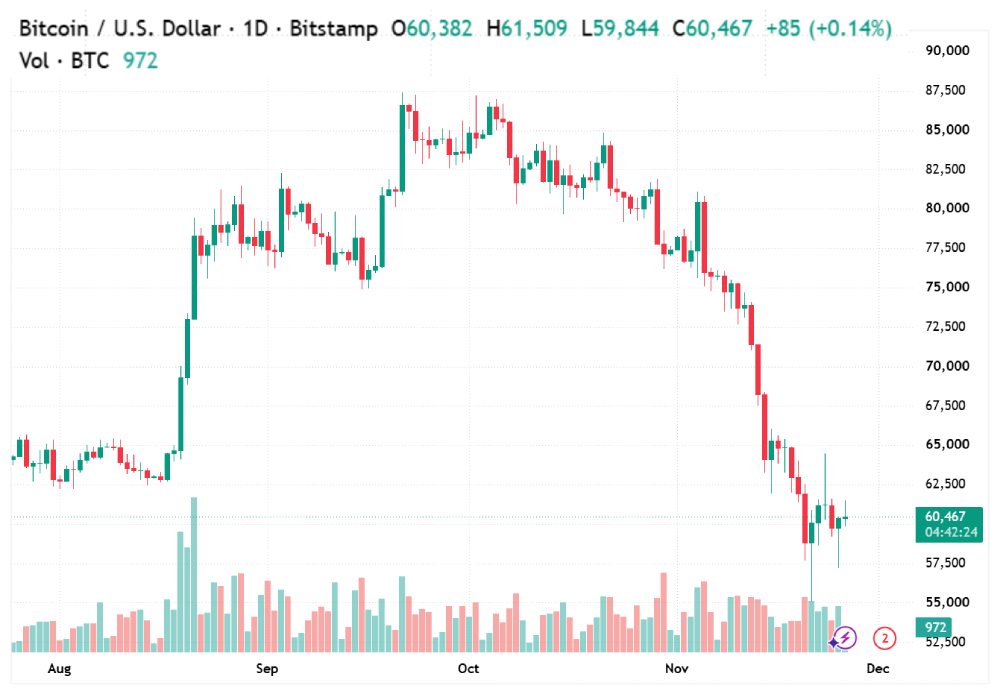
Bitcoin is on track to post back-to-back annual losses for the first time.
Its four-year cycle otherwise ran like clockwork. Bitcoin peaked in October 2025, then slid into a prolonged bear market. But with returns shrinking each cycle and AI sucking up money that once flowed into crypto, another big comeback is no sure thing.
Bitcoin is following the path of NFTs
Bloomberg commodity strategist Mike McGlone believes Bitcoin's glory days are over.
He argues that while Bitcoin's supply is capped at 21 million coins, the supply of cryptocurrencies is virtually unlimited. He sees parallels with the collapse of non-fungible tokens (NFTs), which attracted billions of dollars in speculative investment during the last crypto bull market.
According to CryptoSlam data, global NFT sales reached $23.8 billion in 2022 before falling to $5.63 billion in 2025. Sales totaled just $2.19 billion this year through Nov. 14.
Monthly sales have fallen 97% from a record $6.05 billion in January 2022 to $182.7 million this October.
Bitcoin itself is now trading around $60,000, less than half its October 2025 record of $126,000 and below the $69,000 peak it reached during the 2021 bull market.
In other words, Bitcoin has delivered virtually no return over the past five years.
Institutions are also exiting
The old saying "be careful what you wish for" comes to mind when you look at spot Bitcoin ETFs.
The crypto industry spent years lobbying for these funds before they finally won approval in January 2024. But they've also made it easier for billions of dollars to leave the market in a matter of days.
BlackRock's iShares Bitcoin Trust (IBIT), the largest spot Bitcoin ETF, has recorded $3 billion in outflows so far in November, putting it on track for its second-largest monthly outflow on record.
Last week alone, investors pulled $829 million from IBIT, marking the fund's third consecutive week of outflows. And last Thursday's $545 million withdrawal was the largest in the fund's history.
📌 Bottom line: Bitcoin's obituary has been written hundreds of times, and betting against it has historically been a mistake. But even with billions flowing into spot ETFs, Bitcoin failed to double between its 2021 and 2025 peaks. That makes it harder to count on another spectacular recovery.