Survey: 54% of investors turn to cash as economic uncertainty rises

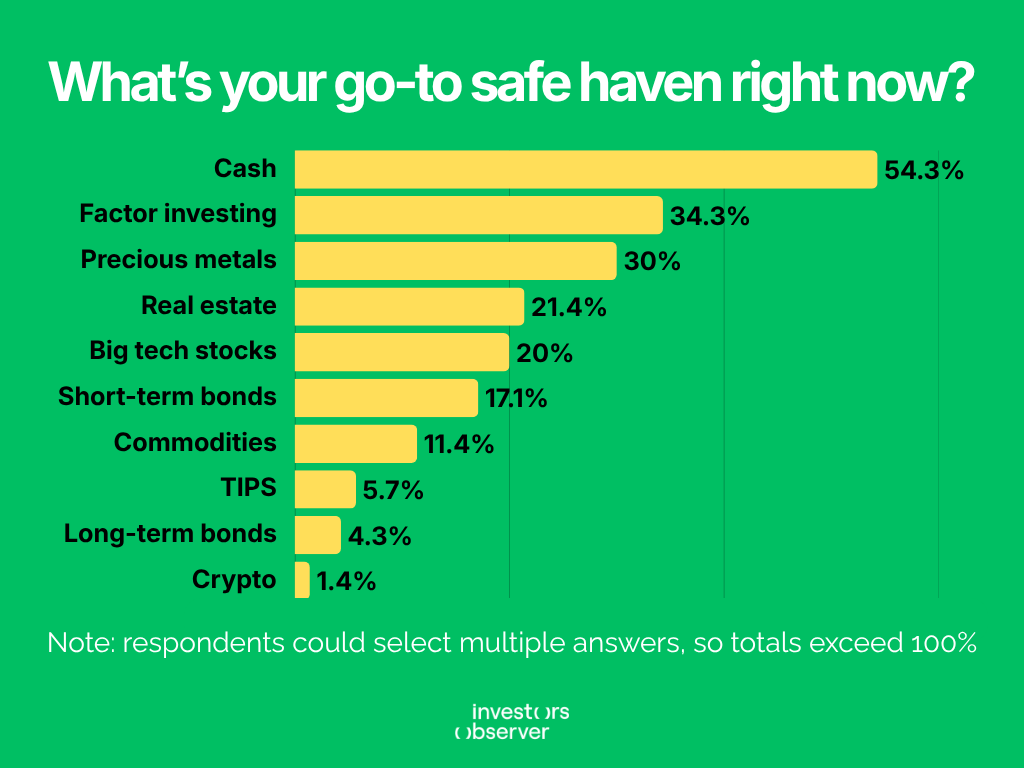
In a new survey, InvestorsObserver found that 54.3% of investors identified cash as their preferred safe haven. And according to Sam Bourgi, a senior financial analyst at InvestorsObserver, when cash becomes the most popular safe haven, it usually reflects caution rather than optimism.
Surprisingly, the survey revealed that only a 1.4% of investors are choosing cryptocurrency as their safe haven. Cryptocurrency markets have been in decline, with the total market cap falling nearly 35% from mid-December 2024 to mid-April 2025. And while some say the cryptocurrency markets should grow in 2026, a survey shows that investors are signaling a loss of interest and becoming more guarded with their investments.
Key findings:
- Most investors (54.4%) are choosing cash as their safe-haven asset, signaling caution.
- Cryptocurrency is the least popular safe haven right now, with only 1.4% of survey respondents choosing it as an asset.
- Multiple recession warning signs are already present: Treasury yields are at their highest since 2007, consumer confidence is at an all-time low, job growth is slowing, jobless claims are rising, and corporate default rates are high.
- According to a financial analyst, high-yield savings accounts, money market funds, and short-term Treasury bills are the lowest-risk assets right now.
Survey results: going back to cash
The InvestorsObserver survey revealed that over half of investors (54.3%) currently view cash as their safe haven. Fewer investors are choosing factor investing (34.3%), precious metals (30%), real estate (21.4%), big tech stocks (20%), short-term bonds (17.1%), and commodities (11.4%).
The lowest number of investors, who participated in the survey, are choosing TIPS (5.7%), long-term bonds (4.3%), and cryptocurrency (1.4%).
Over 20% predict recession by the end of 2026
According to Polymarket, the world’s largest prediction market, current recession odds stand at 23% (number varies). With the recession increasingly discussed in the news, investors are becoming more cautious. The main drivers for these assumptions are the ongoing war in the Middle East and elevated oil prices.
“If prediction markets have taught us anything, it’s that forecasts backed by real money often prove more informative than traditional surveys. That said, I would argue the true odds are somewhat higher given the growing risk of stagflation – a combination of high inflation, slowing growth, and rising unemployment,” says Bourgi.
One of the biggest variables that could impact the recession is inflation, and consumer price inflation is projected to hit 6% in the second quarter. According to Bourgi, the Federal Reserve faces two scenarios: rate cuts or rate hikes. Predictions suggest a 60% chance of a Fed rate hike by January.
The bond market is another critical signal. A sustained rise in long-term Treasury yields would tighten financial conditions by increasing mortgage rates, corporate borrowing costs, and consumer debt costs.
Investors are being cautious
Holding cash provides optionality and flexibility. “Cash gives investors a buffer to cover expenses, avoid forced selling, and take advantage of opportunities when asset prices fall. The drawback is inflation. If consumer prices continue rising faster than interest earned on savings, cash steadily loses purchasing power over time. In other words, cash protects against volatility, but not necessarily against inflation,” says Bourgi.
While more than half of investors choose cash, this does not necessarily mean they are preparing for a recession; rather, it reflects a safe option to avoid selling.
Lower asset prices can create attractive long-term buying opportunities, provided investors have enough liquidity to avoid selling at the wrong time.
Early signs to look out for
According to Bourgi, several signs mean a declining economy, and they are typically found in labor and credit markets:
- Rising weekly jobless claims
- Slowing job growth
- Higher corporate default rates
- Falling consumer confidence
- Weak retail sales
- A sharp rise in long-term Treasury yields
So far, at an all-time high, we have seen several: the 30-year Treasury yield reached 5.13%, its highest closing level since June 2007; consumer confidence is at an all-time low; job growth is slowing; jobless claims are rising; and corporate default rates are high.
“The lowest-risk assets today are high-yield savings accounts, money market funds, and short-term Treasury bills, which currently offer attractive yields with minimal volatility. For investors concerned about inflation, gold and inflation-protected securities can provide diversification,” says Bourgi.
Methodology
Between May 1–18 2025, InvestorsObserver's research team surveyed 1050 internet users who are experienced individual investors in the U.S., ages 35 to 60. Respondents answered multiple-choice questions.
These percentages and findings may not reflect the general population and are subject to fluctuation based on evolving market conditions and investor sentiment.