Survey: 1 in 5 investors don’t trust AI with any money task, and only 5% act on AI advice without human checks


Key takeaways
- 64% of individual investors have never used AI chatbots for investment advice.
- 19% of respondents don’t trust AI with any financial task at all.
- 59% of respondents plan to use or continue using AI financial advice in the future.
- 5% act directly on AI advice without additional research.
While Gen Z investors are increasingly flocking to AI tools for investing, a new survey on AI investment advice by InvestorsObserver shows that many experienced individual investors in the U.S. ages 35 to 60 don’t trust AI with their money.
Despite the growing hype around AI in finance, 19% of respondents say they do not trust AI with any financial task at all, and only 5% act on AI advice without extra research, or human judgement.
This creates a hard line of resistance even as AI tools become more visible in everyday investing, and many respondents plan to use it in future.
InvestorsObserver’s researchers surveyed more than 1,000 internet users to explore how a core demographic of U.S. investors actually uses AI chatbots for portfolio decisions, how comfortable they feel letting algorithms handle different money tasks, and whether they intend to lean more on AI in the future.
Just one-third of investors use AI chatbots for investment advice
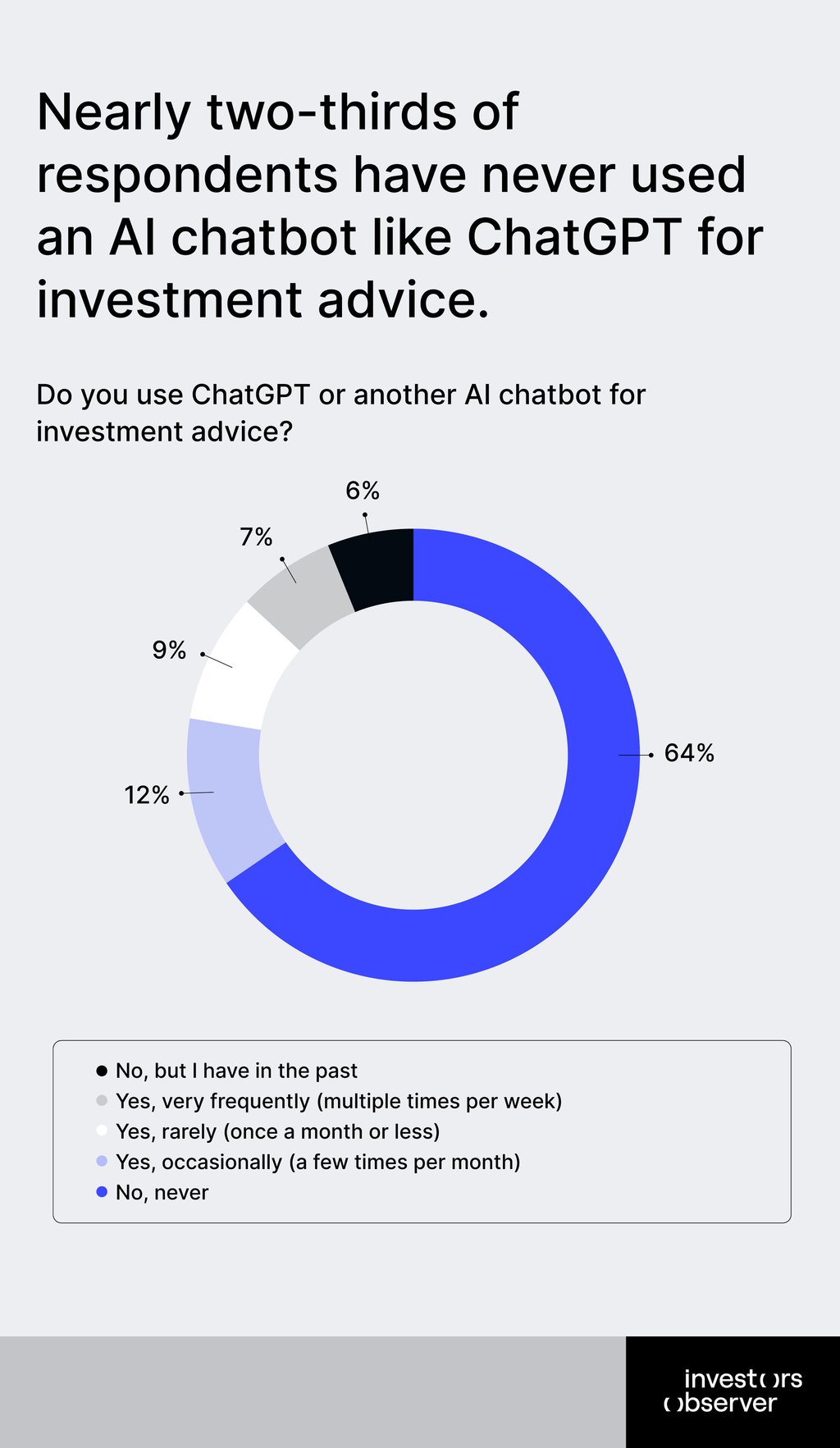
64% of experienced U.S. investors aged 35 to 60 have never used AI chatbots for investment advice, a statistic that shows AI as still an emerging tool, not yet embraced by the majority.
But the remaining 36% show active engagement – 7% using AI multiple times per week, 9% once a month or less, and 12% a few times per month.
These figures reveal a technology caught between cautious curiosity and growing adoption, which means the investment world is in transition. For a sizable minority, AI is already an everyday instrument helping make financial decisions.
This usage rate among individual U.S. investors contrasts with global research which shows that AI use in retail investing is climbing fast. For example, eToro reports that AI tool usage among retail investors has jumped 46% in one year, with Gen Z investors showing some of the highest uptake, with roughly 7 in 10 already using AI tools for investing.
1 in 5 investors trust AI with nothing
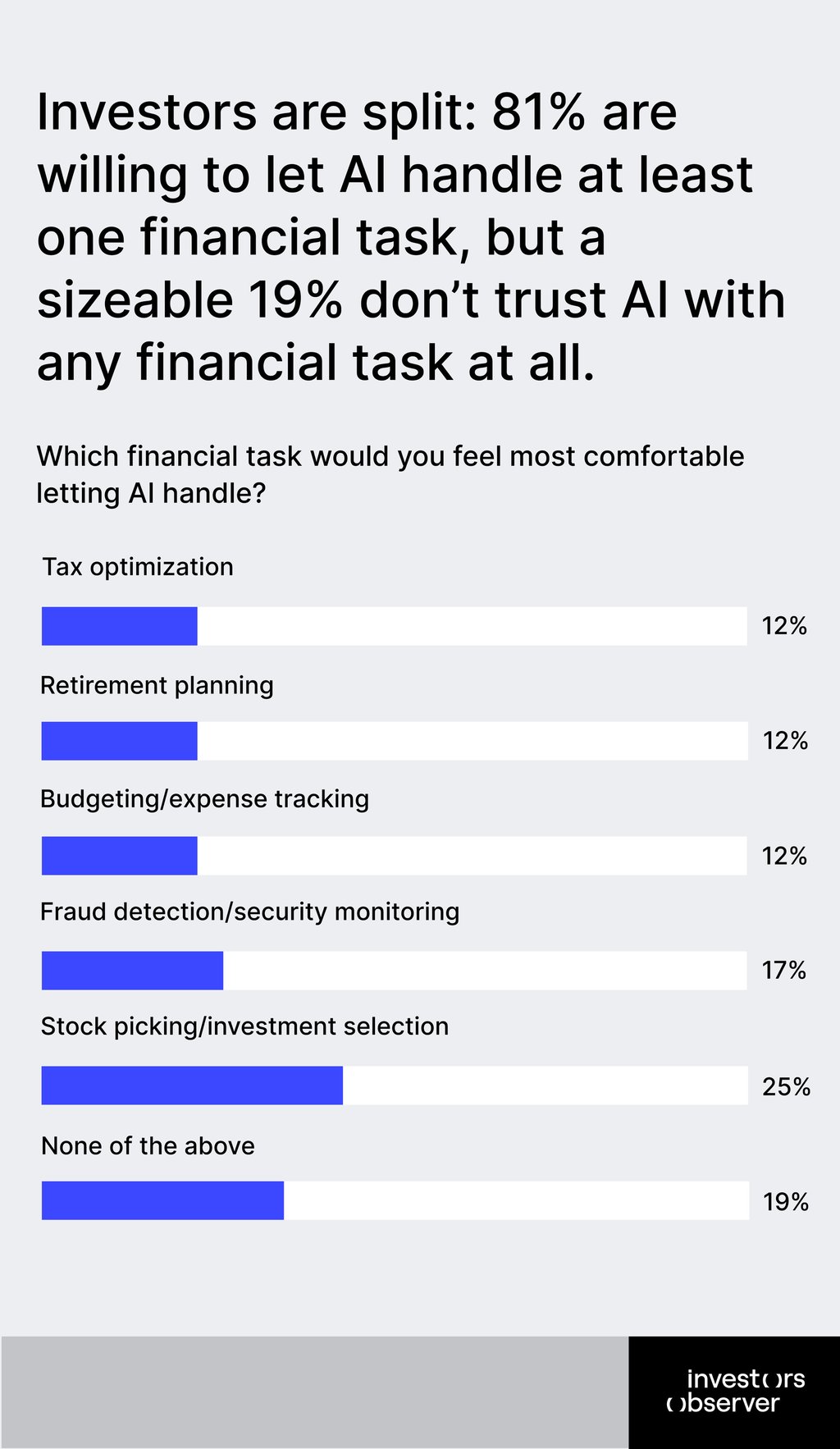
When invited to select financial tasks they’d trust AI with, 25% of respondents picked stock picking – the most favored role. This trust likely stems from AI’s proven capacity to process vast data and spot patterns beyond human reach.
Fraud detection and security monitoring earned 17%, reflecting confidence in AI’s protective capabilities. Simpler administrative tasks such as budgeting, tax optimization, and retirement planning were picked by 12%, showing a limited willingness to delegate routine yet consequential decisions.
Yet, 19% expressed discomfort across the board, which shows that skepticism lingers, and human oversight remains indispensable.
AI advice is a starting point, not the final word
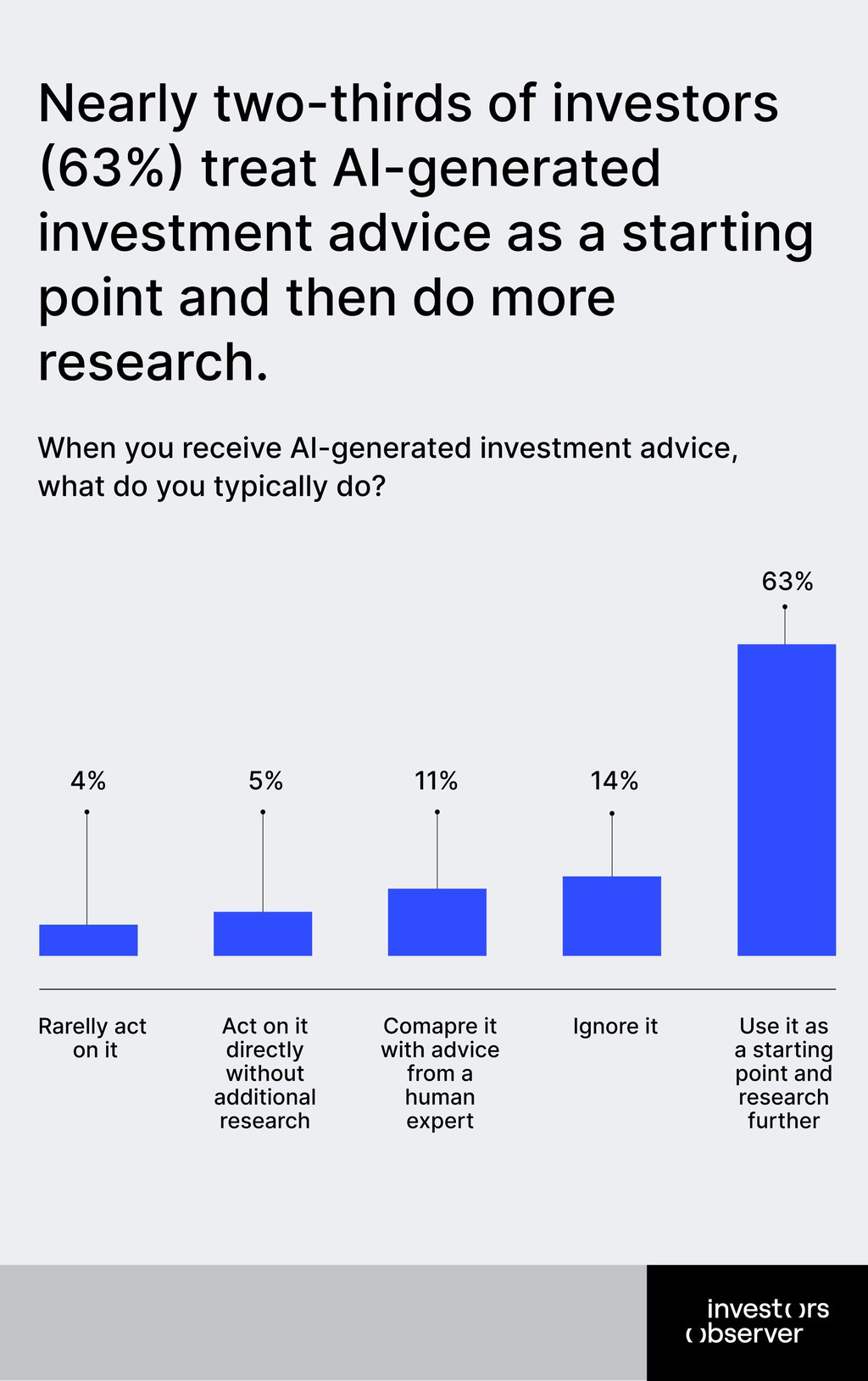
Even among AI users, reliance remains measured. Just 5% of investors say they act on AI advice without further investigation. A telling 63% view AI-generated advice as a starting point, prompting deeper research or consultation with human experts – themselves combining digital tools with traditional judgment.
Another 11% cross-check AI advice with expert opinion, while 14% throw it out altogether. This pattern speaks volumes: AI in investing acts less as a final authority and more as a spark for inquiry, a new source of insight that complements rather than replaces human wisdom.
It points to a hybrid way of investing, where people blend AI tools with their own judgment instead of relying on algorithms alone.
59% of investors plan to use AI for investment advice
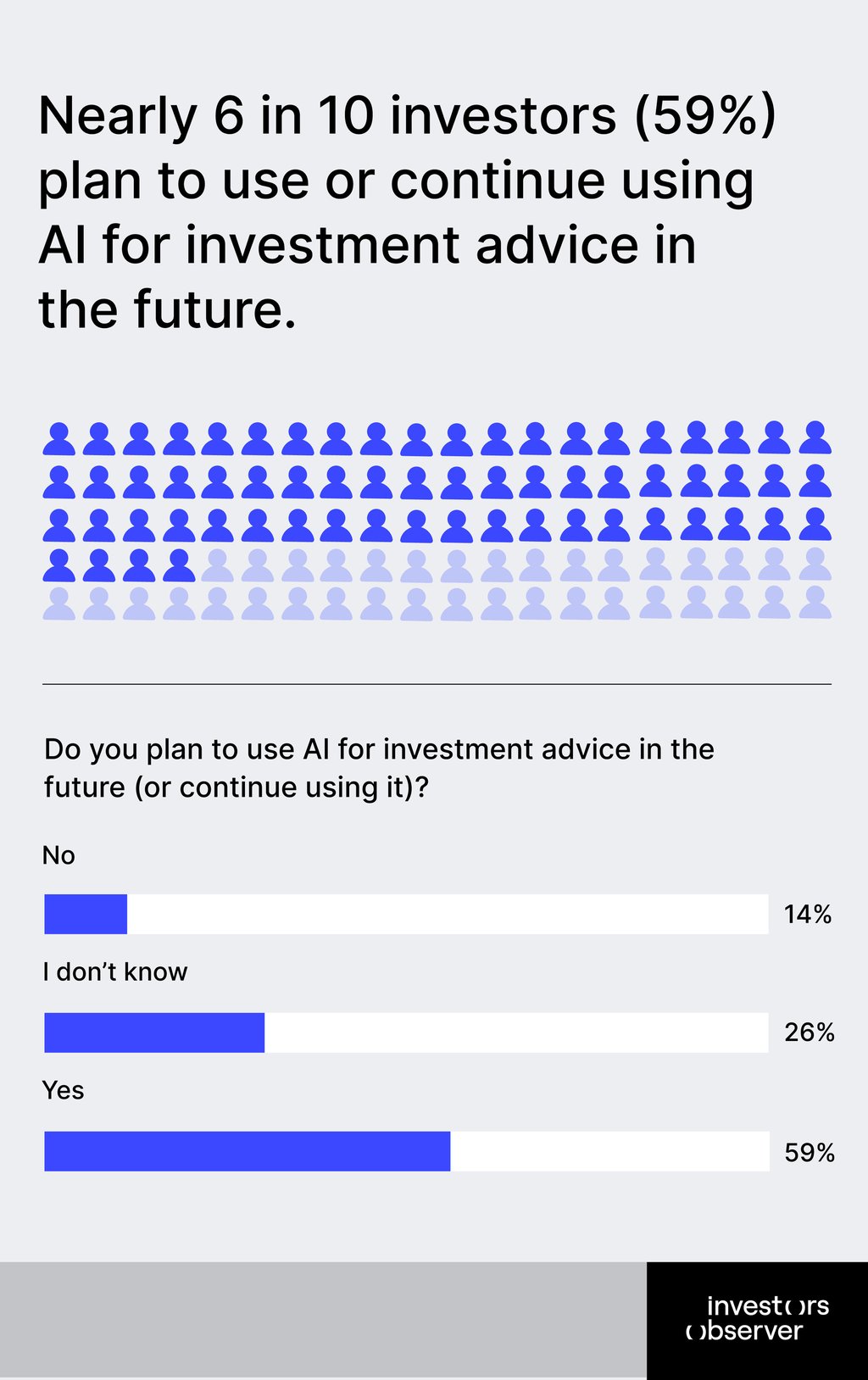
59% of respondents say they plan to use or continue using AI in their investing – a vote of confidence in the growing utility of these tools. Meanwhile, 14% reject the idea, and 26% remain undecided.
This undecided quarter represents a key swing group: their future choices could either accelerate AI’s integration or slow its advance.
The data paints AI adoption as an unfolding story, where conviction is still forming, and experiences yet to come will shape the contours of everyday investing.
This is a pattern that mirrors forecasts projecting the AI in the finance market to reach around $190 billion by 2030.
What this means for investing
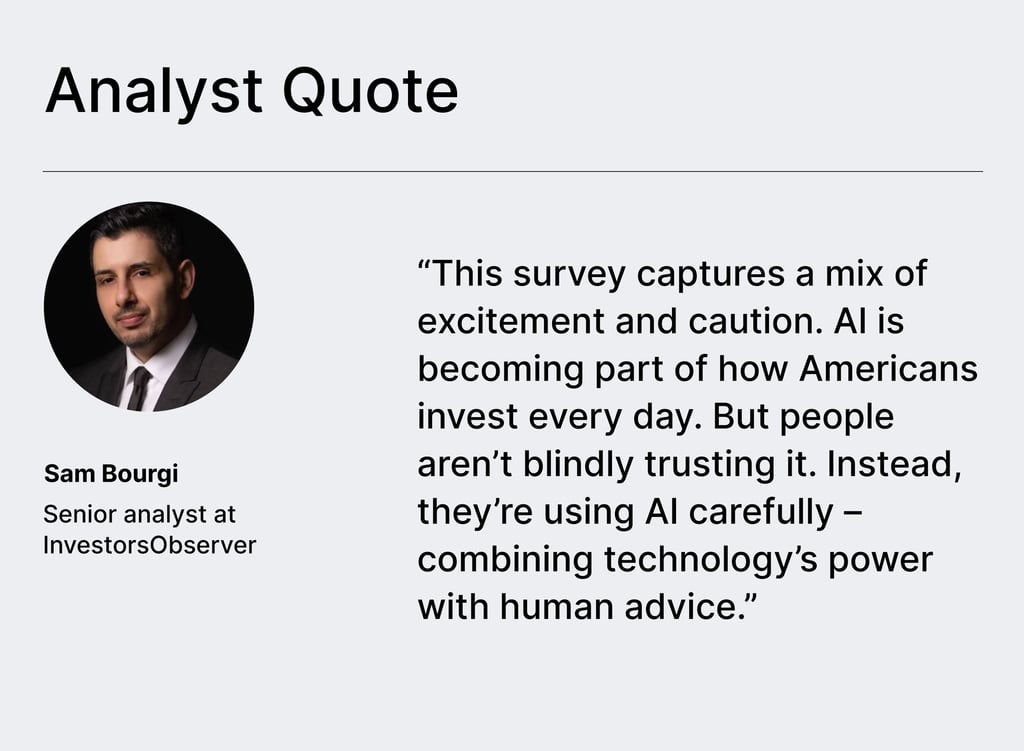
That behavior suggests investors view AI less as a “digital advisor” and more as a research accelerator that can surface ideas, screen securities, or flag risks faster than they could alone.
That's a smart approach – AI can quickly scan markets and suggest ideas, but it doesn't understand your personal goals, risk tolerance, or life situation the way you or a trusted advisor does.
Methodology
Between November 3–21 2025, InvestorsObserver's research team surveyed 1050 internet users who are experienced individual investors in the U.S., ages 35 to 60.
For this survey, "experienced investors" are respondents who meet two criteria: (1) self-identified as advanced-level investors, and (2) hold investment portfolios valued at $500,000 or more, including retirement accounts such as 401(k)s and IRAs.
The survey explored AI usage patterns, comfort with AI chatbots in various financial roles, and intentions for future AI adoption. Respondents answered multiple-choice questions allowing analysis of attitudes toward AI in investment management.
These percentages and findings may not reflect the general population and are subject to fluctuation based on evolving market conditions and investor sentiment.