Home, car, and college now cost 133 times more in dollars, but 42% less in gold

Younger generations say Boomers bought cheap houses and broke the economy. Boomers answer that young people just do not want to work as hard.
But for most families, the real question is simpler: why does the dollar in their paycheck buy less house, less car, and less college than it used to?
Gold helps answer that. While cash loses value as Washington keeps spending and printing, gold tends to hold its buying power over time, so it shows what these things really cost beneath the price tags.
InvestorsObserver looked at what a car, a home, and a Harvard education have cost since 1910. In dollars, that bundle jumped from $5,350 to $712,500, more than 130 higher. In gold, it actually fell from 283 ounces to 164, a drop of 42%.
The research shows that the affordability gap isn’t between generations. It’s between families who own real assets that rise with inflation and families holding cash that gradually loses value year after year.
Key findings
- Car, medium home, and 4-year Harvard tuition dropped 42% in gold ounces since 1910.
- In dollars, car, medium home, and 4-year Harvard tuition skyrocketed 13,218% (133 times more).
- Peak cost in gold: 1,013 ounces in 1970 – highest ever.
- Cheapest in gold: 137 ounces in 1980 (87% crash from 1970s peak).
- Median homes under 100 ounces gold – only twice in 115 years: 1980 and 2025.
- Harvard exception: 4 years of tuition nearly doubled in gold ounces since 1910.
Most dreams actually got cheaper (in gold)
Measured in dollars, buying a car, a home, and 4 years at Harvard has become much more expensive. But measured in gold, it’s much cheaper.
In dollars, the price only goes one direction: up. In 1910, the bundle cost $5,350. By 1970, it was $36,500. In 2000, it hit $230,395. In 2025 it was $712,500.
That’s a 13,218% (133 times) increase over 115 years. And the jumps have been getting bigger, especially after 1970.
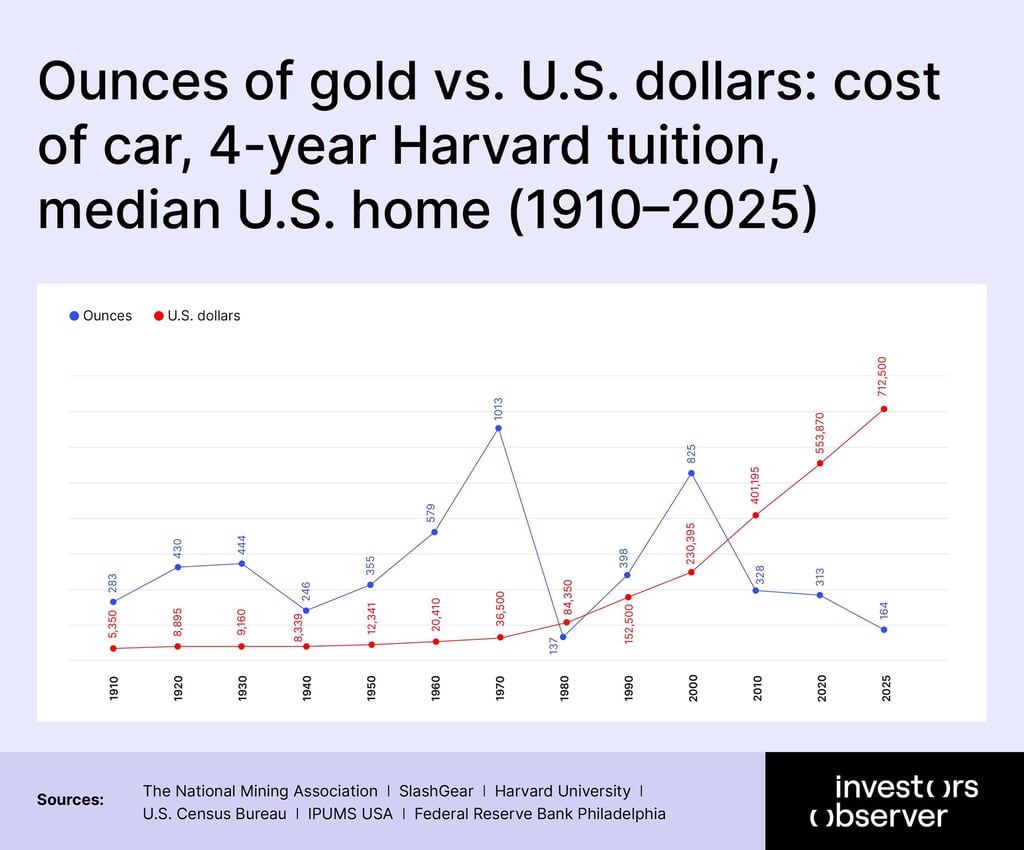
Now look at the same bundle priced in ounces of gold. The pattern is completely different. It started at 283 ounces in 1910. It climbed to a peak of 1,013 ounces in 1970. Then it crashed 87% to just 137 ounces in 1980 – the cheapest year on record.
The price bounced back to 825 ounces by 2000, then fell again to 164 ounces today.
Between 2000 and 2025, the dollar cost more than tripled from $230,395 to $712,500, while the gold cost dropped 80% from 825 ounces to 164 ounces.
It’s the same house, the same car, the same education – moving in completely opposite directions depending on how you measure.
Was it really easier to buy a house “back then”?
The median American home has followed a volatile path when measured in gold ounces, changing a lot across decades before landing near historic lows today.
Back in 1910, people needed 206 ounces of gold to buy a typical home. That number rose for decades – 305 ounces in 1920, 344 ounces in 1930, and all the way up to 639 ounces by 1970. By 1970, a house cost three times more gold than it did in 1910.
Then something entirely different happened. By 1980, a house cost just 77 ounces of gold. That’s the cheapest it’s been in 115 years. A home that took 639 ounces in 1970 could suddenly be bought for 77 ounces just ten years later.
But it didn’t stay cheap. The price bounced back to 206 ounces in 1990, then shot up to 429 ounces by the year 2000 – the second-most expensive on record.
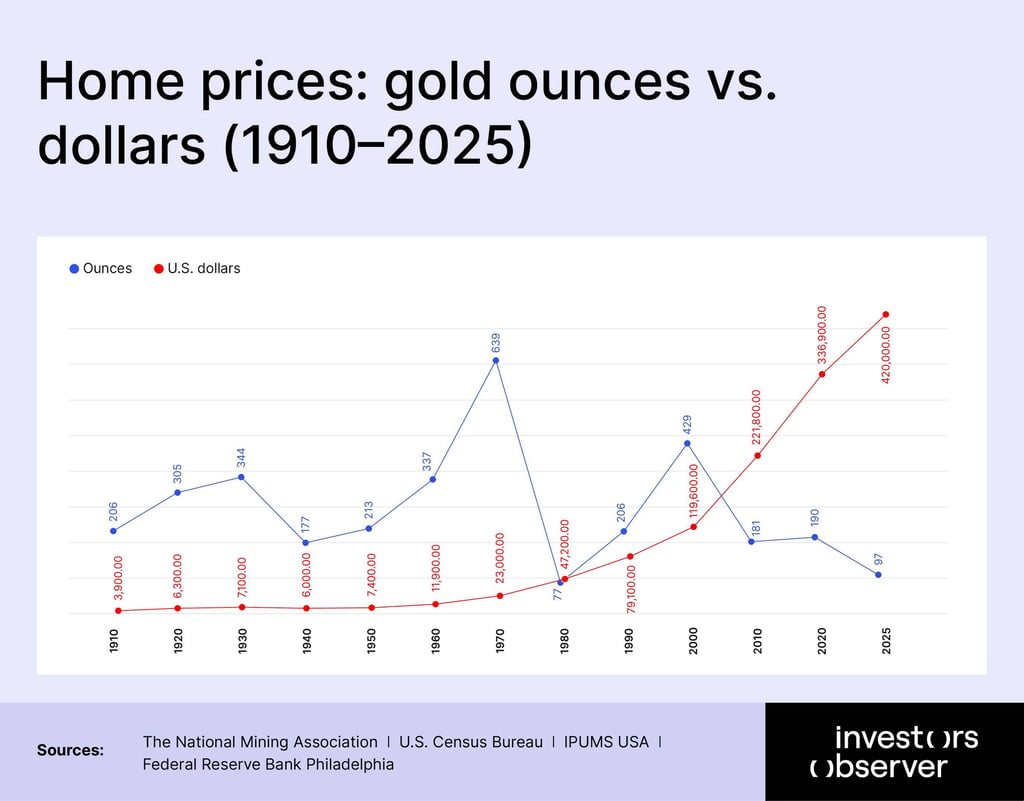
Since then it’s been falling again. A house cost 181 ounces in 2010, and 190 ounces in 2020.
In 2025, people need 97 ounces of gold to buy a median home. That’s half what it cost in 1910. It’s way less than the 639 ounces needed in 1970. And only one other decade in history (1980) has been cheaper.
“This tells you everything about the dollar crisis hiding behind the affordability crisis,” says Sam Bourgi, senior analyst at InvestorsObserver. “The home didn’t get cheaper to build. Gold just reveals how much the currency has been devalued.”
Most popular cars stay under 20 gold ounces since 2010 – cheapest era ever
In dollar terms, car prices have done nothing but grow for 115 years. The Ford Model T cost $850 in 1910. The Oldsmobile Cutlass was $3,100 in 1970. Today’s Ford F-Series – $36,500.
That’s 43 times more expensive. No surprise there. Everything costs more in dollars.
But most people don’t know that when measured in gold, cars have become much cheaper. In 1970, the Oldsmobile Cutlass cost 86 ounces of gold. In 2025, Ford F-Series cost just 8 ounces. That’s a 91% drop.
This means that your parents needed nearly 90 ounces of gold to buy their car. You need 8.
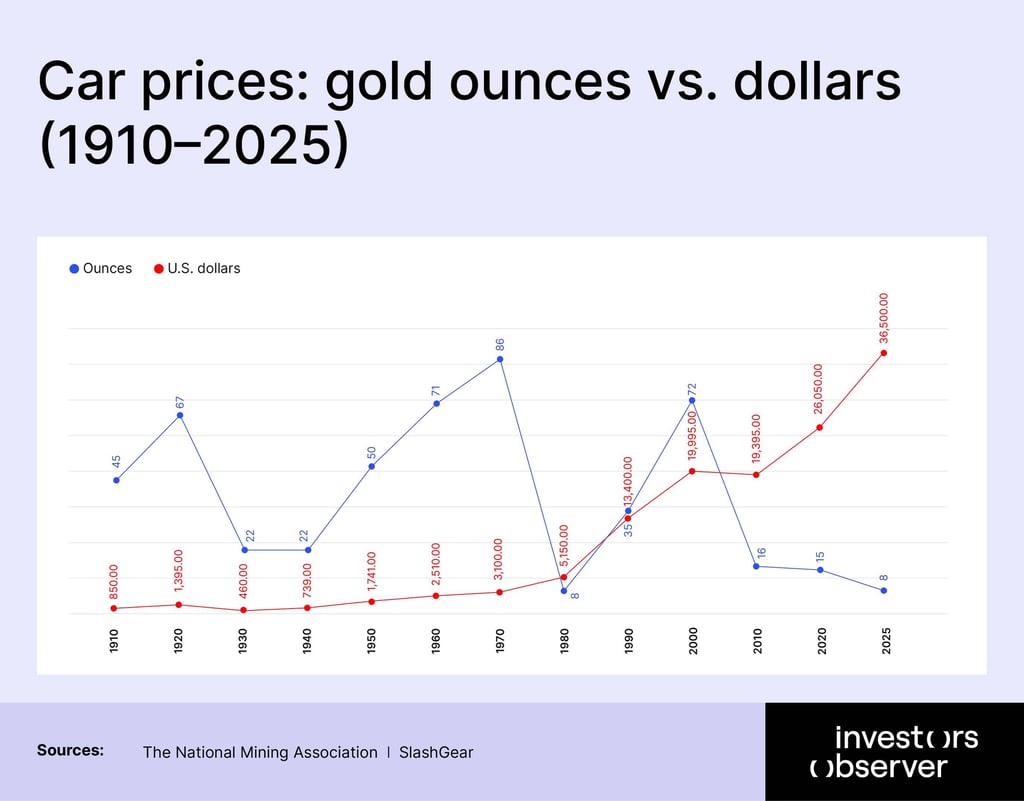
In 1980, the Honda Accord cost just 8 ounces of gold – the cheapest year in 115 years. Twenty years later, in 2000, the Toyota Prius required 72 ounces, making it one of the most expensive years ever.
Fast forward to 2025, and the Ford F-Series is back down to 8 ounces, tied with 1980 for the all-time low.
The point is that from 2000 to today, the dollar price nearly doubled from $19,995 to $36,500. But the gold price dropped 89% from 72 ounces to just 8 ounces. Same vehicle, opposite directions.
“Millennials and Gen Z may complain endlessly about unaffordable cars. But the affordability issue is real only for those paid in depreciating dollars. Cars haven’t become expensive – your paycheck is worth less,” explains Bourgi.
The one expense even gold can’t beat – Harvard
In dollar terms, Harvard tuition has exploded over the past 115 years. Four years at America’s most elite university cost $600 in 1910. By 1970, it was $10,400. In 2000, it hit $90,800. Today it costs $256,000 – 42,567% (427 times) more than in 1910.
The trajectory is relentless. From $1,200 in 1920 to $32,000 in 1980, then $160,000 in 2010 and $190,920 in 2020, the price keeps growing faster than almost anything else in the American economy.
When it comes to gold, Harvard breaks the pattern we’ve seen with cars and homes. Measured in gold, a Harvard education has actually become more expensive over 115 years.
In 1910, four years cost 32 ounces of gold. That grew steadily: 58 ounces in 1920, 77 ounces in 1930, reaching 289 ounces by 1970. Then came a brief collapse to 52 ounces in 1980 during gold’s peak, but costs surged back to 325 ounces by 2000 – the most expensive year on record.
Since then, Harvard has become much cheaper in gold terms. It dropped to 131 ounces in 2010, 108 ounces in 2020, and just 59 ounces today.
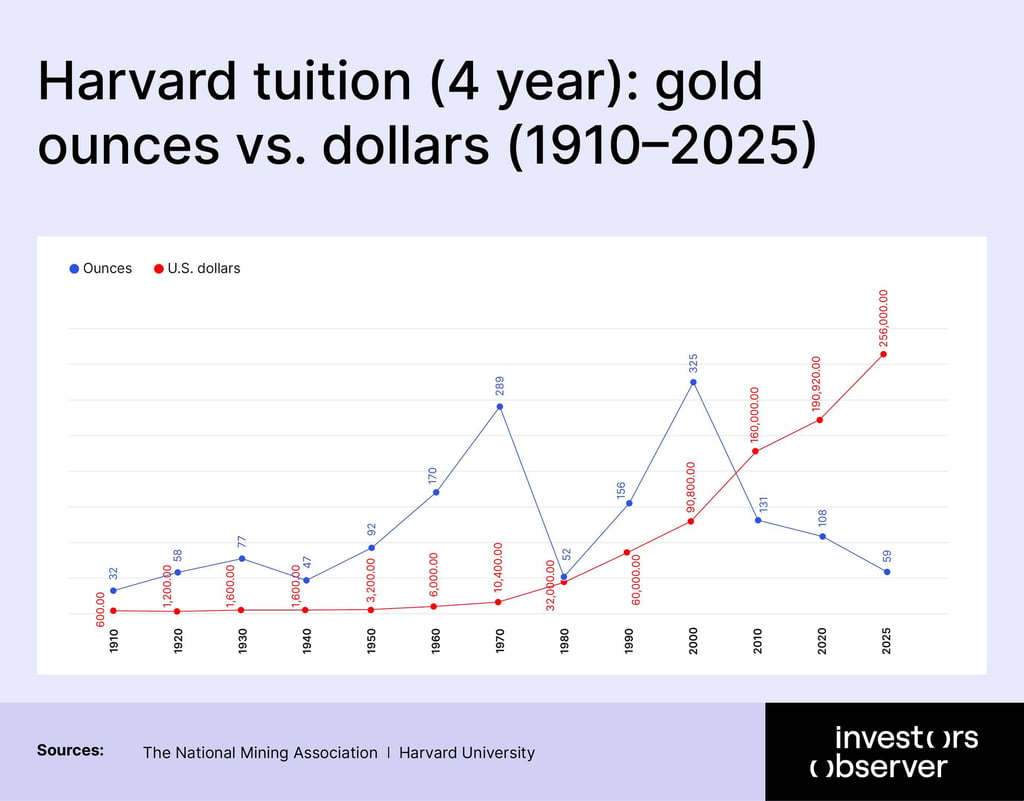
However, today’s 59-ounce cost is nearly double the 32 ounces it took in 1910. That makes Harvard the only major cost in this research that has genuinely become more expensive when measured in gold over the full 115-year period.
For anyone holding gold who needs to pay for college, 2025 is one of the best times in over a century to make that move. Only 1980, when Harvard cost 52 ounces, was cheaper.
But over the full 115 years, the data shows something surprising: elite education has beaten every major investment, including gold itself. Harvard tuition rose 427 times since 1910 (42,567% increase), while gold rose 229 times (22,837% increase). Education is the only major expense that has actually outpaced gold’s gains.
Methodology and sources
Gold price data
Gold prices from 1910 to 2024 were collected from the National Mining Association’s historical price report. The 2025 gold price was sourced from GoldPrice.org as of December 31, 2025, reflecting the most current market value at $4,339.65 per ounce.
Most popular car models
Vehicle selections were based on decade-by-decade popularity analysis from automotive sales data and historical records. For 2025, we identified the Ford F-Series as the most popular vehicle based on full-year sales statistics.
We acknowledge that “most popular” can be interpreted differently across sources, and other publications may identify different vehicles for the same time periods.
Historical car prices came from the Standard Catalog of American Cars (1805-1942), original dealer price sheets, manufacturer press releases, and period brochures.
University tuition data
Harvard tuition figures were obtained from the university’s official fact book and the historical analysis Making Harvard Modern: The Rise of America's University by Morton Keller and Phyllis Keller (Oxford University Press, 2001).
Median home prices
Home price data from 1910 to 1940 were sourced from IPUMS USA historical census data and Federal Reserve Bank of Philadelphia working papers, with appropriate adjustments for consistency.
Prices from 1950 to 2025 came directly from the Federal Reserve Economic Data (FRED) database and U.S. Census Bureau records.
The median home price represents the middle sale price of all homes sold in a given year and does not account for variations in size, style, or features.
Calculations
We calculated how many ounces of gold would be required to purchase a car, a home, or four years of tuition at Harvard, providing a consistent measure of real purchasing power across 115 years.