Research: Gold price searches surged nationwide while AI interest divided American states


Over the past year, Americans have been gripped by the need to shield their savings from soaring inflation, even as they confront the disruptive wave of artificial intelligence that promises (or threats) to reshape their jobs, communities, and daily lives.
To understand where Americans are focusing their attention – whether on the safe haven of gold amid economic uncertainty or the promise and risk of artificial intelligence, InvestorsObserver analyzed the search interest changes across all 50 U.S. states from September 2024 to September 2025 for terms related to “gold price,” “NVIDIA,” and “OpenAI.”
The study reveals a rare moment of national consensus around interest in gold, but beneath this universal flight to financial safety lies a more complex story about which Americans are embracing artificial intelligence and which are turning away from it.
Key findings
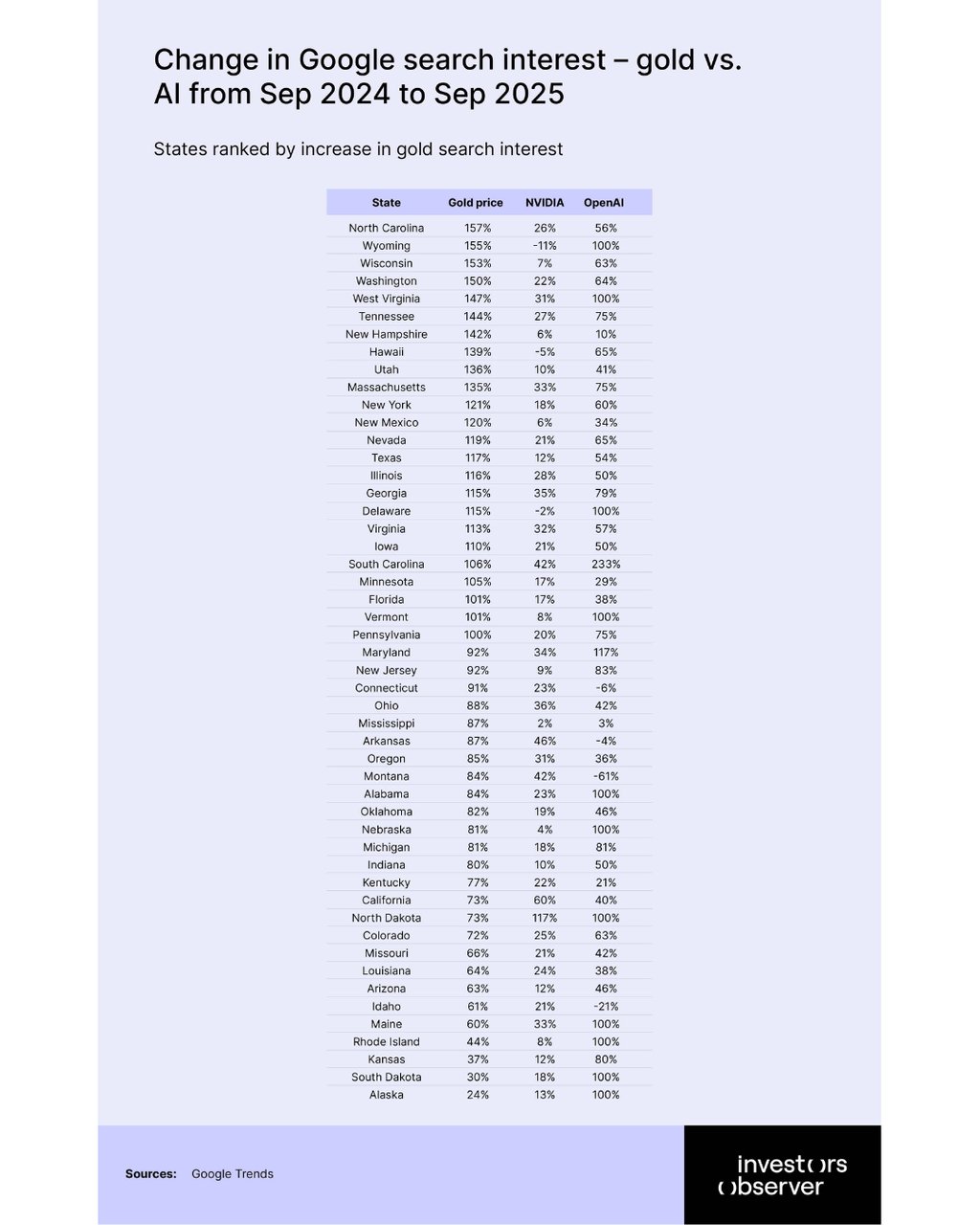
- Gold price searches increased in all 50 states, with an average surge of 97.6% and a median increase of 92%, which represents the most geographically uniform search compared to now very popular AI companies.
- In 24 states, gold searches more than doubled (100%+ increase), led by North Carolina (157.1%), Wyoming (155.4%), Wisconsin (153.1%), Washington (150.0%), and West Virginia (147.1%).
- OpenAI searches grew by 61.4% on average nationwide, but showed extreme regional variation – South Carolina led at 233.3% while Montana experienced a 61.1% decline in interest.
- Only 22.1% average growth in NVIDIA searches, with three states showing negative interest and just one state (North Dakota at 117.1%) exceeding 100% growth.
- In 15 states (30% of the nation), combined interest in AI technology (OpenAI + NVIDIA) exceeded interest in gold prices, concentrated primarily in smaller population states and select coastal regions.
- Smaller-population states demonstrated 74.9% average OpenAI interest growth, with eight out of ten showing 100%+ increases, compared to zero large states crossing that threshold.
The universal gold rush
Gold was the one thing nearly all Americans agreed on this year – the numbers barely budged from state to state. Whether it was Alaska with a small lift of 24.5%, or North Carolina rocketing up by 157.1%, every state saw more people googling gold prices. For once, the whole country was curious about the same thing, cutting across all the usual lines that divide us.
It was the Southeast that set the pace, with gold searches jumping by an average of 106.9% – the biggest leap in any part of the U.S. North Carolina was out front, but Wyoming, Wisconsin, Washington, and West Virginia were close behind, even though these states are totally different when it comes to jobs, industries, and local economies.
North Carolina’s got tech and finance, Wyoming leans on energy and tourism, and West Virginia has its own set of economic hurdles. But all five saw gold searches climb by at least 147%.
It doesn’t matter where people live or what their politics are – the rush to look up gold prices suggests many Americans were worried about inflation or just keeping their money safe. Gold always gets attention when times feel shaky, and this past year was no different. If even folks in Alaska, with the smallest jump, got more interested in gold, that says something about how widespread the nervousness was.
And this trend really stands out compared to past financial shocks – from the 2008 crash to the COVID pandemic, people’s reactions depended a lot on where they lived. This time, though, the surge in gold interest was everywhere. Maybe it’s because financial anxiety is hitting more people, or just because it’s easier than ever to invest in gold, thanks to more options like gold ETFs.
The AI adoption divide
If gold united the nation, artificial intelligence divided it. OpenAI searches told a story of a technology embraced enthusiastically in some places while actively rejected in others.
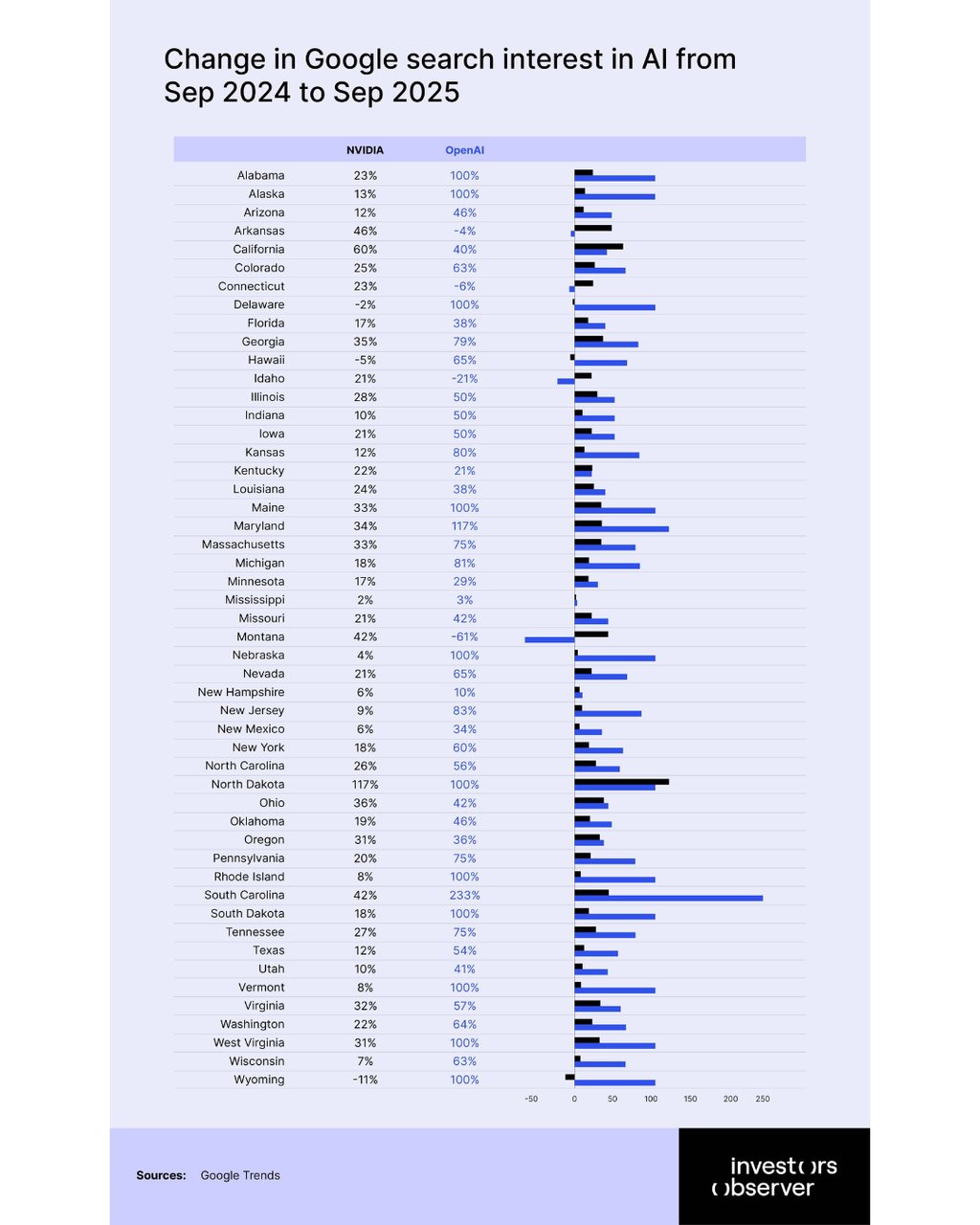
South Carolina's 233.3% increase in OpenAI searches represented the most dramatic surge in any category tracked. Yet just a few hundred miles west, Montana showed a 61.1% decline in interest – the steepest fall in the dataset.
The pattern of AI adoption revealed unexpected geographic trends. Smaller states demonstrated disproportionately high interest: eight of the ten smallest-population states showed OpenAI search increases exceeding 100%, including Wyoming, Delaware, Vermont, West Virginia, and both Dakotas.
Meanwhile, none of the ten largest states crossed that threshold. California, home to OpenAI's headquarters, registered just a 40% increase in searches – well below the national average.
This inverse relationship between state population and AI curiosity defies conventional assumptions about technology adoption. Usually, urban centers with large populations lead technological trends while rural areas lag.
Yet here we see rural Wyoming and sparsely populated North Dakota (which also led NVIDIA searches at 117.1%) expressing more intense interest in AI than major population centers.
Several explanations might account for this: smaller states may have fewer competing sources of information about AI, making Google searches more necessary, economic anxiety in rural areas may drive searches for emerging job skills or business opportunities, or early adopters in less populous states may create larger proportional search spikes.
The Northeast showed the highest average OpenAI interest at 74%, suggesting that proximity to major media markets and educational institutions may play some role in AI awareness. Yet the region's performance on NVIDIA searches lagged at just 17.2% average growth, indicating that interest in AI tools didn't necessarily translate to interest in AI investments.
When tech beats tradition
In 15 states, combined interest in AI technology (OpenAI and NVIDIA searches together) exceeded interest in gold prices – representing 30% of the nation where the future captured more attention than financial security. These states paint an interesting portrait: some are predictable tech hubs like California and Maryland, but others include surprising entries like South Carolina, Alabama, Nebraska, and both Dakotas.
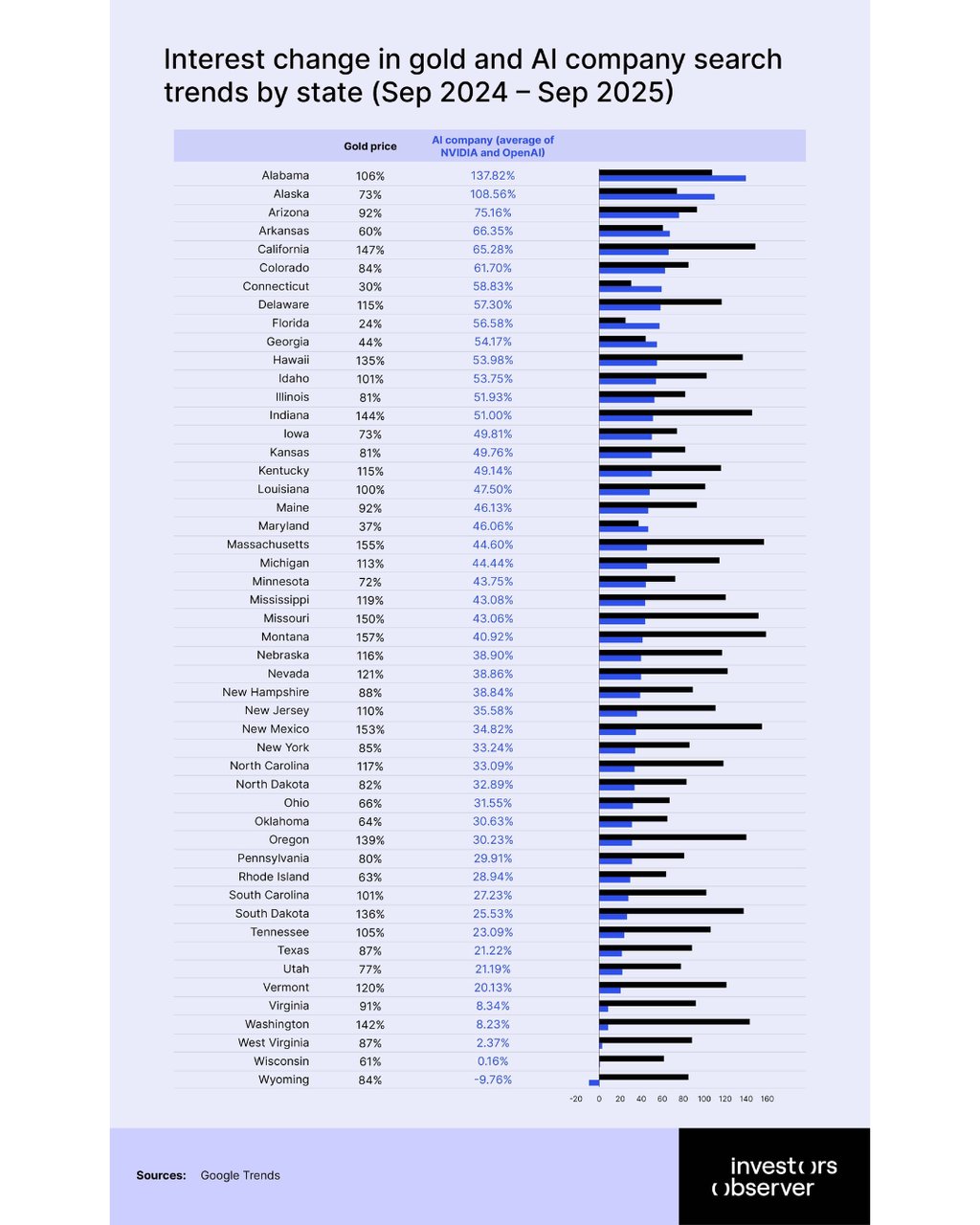
South Carolina's position at the top of this list with tech interest exceeding gold interest by a factor of 2.6 to 1 – raises questions about what's driving such intense AI fascination in a state not typically associated with the technology sector.
The state's growing aerospace and automotive manufacturing presence, including major BMW and Boeing operations, may contribute to workplace interest in AI applications.
Also, North Dakota's top ranking in NVIDIA searches (117.1%) might reflect the state's energy sector exploring AI applications in oil and gas operations.
Maryland's second-place finish in combined tech interest makes more intuitive sense given its proximity to Washington, D.C., and concentration of government contractors and cybersecurity firms. The state showed 116.7% growth in OpenAI searches and 33.7% growth in NVIDIA searches, suggesting both practical interest in AI tools and investment interest in AI companies.
The states where tech interest exceeded gold interest also shared another characteristic: they showed more volatility in their search patterns overall. While gold interest moved in a relatively narrow band (24.5% to 157.1%), these tech-forward states displayed wild swings in AI enthusiasm, with some categories showing triple-digit growth while others stagnated or declined.
The NVIDIA paradox
NVIDIA's modest 22.1% average search interest growth represents perhaps the biggest surprise in the data. Throughout 2024 and into 2025, NVIDIA dominated financial headlines with extraordinary stock performance, briefly becoming the world's most valuable company on the strength of AI chip demand. Yet Americans' interest in searching for information about the company remained low compared to both gold and OpenAI.
Only one state (North Dakota) showed NVIDIA interest exceeding 100%, and three states registered declining interest (Wyoming at -10.8%, Hawaii at -4.6%, Delaware at -1.7%). Even California, home to NVIDIA's headquarters, had just 59.6% growth, ranking second nationally but still representing less than half the enthusiasm shown for gold in that state.
This pattern suggests a major gap between Wall Street's AI obsession and Main Street's. While institutional investors poured money into NVIDIA stock, individual Americans showed far more interest in using AI tools than investing in AI infrastructure.
The data implies that for most Americans, AI means ChatGPT and similar applications, not the semiconductors powering them. This disconnect between professional and retail investor attention may have implications for market stability if retail investors eventually embrace AI stocks en masse, or never do.
The modest NVIDIA numbers also highlight the difference between passive market participation (through 401(k)s and index funds that bought NVIDIA) and active information-seeking.
Many Americans likely gained NVIDIA exposure through broad market funds without ever searching for information about the company specifically. The Google search data captures genuine curiosity rather than mere financial exposure.
The technology reluctance in rural America
Four states showed declining OpenAI interest: Montana (-61.1%), Idaho (-20.8%), Connecticut (-6.3%), and Arkansas (-3.6%). These represent very different demographics and economies, suggesting multiple factors drive AI rejection. Montana and Idaho are sparsely populated Western states with economies dependent on natural resources, agriculture, and tourism.
Connecticut ranks among the wealthiest states with significant financial services and insurance sectors. Arkansas combines rural agriculture with major corporate presences like Walmart.
What these states might share is a perception that AI represents either an economic threat or an irrelevant technology. In Montana, where extractive industries and outdoor recreation dominate, AI tools may seem less applicable to daily work than in knowledge-economy states.
The state's negative OpenAI trend combined with positive NVIDIA interest (41.6%) creates an unusual pattern: Montanans became less interested in AI tools while maintaining interest in AI investments, perhaps viewing AI as something happening elsewhere that might still generate returns.
Connecticut's declining AI interest despite its wealthy, educated population suggests that early adopter enthusiasm may have waned as AI tools' limitations became apparent through use.
The state showed modest positive interest in NVIDIA (22.9%), indicating continued belief in AI's investment potential even as personal interest declined. This pattern (sustained investment interest despite declining usage curiosity) may represent a mature market perspective that separates hype from practical application.
Implications for investors, policymakers, and the public
The data suggests Americans remain far more anxious than optimistic about their economic futures. Even as stock markets reached record highs during portions of this period, gold, the ultimate fear asset, captured more attention in every single state than either AI tool or AI investment.
This disconnect between market performance and public confidence has historically preceded either market corrections or shifts in consumer behavior that affect economic growth.
For policymakers, the regional variations in AI interest present challenges for workforce development and economic planning. States with declining AI curiosity risk creating workforces less prepared for AI-affected job markets, potentially exacerbating existing regional economic disparities.
The concentration of AI enthusiasm in smaller states may also indicate that these areas see AI as an economic development opportunity rather than just a technological curiosity.
The weak retail interest in NVIDIA despite its market prominence suggests that AI wealth creation has been less democratized than previous technology booms. During the dot-com era, everyday investors poured money into tech stocks, creating both a bubble and widespread wealth effects.
The current AI boom appears more institutionally driven, which may contribute to public perceptions of AI as something happening to them rather than for them, potentially explaining both the widespread gold interest and the uneven AI adoption.
Methodology
This analysis examined Google Trends data for three search terms – ”gold price”, “NVIDIA”, and “OpenAI” – across all 50 U.S. states from September 2024 to September 2025. Google Trends provides data on a weekly basis showing search interest relative to the highest point on the chart for a given region and time period, where a value of 100 indicates peak popularity and 0 indicates insufficient data.
Weekly interest scores were aggregated into monthly averages by combining four weekly scores and dividing by four. The analysis calculated the percentage change in search interest for each term in each state by comparing the monthly averages across the full 12-month period.
Values reported represent the proportional change from baseline, where 1.0 indicates a 100% increase (doubling of search interest), 0.5 indicates a 50% increase, and negative values indicate declining interest.
The dataset included complete data for 50 states. Regional categorizations followed standard U.S. Census Bureau definitions, with Northeast (11 states), Southeast (12 states), Midwest (12 states), and West (13 states).
State population classifications as "small" or "large" referenced the ten states with smallest and largest populations respectively based on 2024 Census estimates.
Sources
Data was collected from Google Trends (trends.google.com) for the period September 2024 through September 2025. Search terms analyzed were entered as: “gold price” (all lowercase), “NVIDIA” (all caps as stylized by the company), and "”OpenAI” (capitalized as stylized by the company). Regional population data derived from U.S. Census Bureau 2024 population estimates.