2026 Valentine’s Day costs 51% more than in 2016 – even love can’t escape inflation

Ten years after 2016, the internet is acting like it’s happening all over again. Social feeds are full of side-by-side selfies and grainy Rio de Janeiro Instagram filters as users call 2026 the new 2016.
Yet for Americans planning a lavish Valentine’s Day, one thing particularly stands out – romance isn’t as cheap as ten years ago.
Researchers from InvestorsObserver compared the most popular gifts and their costs in 2016 and 2026, and found that champagne dropped off the list, while a full celebration now costs $774.39, up 51% from $512 in 2016.
Key findings
- In 2026, the most popular Valentine’s gifts are a greeting card, a box of chocolates, diamond earrings, a dozen roses, and dinner for two, totaling $774.39 for the full package – $262.36 more than the top gifts of 2016.
- In 2016, the most popular Valentine’s gifts were a box of chocolates, diamond earrings, a dozen roses, dinner for two, and a bottle of champagne, totaling $512.03 for the full package.
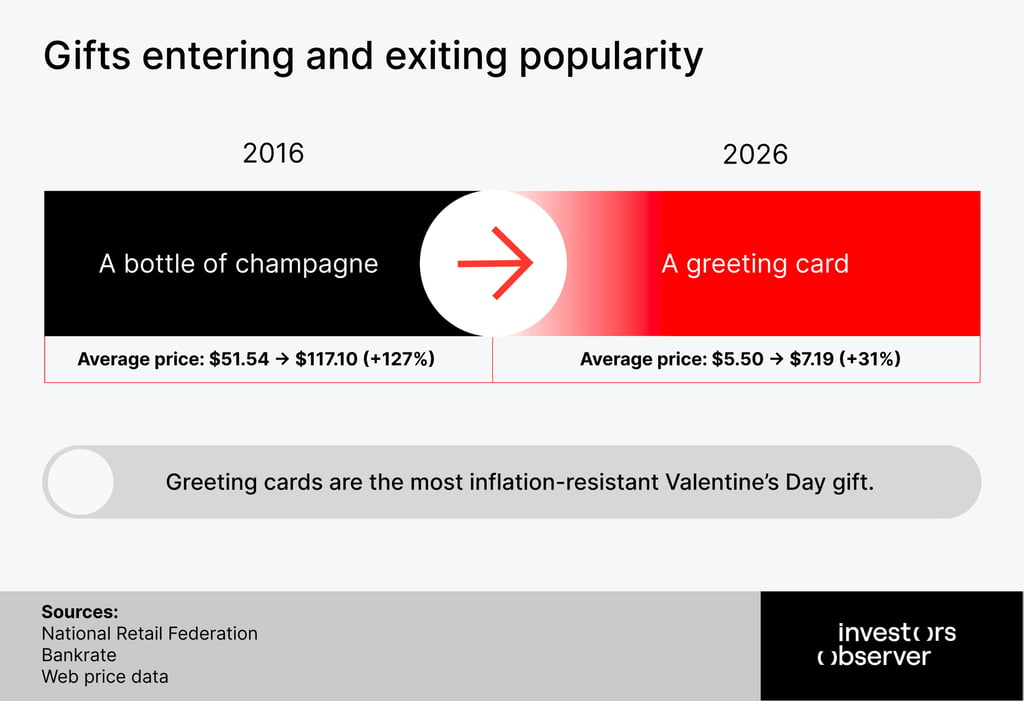
- In the gift lineup, a bottle of champagne (priced at $51.54 in 2016) has been swapped out for a greeting card (averaging $7.19 in 2026).
- A box of chocolates has the biggest price jump – more than tripling from $15.11 to $50.70.
- The second biggest price jump: dinner for two more than doubled, rising from $80.46 to $209.
An all-out celebration rose from $512 to $774 in a decade
Most popular Valentine’s Day gifts haven’t changed much. According to Bankrate’s 2016 ‘Be My Valentine’ Index, a decade ago, the top 5 gifts people were willing to give included a box of chocolates, diamond earrings, a dozen roses, dinner for two, and a bottle of champagne. An all-out celebration with all these top gifts then cost $512.
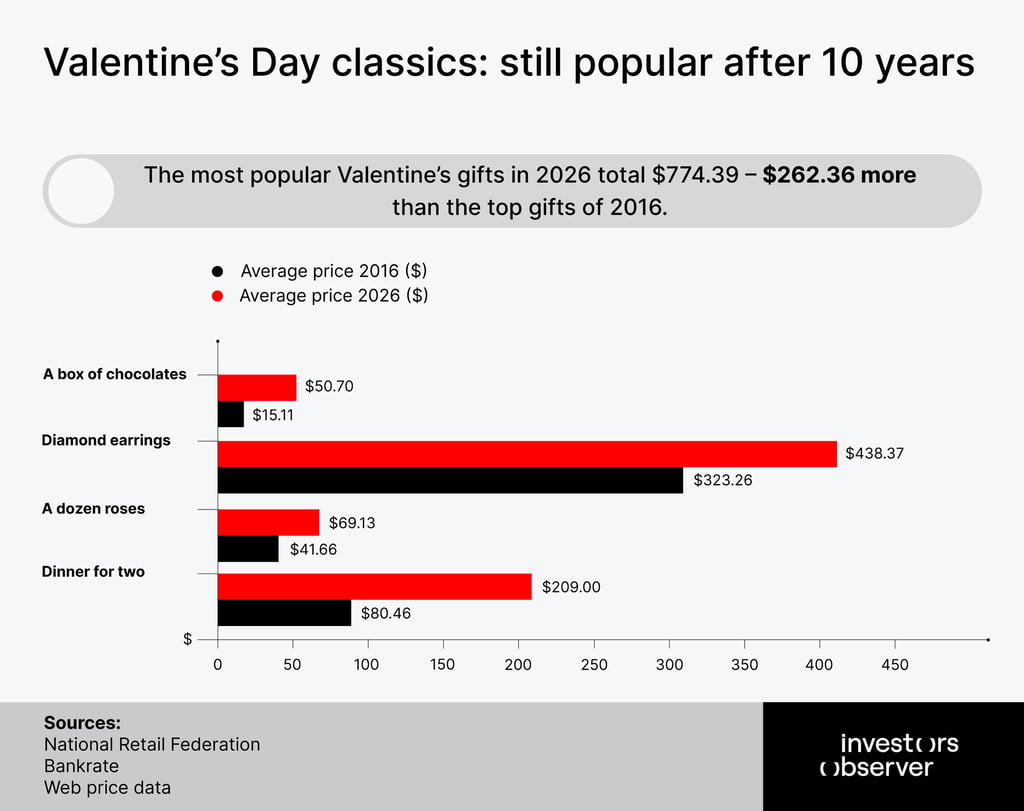
This year, the National Retail Federation’s latest survey shows mostly the same top Valentine’s categories as 2016 – just swap champagne for greeting cards. We then matched those categories to Bankrate’s specific 2016 gifts to compare prices directly. An all out celebration with all these top gifts this February will cost on average $774.
That's a 51% overall increase, outpacing the cumulative inflation rate over the same period and representing real erosion in purchasing power for anyone trying to recreate the romance of years past.
“People may be recreating 2016 aesthetics, but not 2016 prices. Nostalgia might be trending online, but from a finance perspective, it’s clear romance has got a lot more expensive,” says Sam Bourgi, senior analyst at InvestorsObserver.
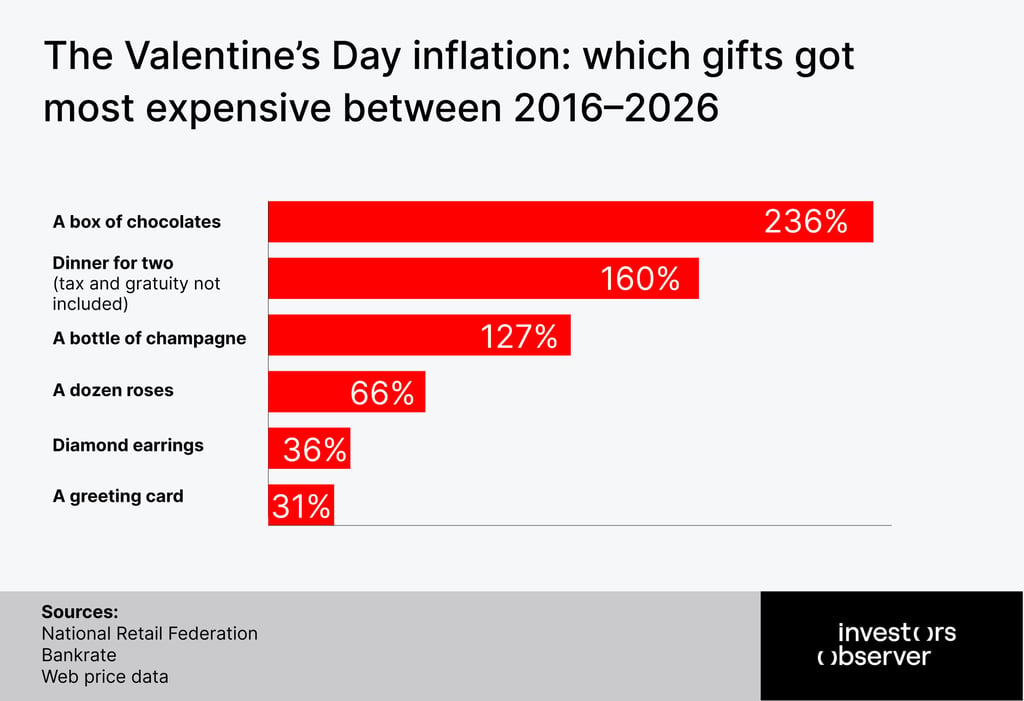
Among classic Valentine’s gifts popular in both 2016 and 2026, chocolates claim the top inflation spot: from $15.11 to $50.70 – a 236% jump.
Dinner for two (before tax and gratuity) ranks second, more than doubling from $80.46 to $209.00 – a 160% increase.
Even champagne, which fell off 2026’s top list, had its price increase from $51.54 to $117.10 – a 127% rise that makes it third overall.
A dozen roses followed with an increase from $41.66 to $69.13 (66%), with diamond earrings from $323.26 to $438.37 (a more modest 36% increase).
The silver lining, if there is one, sits in the greeting card aisle. While in 2016 greeting cards didn’t make it to the top 5 list, this year it’s the second most popular gift people plan to give. At $7.19 in 2026 versus $5.50 in 2016, the handwritten note remains the most inflation-resistant expression of love (31% price increase).
What it means for people’s wallets
If people are planning to celebrate Valentine’s Day the way they did (or wish they had) in 2016, they should prepare for a shock. For budget-conscious romantics, the $262 difference between then and now represents real trade-offs that couples are making right now.
That $262.36 gap between 2016’s $512.03 celebration and 2026’s $774.39 price tag is enough to cover a month of groceries for many households, several tank fills of gas, or a meaningful contribution to an emergency fund.
For many couples, this means recalibrating expectations. “Opt for home-cooked meals or local florists over prix-fixe specials. Nostalgia may call 2026 the new 2016, but your bank account knows better: romance endures, but so does inflation. Plan accordingly,” says Bourgi.
The bottom line is that if people earn the same salary they did in 2016, or even if they have received modest annual raises, their Valentine’s Day purchasing power has significantly decreased.
Methodology and sources
The top 5 gifts and their average prices for 2016 come from Bankrate's Be My Valentine Index:
- A box of chocolates
- Dinner for two (tax and gratuity not included)
- A bottle of champagne
- A dozen roses
- Diamond earrings
The top 5 2026 popularity rankings are from the National Retail Federation’s predictions:
- Candy
- Greeting cards
- Flowers
- An evening out
- Jewelry
The 2026 top gifts (from NRF) were matched to Bankrate's specific 2016 gift items to enable direct price comparisons, beyond just broad categories.
2026 averages reflect five mid-range prices per item, pulled from Google searches (Jan. 30, New York location). We took top results – sponsored and organic, skipping extremes – from retailers like Target, Pandora, and Valentine’s-menu restaurants. Dinner excludes tax and gratuity.
Using the data from the aforementioned sources, we also calculated the following:
- The price of 2016 complete package, which includes a box of chocolates, diamond earrings, a dozen roses, dinner for two, and a bottle of champagne
- The price of 2026 complete package, which includes a box of chocolates, diamond earrings, a dozen roses, dinner for two, and a greetings card
- The difference between 2016 complete package and 2016 complete package
- The price increase percentage for each gift category