2026 Mother’s Day gift prices analysis: 40% cost increase since 2020

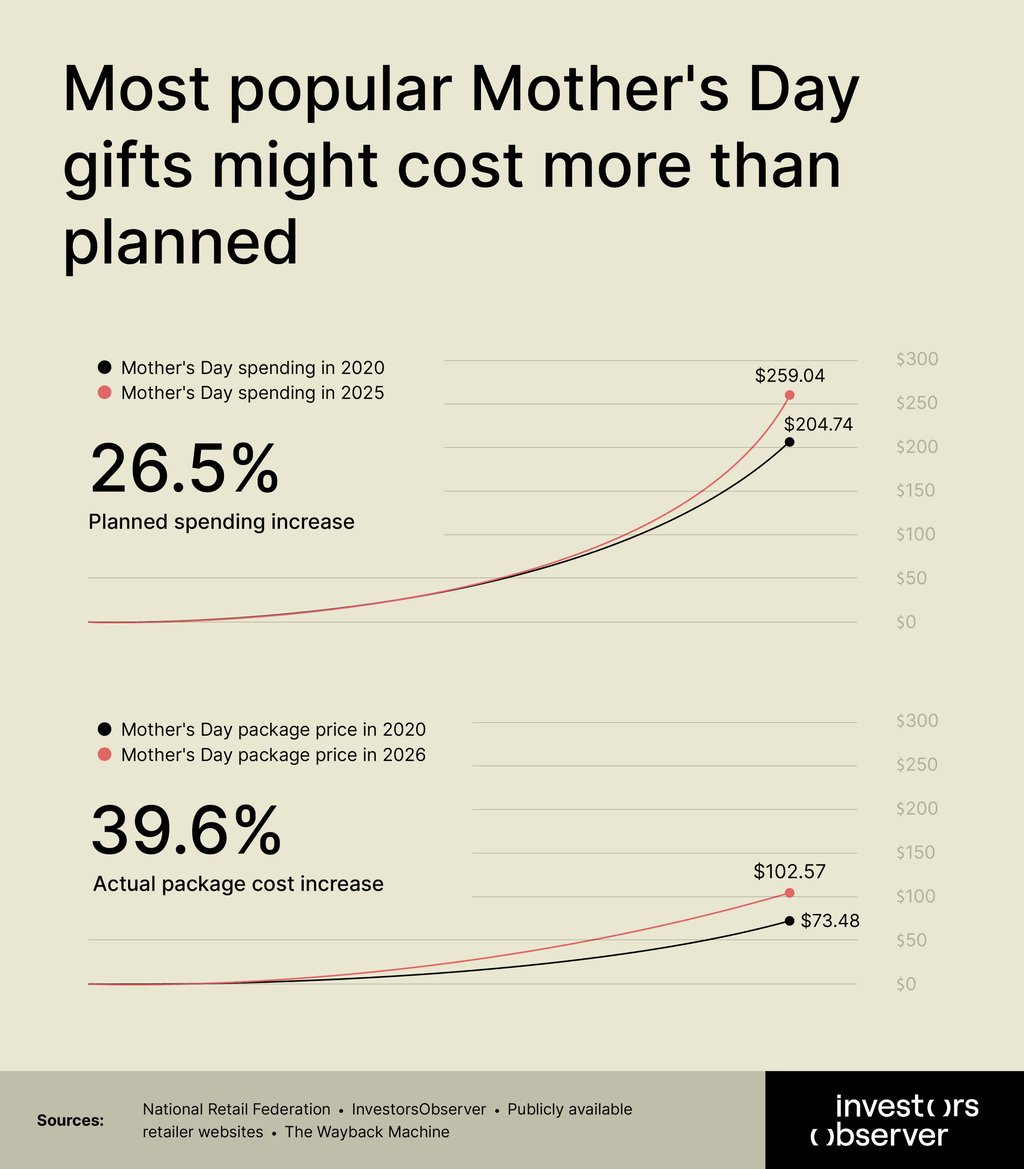
Researchers at InvestorsObserver analyzed the cost of a basic Mother’s Day package, consisting of a bouquet, a greeting card, and a brunch for two, and found that the overall price has increased from $73.48 in 2020 to $102.57 in 2026. The analysis shows that the restaurant costs led the way, with eating prices jumping by more than 50% over the same period.
The cost of a Mother’s Day celebration has risen 39.6% since 2020, outpacing the NRF’s reported 26.5% increase in average planned Mother’s Day spending.
With 84% of consumers planning to celebrate Mother’s Day, and prices rising at a more volatile rate, families may need to stretch their budgets more than they realize, choose more carefully, or scale back in other ways.
Key findings:
- A basic Mother’s Day package (a bouquet, a greeting card, and a brunch for two) increased by 39.6%, from $73.48 in 2020 to $102.57 in 2026.
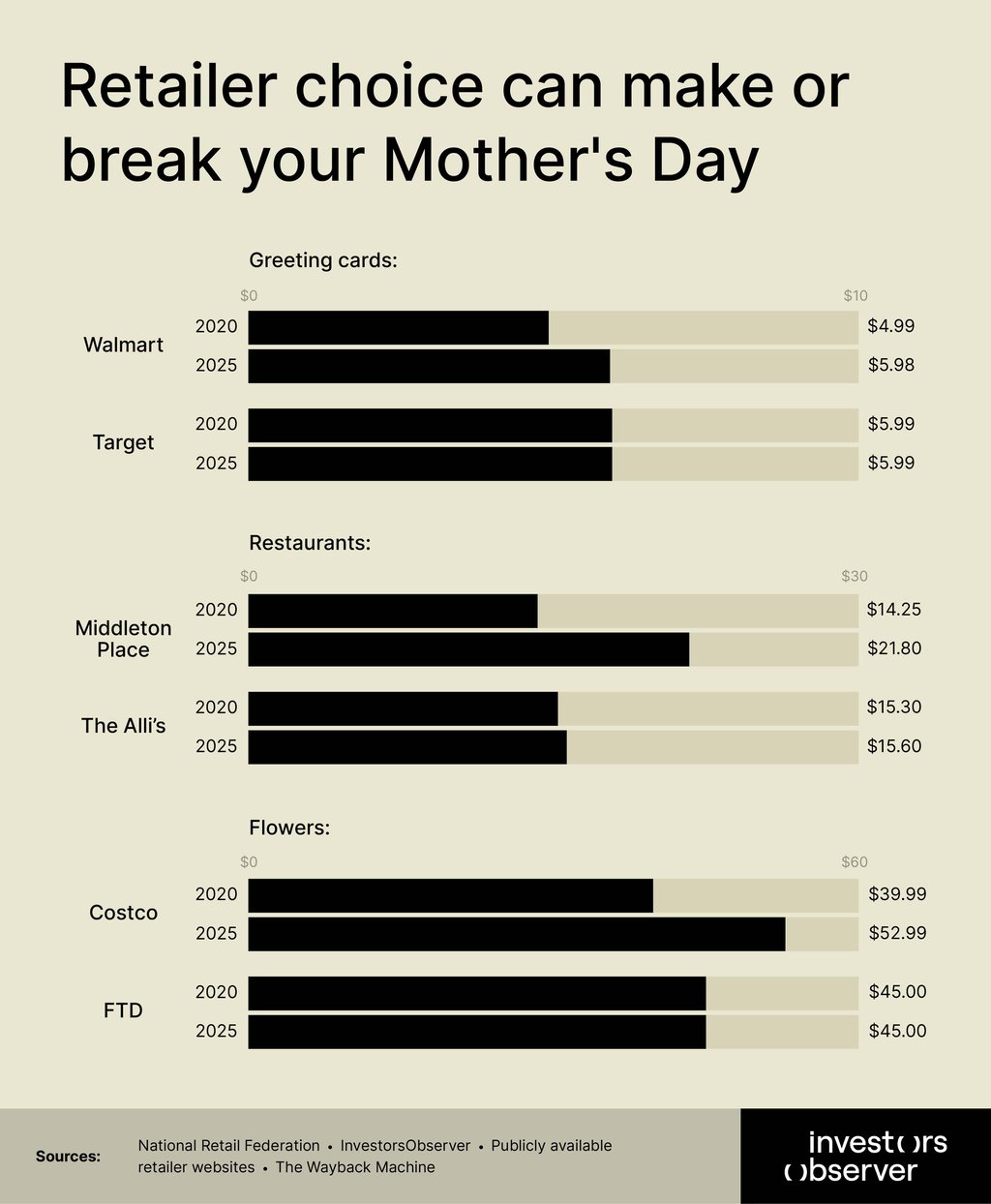
- Average brunch prices at one of the top restaurants rose by 53%, from $14.25 in 2020 to $21.80 in 2026 per person.
- A flower bouquet that cost $39.99 in 2020 now costs $52.99, a 32.5% increase, with the entire price jump occurring in 2026 after five years of price stability.
- Greeting cards changed the least. A Walmart greeting card rose from $4.99 to $5.98 (+19.8%), while Target’s card held steady at $5.99 across all seven years.
- Prices did not increase at the same time: flowers spiked in 2026, restaurants prices climbed steadily from 2021 to 2025, and greeting cards saw their largest single-year jump in 2022.
The biggest spending increase comes from going out
According to researchers at InvestorsObserver, the total Mother’s Day package cost rose 39.6%, outpacing the roughly 26.5% rise in planned spending, with outings showing the steepest increase. Looking at the average brunch/lunch menu options, researchers found that dining out saw the sharpest rise compared with 2020.
The Middleton Place Restaurant, a popular Mother’s Day brunch destination, saw its average menu price rise from $14.25 to $21.80 per person. For a brunch for two, that means spending $43.60 in 2026 compared with $28.50 in 2020.
“What gets the attention is not the fact that the prices have risen, but more how unevenly it has happened. Restaurant meals have gradually become more expensive, while flowers remained stable for several years. Greeting cards had only minor increases. This pattern means the total cost didn’t spike suddenly. It sneaked up, catching many consumers by surprise,” says Sam Bourgi, senior financial analyst at InvestorsObserver.
The Alli’s, another restaurant frequently featured on Mother’s Day dining lists, was far more stable, with average brunch prices moving from $15.30 to $15.60 (+2.0%) over the same period.
Food costs are a major factor in this rise. Beef prices are up 17% year-over-year, and while egg prices have fallen sharply, they peaked at $5.12 per dozen in April 2025 and before dropping by $2.50 by February 2026, offering some relief for brunch spots.
Save on spending by smartly choosing a retailer
Choosing the right retailer for the flowers can significantly affect overall spending. The Costco Warm Wishes Bouquet held at $39.99 for five consecutive years (2020–2025) before jumping to $52.99 in 2026. While FTD’s Sweet & Pretty Bouquet peaked at $60.00 in 2023 before returning to its original $45.00 price in 2026. For those who want to splurge, premium bouquets can easily exceed $100.
Greeting cards were the most price-stable Mother’s Day gift. Target’s American Greetings card held at $5.99 for all seven years tracked. Walmart’s greeting card rose from $4.99 to $5.98, a 19.8% increase, though the price held flat from 2022 through 2025 after a single jump from $4.74 to $5.99 in 2022.
Greeting cards were the most price-stable Mother’s Day gift. Target’s American Greetings card held at $5.99 for all seven years tracked. Walmart’s greeting card rose from $4.99 to $5.98, a 19.8% increase, though the price held flat from 2022 through 2025 after a single jump from $4.74 to $5.98 in 2022.
Methodology
Products tracked
The three most popular Mother’s Day gift categories, according to NRF (flowers, greeting cards, and special outings), were tracked across two sources each:
- Flowers: FTD Sweet & Pretty Bouquet and Costco Warm Wishes Bouquet
- Greeting cards: Greeting cards from Target and Walmart
- Restaurants: The Alli’s and The Middleton Place Restaurant, both featured on a popular Mother’s Day dining recommendation list. The average of all brunch/lunch menu options was used as the per-person price.
Data sources
Price data was collected from retailer websites (FTD, Costco, Target, Walmart) and restaurant menu pages (The Alli’s, The Middleton Place Restaurant). Historical prices (2020–2025) were obtained via the Wayback Machine (web.archive.org) using archived snapshots. The 2026 prices reflect live website listings as of April 2026. NRF/Prosper Insights & Analytics annual Mother’s Day spending surveys were used for consumer spending context.
Calculations
Year-over-year and baseline (2020 vs. 2026) percentage changes were calculated for each product. The Mother’s Day package uses one item from each category (Costco bouquet + Walmart greeting card + Middleton Place brunch for two) to represent a baseline celebration. Restaurant prices represent the average of all brunch/lunch options on the menu, doubled for a meal for two.
Limitations
- Limited sample size: only two sources per category. Prices at other retailers, florists, or restaurants may differ.
- Wayback Machine coverage: archived snapshots may not capture seasonal or promotional pricing and snapshot dates may not align exactly with Mother’s Day week pricing.
- Restaurant menu variability: The Alli’s and The Middleton Place menus shifted between brunch, breakfast, and lunch formats across years, which may affect the comparability of average prices.
- Package composition: The package model uses the lower-priced option from each category. Using the higher-priced sources (FTD + Target + The Alli’s) yields a near-flat change ($81.59 to $82.19, +0.7%), illustrating how retailer choice dramatically affects the outcome.