Why foreign central banks are pulling $240 billion from the Fed

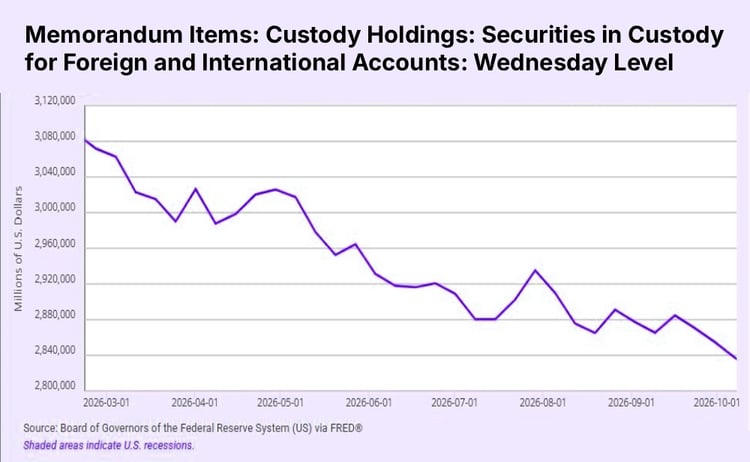
Foreign central banks have been moving billions of dollars in securities out of accounts held at the Fed since the Iran war began. Some see the shift as another sign of de-dollarization, but the explanation may be more nuanced.
A $240 billion exodus
According to Fed data, the value of securities held in Fed custody accounts for foreign officials and international institutions has fallen by $240 billion since late February.
These aren't ordinary investment accounts. Foreign central banks use them to safeguard dollar reserves, which they can draw on to support their currencies during periods of economic stress.
The decline raises an important question: Are central banks selling U.S. debt to raise dollars or simply moving their securities elsewhere?
If they're selling, that could drive Treasury yields higher, making it more expensive for Washington to borrow. If the securities are being transferred to other custodians, foreign governments may still own them.
The Treasury Department's own figures are less encouraging. Foreign official institutions' holdings of U.S. Treasuries fell from $4.01 trillion in February to $3.67 trillion in September.
The Iran war connection
Some analysts have interpreted the decline as a sign of waning confidence in U.S. debt.
Others say the oil crisis has increased demand for dollars, especially in energy-importing countries, where central banks may need to offload reserves to prop up their currencies.
"The longer this war drags on, the more countries are forced to sell dollar reserves to defend their currencies," analyst Lukas Ekwueme wrote.
📌 Bottom line: If foreign central banks are selling Treasuries to support their currencies, the Iran war could be pushing up Washington's borrowing costs just as its military spending rises.