Lucid's big week includes unveiling of new robotaxi with Uber

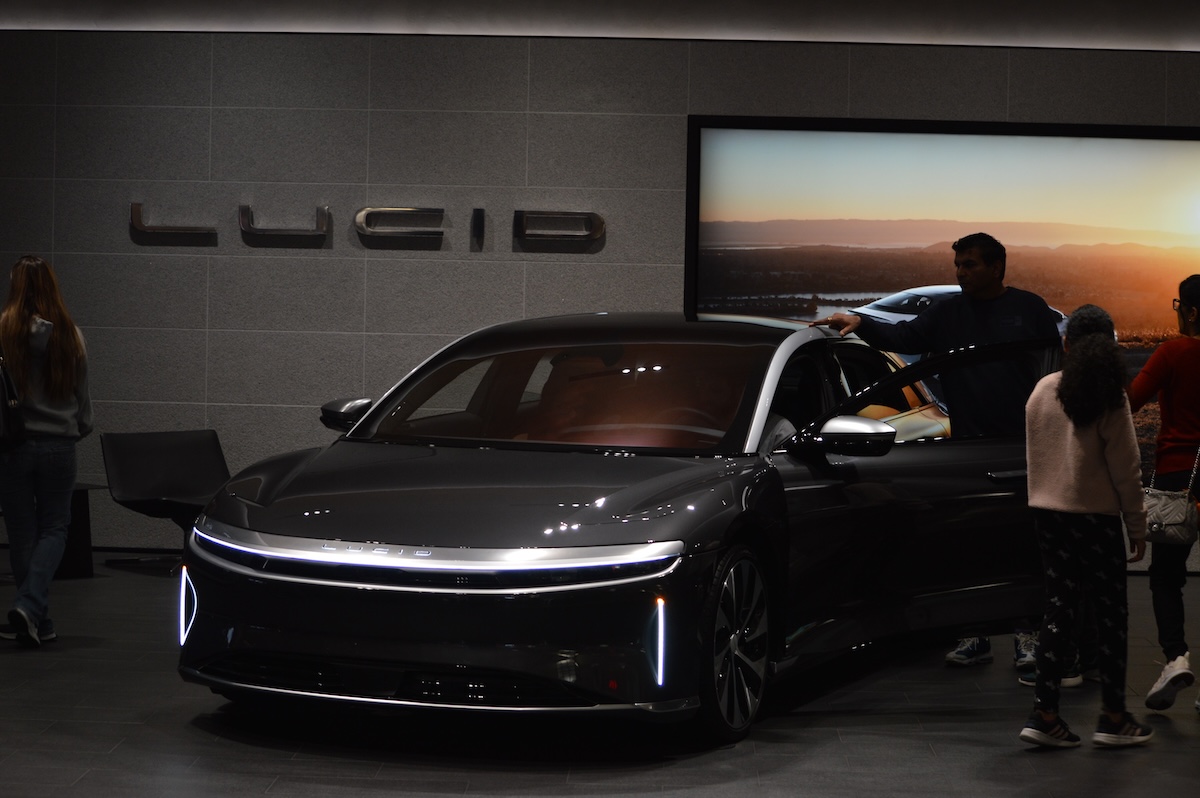
Lucid Group, Inc. (LCID) has started the first full week of 2026 on a winning streak, as the company looks to put some of last year's struggles behind it.
On Monday, the company unveiled the new robotaxi that it has designed with Uber Technologies (UBER) at the Consumer Electronics Show (CES) in Las Vegas.
In addition to Lucid and Uber, the robotaxi is also being developed with Nuro, a universal autonomy platform. Nuro's self-driving platform provides Level 4 autonomy, which is when a vehicle can drive itself completely within certain conditions (such as specific roads) without human intervention.
For the robotaxi, the Lucid Gravity has been outfitted with an Uber-designed in-person rider experience, which includes interactive screens that allow riders to personalize their trip with temperature control, music selection or even the ability to request that the vehicle pull over.
The Lucid Gravity fits up to six passengers and also has space for luggage.
In a press release announcing the robotaxi, Lucid noted that on-road testing began last month, putting it on pace to launch in the San Francisco Bay Area later this year. The on-road testing is being led by Nuro, which is utilizing engineering prototypes that are being supervised by autonomous vehicle operators in the Bay Area.
The vehicle's high-performance compute is based on NVIDIA DRIVE AGX Thor, part of the NVIDIA DRIVE Hyperion platform. The platform supports the real-time AI processing and system integration that's needed for advanced autonomous driving.
"Our robotaxi program with Uber and Nuro is a key part of how Lucid is leveraging its technology to create a more sustainable future of mobility that is widely accessible," Kay Stepper, vice president of ADAS and Autonomous at Lucid, said in a statement.
"Our engineering, range and interior comfort offers a unique platform, and when combined with Nuro's technology and Uber's scale, we are collectively building an experience like no other."
Nuro's on-road testing evaluates critical capabilities across its autonomous stack, including its end-to-end AI foundation model. The robotaxi is also being put through closed-course testing in order to evaluate performance across multiple different simulation scenarios.
Once final validation of the vehicle has been completed, production is slated to begin at Lucid's Arizona factory later this year.
A strong showing for vehicle production and deliveries
In addition to its robotaxi announcement with Uber and Nuro, Lucid on Monday also revealed that it had produced 18,378 vehicles in 2025, a 104% increase over 2024. The company also delivered 15,841 vehicles, up 55% over the previous year.
Lucid also said that it had produced 8,412 vehicles during Q4, a 116% increase over Q3. It also delivered 5,345 vehicles, beating its third-quarter numbers by 31%.
These numbers are especially significant because Lucid had sold zero units of its Gravity in July, marking the third-consecutive month that the company had failed to sell a single unit of its SUV, according to data from Market Intelligence.
Lucid's interim CEO Marc Winterhoff pushed back on this data during the company's second-quarter earnings call, saying that "the number is false" when asked by an analyst about the data.
“When it comes to numbers for the second half, we are not disclosing this, but we’re definitely in the process right now of ramping up Gravity in the second half of this year,” he said.
Based on the numbers shared on Monday, that was proven to be true. By comparison, both Tesla (TSLA) and Rivian (RIVN) have reported sharp drops in their fourth-quarter deliveries.
Lucid will share its full Q4 results on Feb. 24.