Economists say AI's boom is the only thing saving US economy

One of the biggest problems that Joe Biden faced during his presidency was a lingering disconnect between strong economic metrics and public sentiment about the economy.
The American GDP rose 12.6% during Biden’s four years in the White House, while unemployment remained low.
Although inflation spiked during the early part of his term, which is partially blamed on Covid, it eventually eased by the time he left office.
And yet, for many Americans, the economy felt much worse than it actually was, a scenario that has been dubbed a “vibecession,” where it just feels like the country is in a recession.
This sentiment became a major theme of the 2024 presidential election, and was seen as being crucial to Donald Trump’s victory.
As the first year of President Trump’s second term in office nears the home stretch, it’s starting to look like the inverse effect is happening under Trump than what happened under Biden.
The US economy feels like it's in much better shape than it actually is, at least according to several economists.
The reason for this latest disconnect falls squarely on the shoulders of the AI boom.
“AI has kept the economy out of a recession,” BNP Paribas chief US economist James Egelhof recently told a roundtable of reporters.
He noted that AI-driven investments in data centers and microchips have kept growth accelerating and the stock market soaring, which has in turn kept businesses spending.
“The AI boom has convinced the broader business community that a robust expansion and productivity surge lies just over the horizon,” Egelhof added.
He’s not alone in thinking that way.
“AI machines — in quite a literal sense — appear to be saving the U.S. economy right now,” George Saravelos, global head of FX research at Deutsche Bank wrote in a recent client note.
“In the absence of tech-related spending, the U.S. would be close to, or in, recession this year.”
Saravlos points out that AI itself is not really fueling the economy, but rather the money being spent on building data centers.
Instead of actual real-time growth, it’s a bet on the future that’s driving expansion.
AI spending is masking weak economy
When Nvidia entered into a staggering $100 billion partnership with OpenAI to " power the next era of intelligence,” Nvidia founder and CEO Jensen Huang said it was more than a corporate deal.
“It may not be an exaggeration to write that NVIDIA — the key supplier of capital goods for the AI investment cycle — is currently carrying the weight of U.S. economic growth,” Saravalos said in his note.
“The bad news is that in order for the tech cycle to continue contributing to GDP growth, capital investment needs to remain parabolic. This is highly unlikely.”
Torsten Sløk, chief economist for Apollo, pointed to the distorted view of the economy that’s being driven by the rise of the Magnificent 7 stocks.
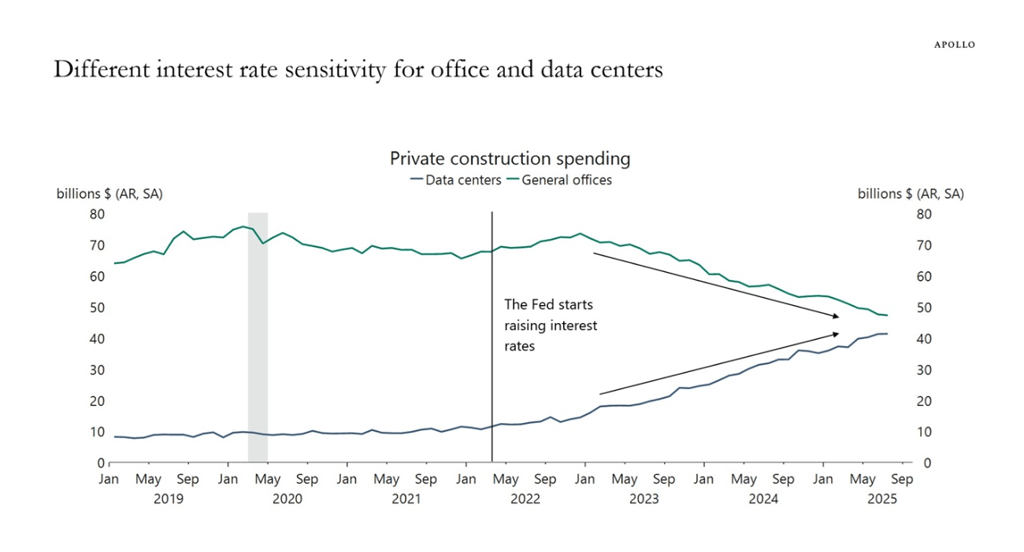
Although capex spending normally goes down when the Fed raises interest rates, the spending on AI data centers never declined when interest rates were hiked in 2022.
The reason, according to Sløk, is “because data center financings and the AI boom are ultimately financed by the rise in equity prices of the Magnificent Seven.”
This means that “the transmission mechanism for monetary policy has been broken for data centers,” but not for other parts of the economy.
“That is the reason why there is basically no growth in corporate capex outside of AI at the moment,” Sløk said, as shown in the chart below courtesy of Apollo.
The economist Paul Krugman wrote in his Substack newsletter that “the economy is growing thanks to AI spending,” but it’s a “K-shaped expansion” in which wealthy Americans are becoming wealthier and working-class and lower-class people are struggling.
“There are some objective, measurable reasons to say that the US economy, which appears OK by the most commonly used measures, is definitely not OK once you look under the hood,” Krugman wrote.
Another way of putting this: “AI is booming, but the rest of the economy isn’t,” Krugman added.