Did Nvidia’s CEO hand Broadcom the keys to the AI future?

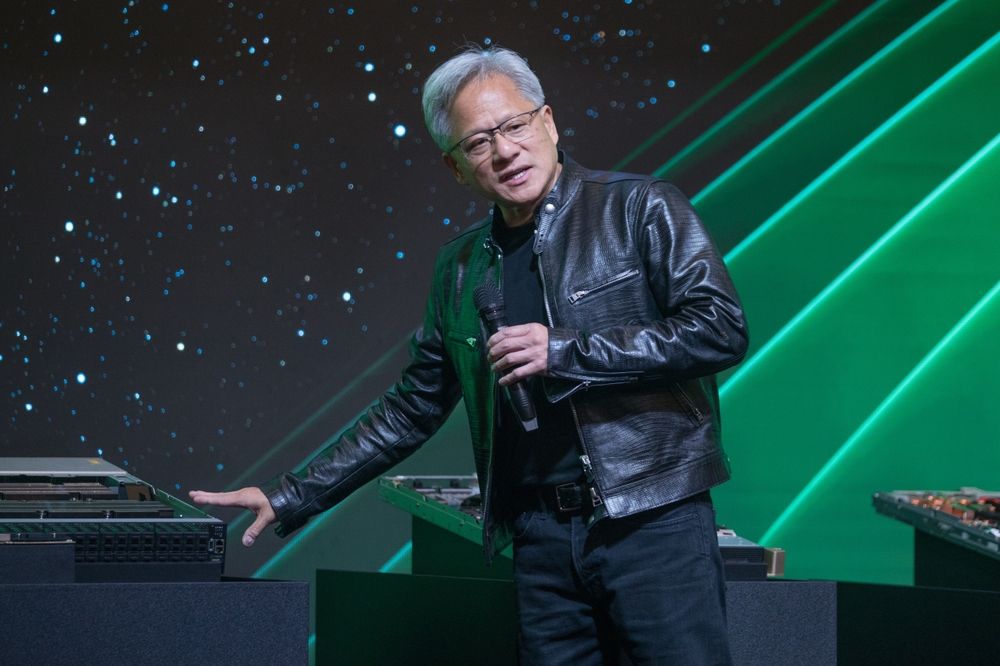
Although Nvidia and Broadcom compete across parts of the data center and AI infrastructure stack, the two companies also share powerful synergies that could make large-scale AI computing far more efficient, with Broadcom potentially benefiting the most as that relationship deepens.
Earlier this year, Nvidia CEO Jensen Huang called optical connectors — the infrastructure that allows AI computers to communicate with one another — the future of AI data center growth.
Optical connectors are crucial because they enable massive AI systems to transfer data quickly and with significantly less heat and power consumption compared to traditional copper cables.
As AI clusters grow larger and more power-hungry, copper is increasingly hitting physical and economic limits that optics can overcome.
That framing is especially notable because Nvidia’s key partner in optical networking is Broadcom. This company has also ridden the AI investment wave and is now viewed by some investors as a potential future addition to the so-called “Magnificent Seven” cohort of mega-cap tech stocks.
Optics have become mandatory because modern AI no longer runs on a single chip, but on tens of thousands of GPUs that must share data in near-real time. What Huang is effectively signaling is that without optical networking, future AI systems simply cannot scale.
While it remains difficult to pinpoint exactly how much of Broadcom’s revenue comes specifically from optical networking, the business is embedded within its semiconductor segment, which totaled $30.1 billion in fiscal year 2024 and is widely expected to grow rapidly alongside the demand driven by AI.
Broadcom’s ascent
Broadcom’s growth trajectory broadly mirrors that of Nvidia. Revenue began accelerating in the mid-2010s, expanded more gradually through the pandemic years, and then shifted sharply higher during the recent surge driven by AI and software.
Between 2023 and 2025, Broadcom’s trailing 12-month revenue nearly doubled, climbing to roughly $60 billion, according to data from Qualtrim.
Jensen Huang has called optical connectors the requirement for the future of AI data centers.
undefined Qualtrim (@qualtrim) November 30, 2025
Guess who Nvidia’s optical-networking partner is?
Broadcom.$AVGO $NVDA pic.twitter.com/aGs9oDYfGn
Broadcom has become one of the key suppliers supporting the global AI buildout, despite not manufacturing GPUs.
The company plays a central role in data-center switching chips, high-speed networking silicon, optical connectivity, and custom AI chips for large cloud companies. As AI data centers grow, demand for these products rises in tandem with them.
Growth was further strengthened by Broadcom’s acquisition of VMware, which closed in late 2023. The deal added a large and steady stream of enterprise software revenue, shifting Broadcom from being mainly a chip company into one with both hardware and software at its core.
Broadcom shares are up more than 60% this year, sharply outperforming both the technology sector and the S&P 500 Index. The rally has lifted Broadcom’s market capitalization to roughly $1.8 trillion, with the stock currently trading around $382.