S&P 500 valuations enter bear market as Nvidia (NVDA) leads AI stock selloff

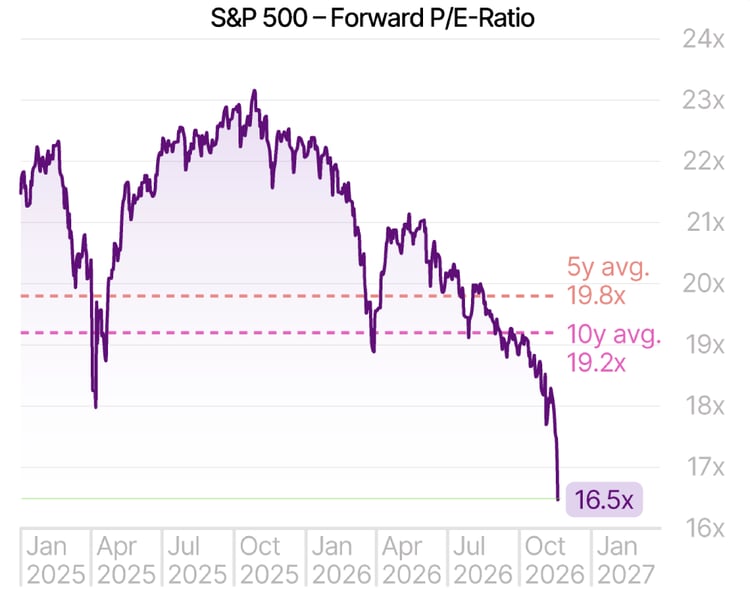
The S&P 500 declined more than 11% from its October peak to Nov. 20, as the AI selloff accelerated following Jensen Huang's brief resignation from Nvidia.
Although stocks somewhat rebounded yesterday, the S&P 500 is already in a "bear market" from a valuation perspective.
Wall Street's valuation collapse
Following last week's selloff, the S&P 500's forward price-to-earnings (P/E) ratio has plunged to 16.5, its lowest level since early 2023, according to Duality Research.
For comparison, the ratio was above 23 in October 2025, meaning investors were paying more than $23 for every dollar in expected corporate profits.
"It's a correction in stocks, but a bear market in valuation," wrote Mike Zaccardi, a Chartered Financial Analyst.
The S&P 500 now trades well below its five-year average forward P/E of 19.8 and its 10-year average of 19.1, according to FactSet.
Earnings forecasts are also rising
Perhaps ironically, earnings forecasts have also helped bring valuations down.
FactSet data shows that the S&P 500 fell 6.2% between Sept. 30 and Nov. 20, while analysts raised their forward earnings estimates by 4.4%.
AI stocks have undergone an even bigger valuation reset. According to Citadel Securities, semiconductor stocks' forward P/E ratios fell 35% between June 30 and Nov. 3, even as forward earnings estimates rose 30%.
Across the S&P 500, earnings are on track to grow 32.9% year over year in the third quarter, which would mark the third consecutive quarter of growth above 25%, according to FactSet.
📌 Bottom line: The S&P 500 is trading at valuations last seen during the recovery from the 2022 bear market, even though corporate profits continue to grow.