Meta just made $65 billion. So where did all the cash go?

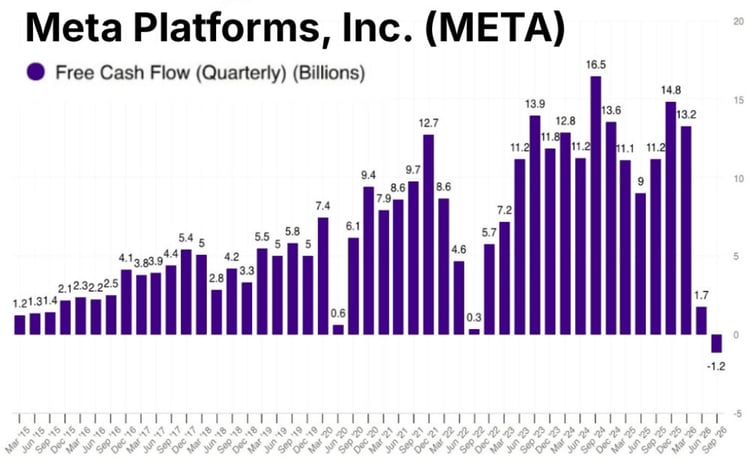
Meta's advertising business has generated billions in cash every quarter for years, giving Mark Zuckerberg plenty of room to pursue his ambitions.
That engine is still growing fast, but AI spending has now pushed Meta's free cash flow into the red.
Meta's cash flow turns negative
During its latest quarter, Meta reported negative free cash flow of $2.1 billion. Excluding finance lease principal payments, the shortfall was roughly $1.2 billion.
By comparison, Meta routinely generated more than $10 billion in quarterly free cash flow in recent years.
Free cash flow measures the cash left after capital expenditures. Meta's reported figure also subtracts finance lease principal payments.
A negative reading means the company spent more on those items than it generated in operating cash that quarter.
The cost of Meta's AI ambitions
The cash flow reversal came despite another blockbuster quarter. Meta generated $64.6 billion in revenue, up 26% from a year earlier.
The problem is how much Meta is spending. Capital expenditures totaled $34.9 billion during the quarter, largely driven by its massive investment in AI infrastructure.
Meta has also raised the lower end of its full-year capital expenditure forecast to $135 billion, with the upper end remaining at $145 billion.
The payoff is still ahead
As we wrote earlier this week, Meta plans to monetize Muse through shopping commissions and high-margin AI inference for enterprise clients.
But so far, the model is too compute-hungry to roll out to a wider audience, and Meta hasn't given a timeline for when its AI investments will earn a return.
Meta believes it can make Muse 10x more efficient as soon as next year. In the meantime, the infrastructure bill continues to eat into its cash flow.
📌 Bottom line: Meta's advertising business remains highly profitable, and Muse could open up new ways to make money. But the AI investment is consuming cash now, while the payoff is yet to come.