Brazil's bond market is in free fall

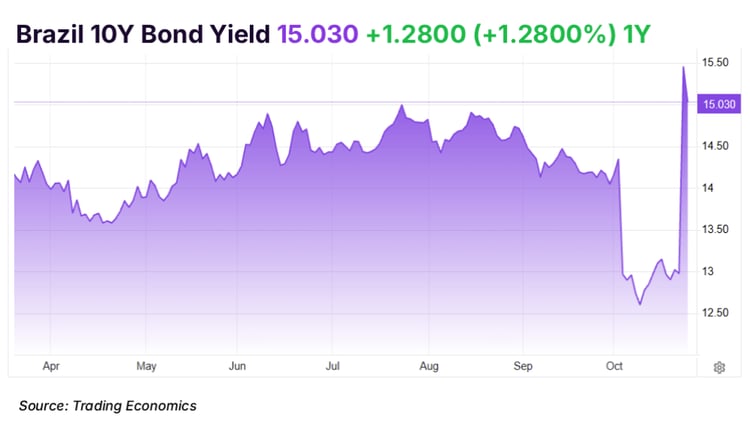
Brazil had its own "Black Monday" this week after Lula da Silva's election victory. The country's main stock index plunged 17%, small-cap stocks fell 30%, and the Brazilian real tumbled 12%.
But the biggest bloodbath was the bond market where yields surged to levels that would normally set off alarm bells well beyond Brazil.
Bond market carnage
Brazil's 10-year government bond yield surged 300 basis points in a single day, approaching 16%.
Lula's victory over Bolsonaro has raised concerns about higher government spending, particularly among investors who had expected Bolsonaro to pursue greater fiscal restraint.
"The fiscal side has always been Brazil's Achilles heel, and a 7-8% budget deficit and 70% net debt-to-GDP ratio leave Brazil vulnerable in a global bond sell-off," wrote ING strategist Chris Turner.
Higher yields also mean Brazil will have to cope with higher borrowing costs, potentially exacerbating fiscal problems investors are already concerned about.
No contagion (yet)
Perhaps the most surprising development is how little the turmoil has affected markets elsewhere.
Despite Brazil's position among the world's largest economies, there has been "virtually no corresponding reaction across global stock markets, cryptocurrencies, precious metals, or safe havens," according to analyst Michael Gogel.
Brazilian bond turmoil has spilled over into other markets before, mainly across emerging economies.
For example, after Brazil devalued the real in 1999, short-term interest rates rose by as much as 500 basis points in Argentina and Mexico, and bond spreads widened across the region.
The shock was brief, however, and the IMF reported little impact on advanced economies.
📌 Bottom line: So far, the spillover looks limited. Brazil’s real and stocks recovered some ground on Tuesday, and analysts reported little contagion across the region.