Baby Boomers are winning the pension game at Gen Z’s expense

The generational wealth gap is usually measured in terms of housing affordability and job security. But another divide is emerging in retirement.
Boomers win again
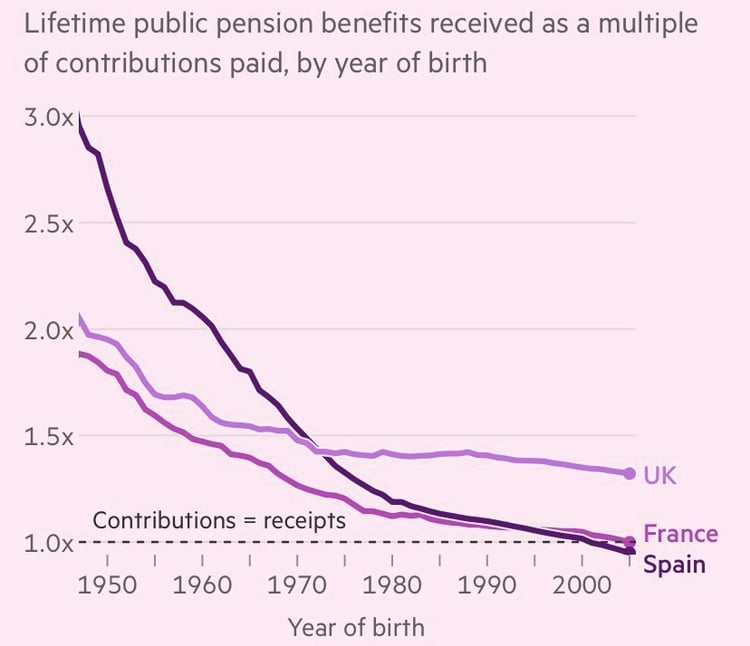
A recent Financial Times analysis found that retirees in several wealthy Western countries are receiving significantly more from public pensions than they paid into the system.
In Spain, Boomers born in the late 1940s are projected to receive nearly three times their lifetime pension contributions in benefits. For Millennials and Gen Z, the ratio has fallen to roughly one-to-one.
In France, older generations are projected to receive nearly twice as much in pension benefits as they contributed, while younger generations are expected to receive about as much as they paid in.
Similar trends exist in the U.K. and other European countries.
As more Boomers retire, there are fewer working-age adults relative to the number of pensioners. Across OECD countries, there were 22 people aged 65 and older for every 100 working-age adults in 2000. By 2025, there were 33.
Inequality built into the pension system
Public pensions in these countries largely operate on a pay-as-you-go basis, meaning today's workers finance the benefits of current retirees.
But aging populations and slower workforce growth mean younger generations are unlikely to receive the same benefits relative to their contributions.
The imbalance is already showing up in household incomes. The average pensioner now has a higher disposable income than the average working-age person in the U.S. and several European countries.
Younger Americans face a similar problem with Social Security.
The 2026 Social Security Trustees Report found that, without legislative changes, incoming revenues would cover just 78% of scheduled retirement and survivor benefits in 2032 and 62% by 2100.
📌 Bottom line: Younger generations are paying for retirement benefits they may never receive themselves.