🧠 Zuckerberg's master AI plan


Morning Observers,
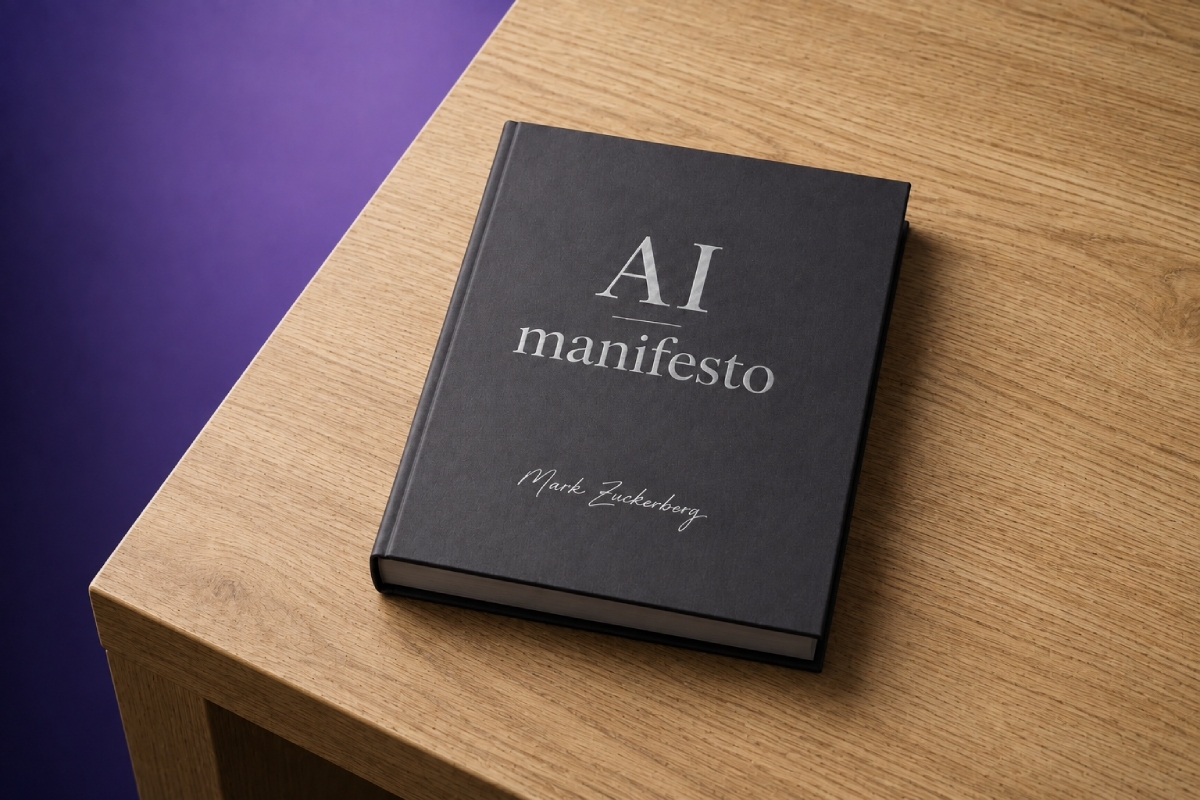
Mark Zuckerberg dropped a 6,500-word AI manifesto yesterday.
The media has fixated on his attack on OpenAI and Anthropic, his defense of open-source AI, and his argument that superintelligence should eventually be available to everyone.
But the much bigger investing story is that Zuckerberg wants to turn AI into a commodity.
Meta's new Muse Glimmer model is open-weight, small enough to run locally on consumer hardware, and free for developers to download and modify.
The company also plans to release an open-weight version of the much more powerful Muse Spark.
Zuck also argued that AI companies should be allowed to distill knowledge from competing models, essentially allowing one AI to learn from another, and warned Washington against policies that make this harder.
That's almost the opposite of how most technology companies traditionally defend a moat.
If that happens, a lot of the money investors expect to be made selling AI models may migrate elsewhere. And Zuckerberg has an enormous incentive to make sure it does.
Meta doesn't need to make its fortune by charging you every time you ask an AI a question. Its existing empire makes almost all of its revenue from advertising.
The cheaper AI becomes, the more AI-generated content gets created, the more businesses can advertise, the more useful Meta's apps become, and the more compelling always-on AI devices like smart glasses become.
Let's dive in!
- Dan Runkevicius, Editor

🏭 Intel’s $15 billion raise comes with a dilution trade-off
Intel is looking to capitalize on renewed investor enthusiasm, announcing plans to sell $15 billion worth of common stock. The raise gives Intel more financial firepower to fund its turnaround and chip ambitions, but it comes with a trade-off: issuing new shares dilutes existing investors, who have enjoyed gains of more than 160% this year.
🎮 GameStop may rethink its $56 billion eBay bid
GameStop CEO Ryan Cohen is considering pulling the company’s proposed $56 billion bid for eBay and pursuing a partnership instead. One possibility would be a joint venture combining eBay’s online marketplace with GameStop’s roughly 1,600 U.S. stores, potentially giving both companies a bigger foothold in high-margin categories like trading cards and collectibles.
🤖 Microsoft wants a much bigger piece of the AI chip market
Microsoft is preparing to significantly boost production of its next-generation AI chips. The company is discussing securing TSMC capacity for more than 300,000 chips slated for delivery in 2027. If it can successfully scale its own silicon, it could lower costs, gain more control over its data centers, and become a more serious competitor in a market dominated by Nvidia.
📈 Corporate profits just hit a record share of the economy
U.S. corporate profits before taxes have climbed to a record 14% of GDP, nearly double their level around the 2008 financial crisis and above previous peaks of roughly 13%. After-tax profits have also reached a record share of the economy at around 11% of GDP, while nominal after-tax profits have jumped 101% since the pandemic to $3.62 trillion. Despite years of inflation, higher rates, and recession warnings, corporate America’s profit machine has rarely been stronger.
🥇 Gold is up $300 in a week
Gold climbed back above $4,400 an ounce on Monday, its highest level since early June. The latest move comes as investors dial back expectations for U.S. rate hikes while fresh data points to renewed buying by global central banks. That combination is increasingly favorable for bullion because lower expected interest rates reduce the opportunity cost of holding gold, while central-bank demand provides additional support for its price.
America's latest import: nervous money
The strange thing about America’s rally is that some of its most enthusiastic buyers are coming from markets where the AI trade just broke.
South Korea is a perfect example.
While Americans debate whether the AI boom has gone too far, Korean investors are dealing with what happens when it does… and responding by buying America.
Korea’s tech wreck is becoming America’s inflow
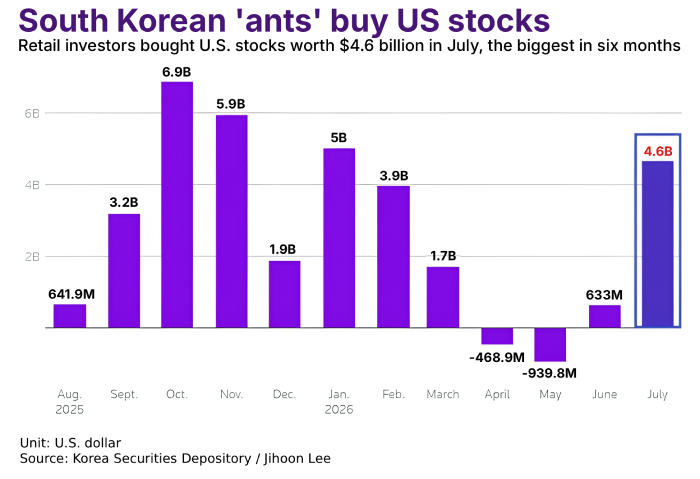
Data from the Korea Securities Depository shows a dramatic reversal in South Korean retail investor flows.
After selling a net $469 million of U.S. stocks in April and $940 million in May, Korean retail investors bought $4.6 billion in July — the largest haul since January. That was also well above the $2.7 billion monthly average recorded in 2025.
For the first time since February, Korean retail investors bought more U.S. stocks than domestic equities. The timing is no coincidence.
The KOSPI has fallen 33% from its June peak, with Samsung and SK Hynix driving roughly three-quarters of the decline. The selloff shows the downside of having so much of a market riding on just two stocks.
America’s valuation premium may also be an insurance premium
South Korea’s $4.6 billion alone won’t move the U.S. market, but it’s part of a much bigger wave: foreign purchases of U.S. stocks remain near record levels.
That may help explain why the S&P 500 has quietly returned to all-time highs even with semiconductors still 15% below their June peak.
📌 Bottom line: America doesn’t have to look cheap if the alternatives look worse. Global investors continue to buy U.S. stocks during overseas selloffs, giving this rally another source of fuel.
Everyone’s all-in?
Individual investors and professionals don’t always move in lockstep. But right now, they’re making the same bet.
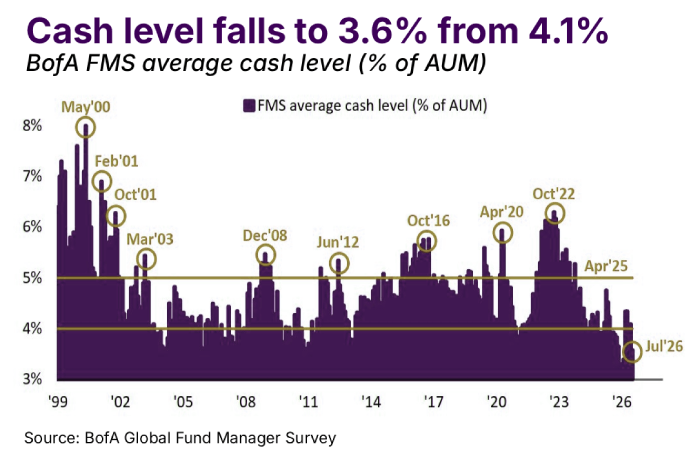
According to recent AAII data, retail investors are holding near-record-low levels of cash. Now Bank of America says institutional investors are doing much the same.
Fully invested
Cash levels among global fund managers have fallen to 3.6%, according to Bank of America’s latest survey. It’s the lowest level since February and near the lowest levels of the past two decades.
Meanwhile, AAII data shows that individual investors are holding near-record-low levels of cash, too. That means both Wall Street and Main Street now have unusually little dry powder left.
That’s fine while markets keep rising. But with the S&P 500 above 7,700, there’s less cash sitting on the sidelines to step in when stocks fall.
Where the money is going
The money still coming in is increasingly piling into tech.
Global tech funds attracted $15.7 billion in the final week of July, the third-largest weekly inflow on record and the fourth straight week above $10 billion.
Much of that money ultimately finds its way to the U.S., home to many of the world’s biggest tech companies, including Nvidia, Microsoft, Apple, Broadcom, and Meta.
And the buying isn’t slowing. Tech funds are now on pace for their largest year of inflows ever.
So investors are going all-in on two fronts: holding less cash and putting more of what they invest into the same corner of the market.
📌 Bottom line: The next market dip could be the real test. With investors already fully invested, there may be fewer dollars waiting to turn a 5% pullback into another quick rebound.