You Can't See Everything

Morning Observers,
What happened yesterday drives home probably the most important lesson for long-term investors: You Can't See Everything.
As you probably know, Huang was reinstated, and Nvidia popped more than 30%, sending the whole market back into euphoria mode.
There's already a lot of speculation about the whys and hows of what happened and what will happen next. But there are so many layers to this that nobody really knows what's going on, and most takes are just an extension of their confirmation bias.
What we do know, though, is that these kinds of pops are typical of the stock market, especially following big losses. And as a long-term investor, you have only one job: don't miss them at all costs.
The way we're taught compound interest creates the illusion that portfolio gains are more or less linear. But in reality, most retirements are built on a handful of days like yesterday.
Miss 10 pops over the course of 20 years — twenty years! — and your portfolio is half the size it could have been if you'd stayed invested.
Miss 60, and you're left with virtually nothing.
One thing I've learned from working with people who know more about finance than I ever will is that cycles are just impossible to forecast. Howard Marks admitted that even in retrospect no one knows exactly what popped the dot-com bubble.
So if you're in it for the long haul, don't get cute and think you know better.
- Dan Runkevicius, Editor

📈 Jensen Huang's return adds $3 trillion to stock market
Nvidia's decision to bring back Jensen Huang as CEO set off a 30% rally in its stock, but the impact extended well beyond the chipmaker. The S&P 500 Index surged 4.7% on the day, with the U.S. stock market adding $3.5 trillion in market capitalization. Short sellers betting against Nvidia also lost more than $12 billion, the biggest loss since at least 2019.
🥇 Investors dump gold for other safe havens
Gold prices stabilized around $3,700 a troy ounce on Monday, but remain on track for their worst three-month performance since 2013. The yellow metal is down nearly 22% on a rolling three-month basis and has now underperformed even Bitcoin since the Iran war began. Meanwhile, demand for long-dated U.S. Treasuries has rebounded, with the 10-year yield slipping further below 5% after spending 27 trading days above that level this year, the most since 2007.
🏗️ Caterpillar's 2008 moment
Caterpillar stock has fallen more than 51% from its 2025 record high after riding the AI infrastructure boom and its subsequent bust. It's the worst drawdown for CAT stock since 2008. The company's energy and power business benefited from booming data center construction, but concerns about excessive AI infrastructure spending have triggered a pullback. Caterpillar has also significantly underperformed the industrials sector, which is up 4% over the past 12 months.
🤖 Anthropic lags broader AI rebound
While the Nasdaq surged more than 6% on Monday, Anthropic stock fell 1.4% as its post-IPO hangover continued. Investors have questioned the IPO's share allocation, which allowed early and institutional investors to unload large positions shortly after its debut. The company's spending plans have also drawn scrutiny. Despite reporting $16.3 billion in revenue for the first half of 2026, Anthropic plans to spend a staggering $750 billion on computing capacity over the coming years.
⚠️ KPMG warns about new tariff-fueled inflation wave
KPMG has warned that another round of tariffs could push prices even higher. According to chief economist Diane Swonk, the Trump administration's investigations into trade practices across 16 economies, including China and the EU, could result in additional tariffs. New tariffs on AI infrastructure are also expected to take effect Dec. 4.
“A correction in stocks, but a bear market in valuation”
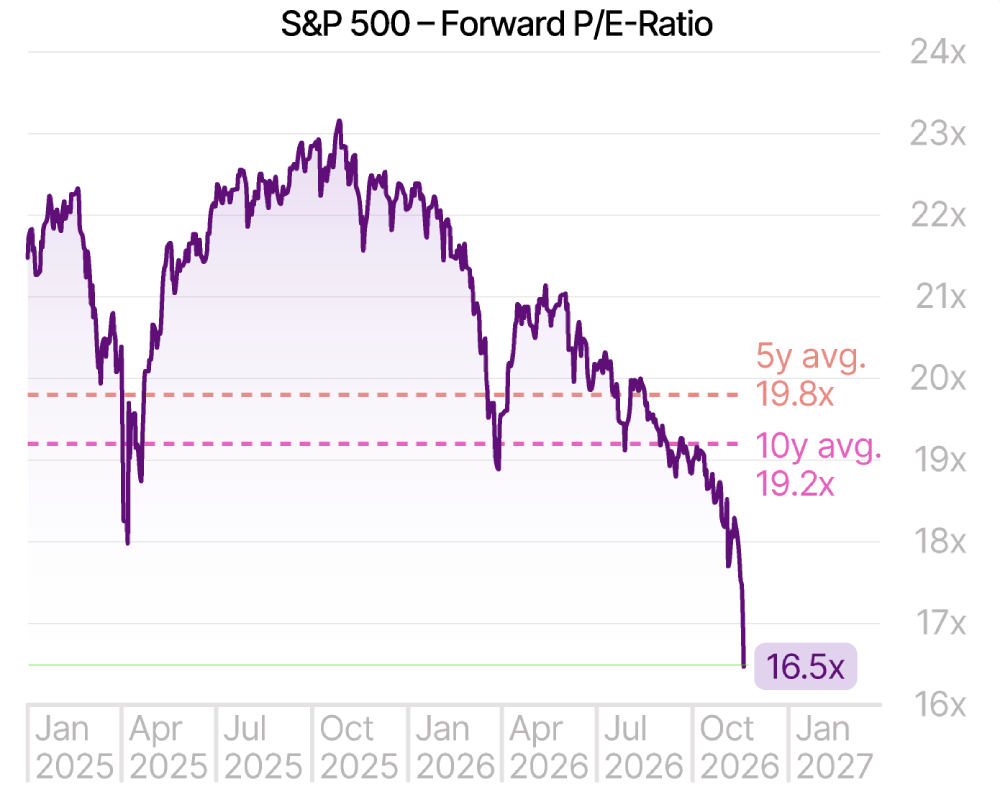
The S&P 500 declined more than 11% from its October peak to Nov. 20, as the AI selloff accelerated following Jensen Huang's brief resignation from Nvidia.
Although stocks somewhat rebounded yesterday, the S&P 500 is already in a "bear market" from a valuation perspective.
Wall Street's valuation collapse
Following last week's selloff, the S&P 500's forward price-to-earnings (P/E) ratio has plunged to 16.5, its lowest level since early 2023, according to Duality Research.
For comparison, the ratio was above 23 in October 2025, meaning investors were paying more than $23 for every dollar in expected corporate profits.
"It's a correction in stocks, but a bear market in valuation," wrote Mike Zaccardi, a Chartered Financial Analyst.
The S&P 500 now trades well below its five-year average forward P/E of 19.8 and its 10-year average of 19.1, according to FactSet.
Earnings forecasts are also rising
Perhaps ironically, earnings forecasts have also helped bring valuations down.
FactSet data shows that the S&P 500 fell 6.2% between Sept. 30 and Nov. 20, while analysts raised their forward earnings estimates by 4.4%.
AI stocks have undergone an even bigger valuation reset. According to Citadel Securities, semiconductor stocks' forward P/E ratios fell 35% between June 30 and Nov. 3, even as forward earnings estimates rose 30%.
Across the S&P 500, earnings are on track to grow 32.9% year over year in the third quarter, which would mark the third consecutive quarter of growth above 25%, according to FactSet.
📌 Bottom line: The S&P 500 is trading at valuations last seen during the recovery from the 2022 bear market, even though corporate profits continue to grow.
November’s official inflation could surprise the Fed
The Fed is preparing to raise interest rates again in December after months of rebounding inflation. But alternative data suggest consumer prices may have stalled in November, complicating the case for another hike.
November inflation could come in at zero
Bloomberg Economics' alternative-data model is tracking 0% CPI inflation for November, according to chief U.S. economist Anna Wong.
If the forecast holds, it would mark a U-turn from October, when consumer prices rose 0.4%, and annual inflation was estimated to be near 4%.
Falling commodity prices could help explain the slowdown. A Nov. 20 report from the Asian Development Bank highlighted a major drop in global commodity prices over the preceding 30 days:
- Broad commodity index: -12.4%
- Brent crude: -21.2%
- WTI crude: -19.7%
- Copper: -13.3%
- Sugar: -11.9%
- Palm oil: -9.8%
Investors are expecting less inflation, too
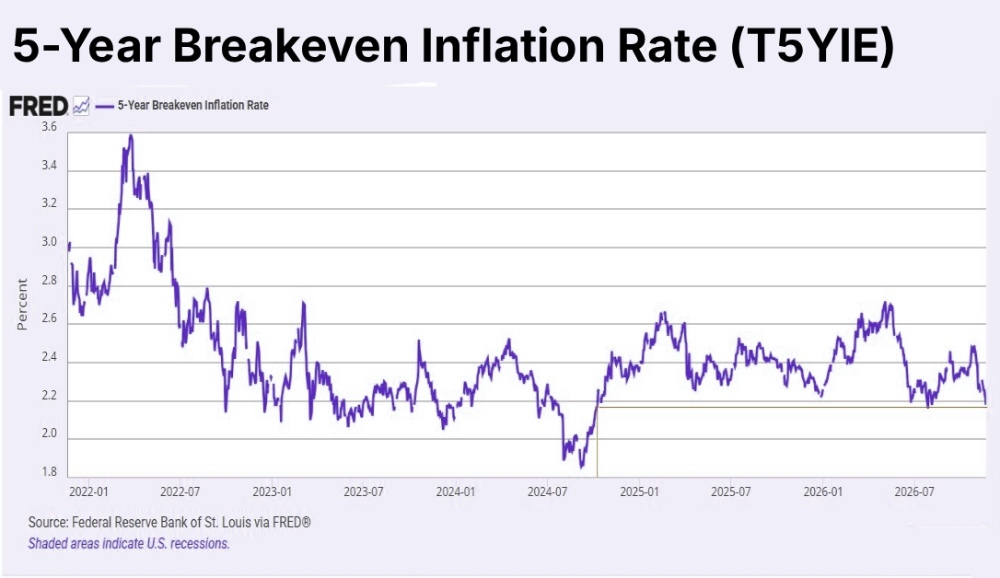
Inflation expectations on Wall Street also appear to be cooling.
The five-year breakeven inflation rate, a measure of investors' inflation expectations, fell to 2.18% on Nov. 20, approaching its lowest level in two years, according to data from the St. Louis Fed. Its decline suggests investors are becoming less worried about future price increases.
📌 Bottom line: Fed Governor Christopher Waller has called for a half-percentage-point rate hike in December, but the next CPI report could challenge his argument. A flat November reading would give policymakers reason to reconsider another hike.