World's most expensive Ctrl+Z?

Morning Observers,
Is this a peace deal or just the world’s most expensive Ctrl+Z?
The U.S. and Iran say they’ve reached an interim agreement to end the war and reopen the Strait of Hormuz, but the real question is whether this is a breakthrough or just a very expensive reset.
For now, this is exactly the headline markets wanted. Hormuz handles a fifth of global oil flows, so reopening it takes the scariest energy-shock scenario off the table.
The catch is that nothing is actually signed yet.
The formal signing is expected on Friday.
There are still four full days for someone to bomb something, walk something back, redefine what “all fronts” means, or discover that both sides agreed to completely different versions of the same deal.
Even if the deal gets signed on Friday, the main achievement is reopening the Strait of Hormuz, a waterway that was open before the war started.
The bigger issues, like Iran’s nuclear program, sanctions relief, frozen assets, Lebanon, and Israel, are getting pushed into a 60-day negotiation window.
That’s the part of this deal that markets are not trading this morning.
— Dan Runkevicius, Editor
|
Five things to know before opening bell
🚀 SpaceX valuation tops $2.2 trillion
SpaceX delivered the biggest IPO debut in market history, attracting more than $350 billion and briefly pushing its market value above $2.2 trillion. The stock surged as much as 31% above its $135 offering price before closing up 19% at $160.95, cementing the company’s place among the world’s ten most valuable publicly traded businesses.
🛰️ Space stocks come crashing back down to earth
SpaceX’s blockbuster debut pulled money away from the rest of the sector, sending space stocks lower on Friday. Rocket Lab, Redwire, AST SpaceMobile, Firefly Aerospace, and Virgin Galactic fell between 11% and 32% as investors rotated into the industry’s newest heavyweight. The Procure Space ETF, which had rallied nearly 38% this year, finished the session down 7%.
🛢️ Oil falls on renewed hopes of a U.S.-Iran peace deal
Oil prices dropped after the U.S. and Iran reached an interim deal, raising hopes that the Strait of Hormuz could soon reopen to normal shipping. Brent crude and WTI fell to around $80 a barrel. Now all eyes are on Friday when the official signing is expected.
🛒 Consumer sentiment rebounds from record lows
Consumer confidence improved for the first time in four months, with the University of Michigan’s June sentiment index rising 9% from May’s record low to 48.9, comfortably ahead of expectations. Lower gasoline prices appear to be providing some relief for households, although sentiment remains well below year-ago levels, suggesting consumers are still approaching discretionary spending with caution.
🏦 Private credit faces another stress test
BlackRock is the latest private credit giant to get a little reminder that “private” does not mean investors never want their money back. Investors asked to redeem 13.3% of shares from its flagship private credit fund in the second quarter, but BlackRock said it will repurchase only 5% of the requested amount. This is yet another sign that investors are getting more cautious toward one of Wall Street’s hottest asset classes.
SpaceX just joined Wall Street’s most dangerous club
The SpaceX IPO is one of the most FOMO-inducing events in market history. But history suggests it takes a very long time, if ever, for the biggest IPOs to actually reward investors.
And when a company is valued at roughly 105x trailing revenue, even a small reset in expectations can translate into a very large crash in the stock price.
The bigger the IPO, the bigger the drawdown
There’s a common belief that mega-cap IPOs are somehow safer because they’re already proven businesses. History suggests the opposite.
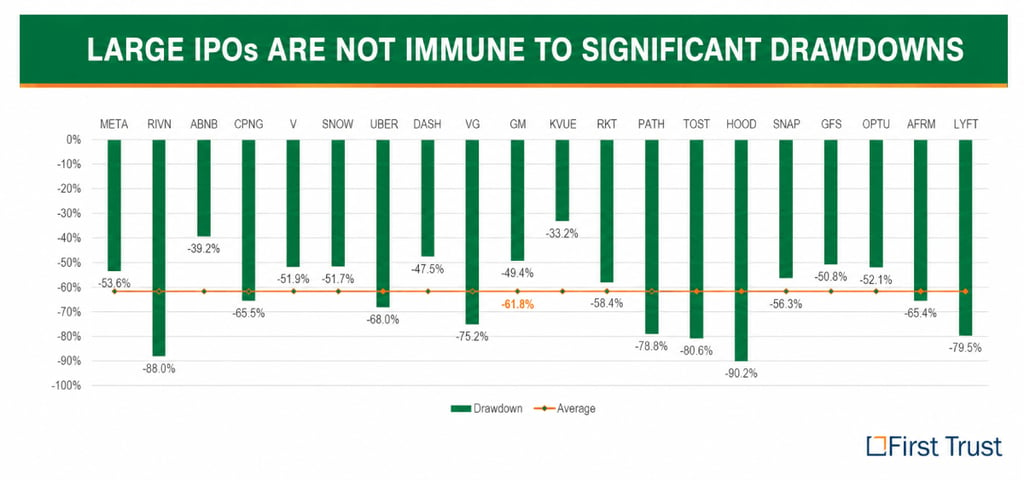
According to First Trust, the 20 largest U.S. IPOs since 2006 suffered an average maximum drawdown of 61.8% during their first year.
Meta Platforms dropped 54% before becoming one of the decade’s greatest investments. Uber fell nearly 70% and spent years underwater. Rivian dropped 88% and Robinhood 80%.
The pattern isn’t a coincidence.Massive IPOs often come to market at premium valuations, with a lot of hype and momentum trading. That sets companies up for painful corrections when reality falls short of or merely meets expectations.
When the IPO is the exit
SpaceX spent more than two decades as a private company, allowing venture capital firms and insiders to capture almost all of its explosive growth before public investors ever had a shot.
Valor Equity’s roughly $500 million investment grew into a stake worth more than $80 billion as of Friday’s close, according to PitchBook data.
Founders Fund built a position now worth more than $50 billion. Sequoia and Andreessen Horowitz are sitting on gains of between $10 billion and $20 billion after investing heavily before the IPO.
To be clear, Musk has a long track record of breaking patterns and making things happen that looked impossible to skeptics. But there’s only so much magic you can compound when the starting base is already $2.2 trillion.
📌 Bottom line: That doesn’t mean SpaceX can’t become a great long-term investment. It's just that public investors may be buying into the story after the easiest money has already been made.
AI is stealing the stock market’s biggest buyer
For years, corporate buybacks have been one of the strongest sources of demand for U.S. stocks. That source of demand is now shrinking as companies plow hundreds of billions of dollars into AI capex.
Buybacks are becoming data centers
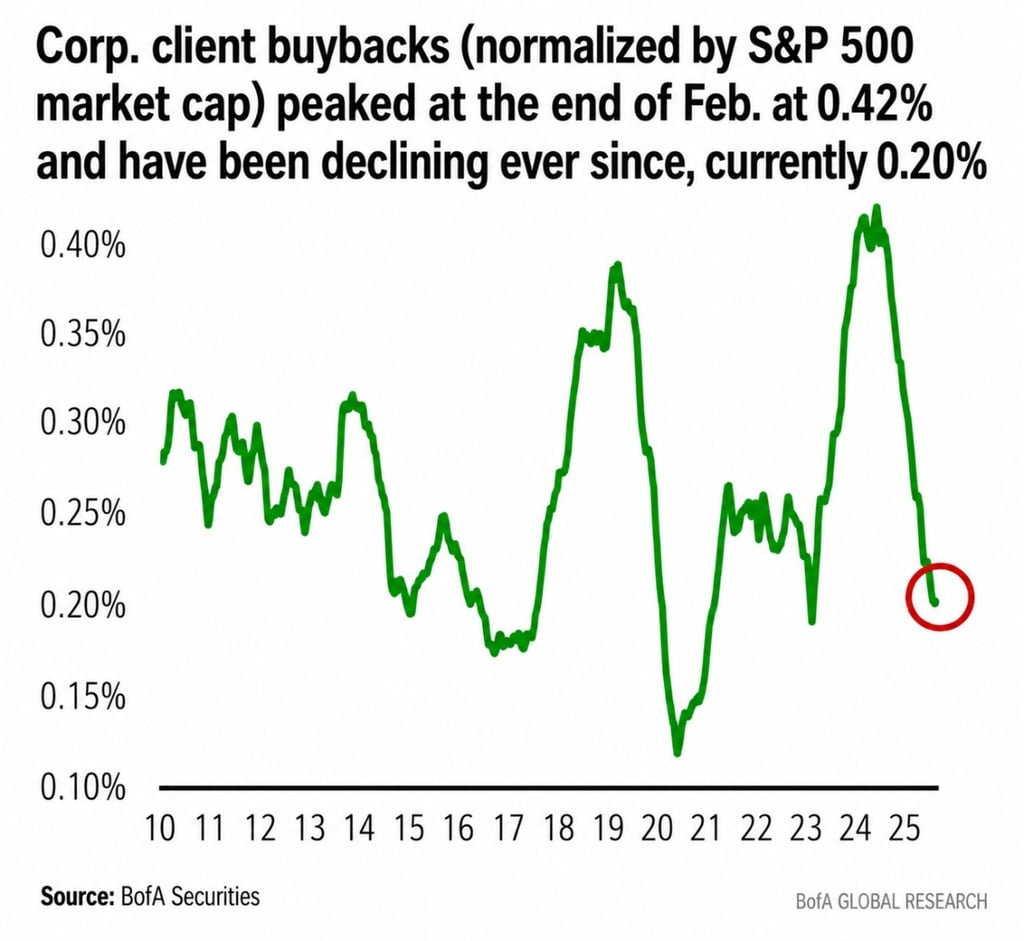
According to Bank of America data, corporate client buybacks have fallen to 0.20% of the S&P 500’s market cap, down more than 50% from the recent peak of 0.42%.
Google parent Alphabet offers a striking example. After spending more than $40 billion annually repurchasing its own stock for five consecutive years, the company has effectively abandoned buybacks.
Like other Big Tech companies, Alphabet is betting that AI will generate a better return than buying back its own stock.
Instead of retiring shares, companies are building data centers, buying chips, securing electricity, and expanding cloud capacity. Alphabet, Microsoft, Amazon, and Meta are expected to spend more than $650 billion on AI infrastructure this year alone.
A proven return versus a promised one
Buybacks are one of the few corporate investments with an immediate and measurable effect: they reduce share count, increase earnings per share, and have historically supported stock prices.
S&P 500 companies repurchased $942.5 billion of stock in 2024, and the rolling 12-month total reached a record $1.02 trillion by September 2025, according to S&P Global.
AI infrastructure works in reverse. Cash leaves the balance sheet today, while any payoff may take years to arrive — and only if demand ultimately justifies the industry’s enormous capacity buildout.
📌 Bottom line: Buybacks have been one of the biggest forces holding up U.S. stocks for years. If that money keeps getting redirected into AI data centers, the market will need someone else to step in, or earnings will have to do a lot more heavy lifting.