Why OpenAI doesn't IPO

Morning Observers,
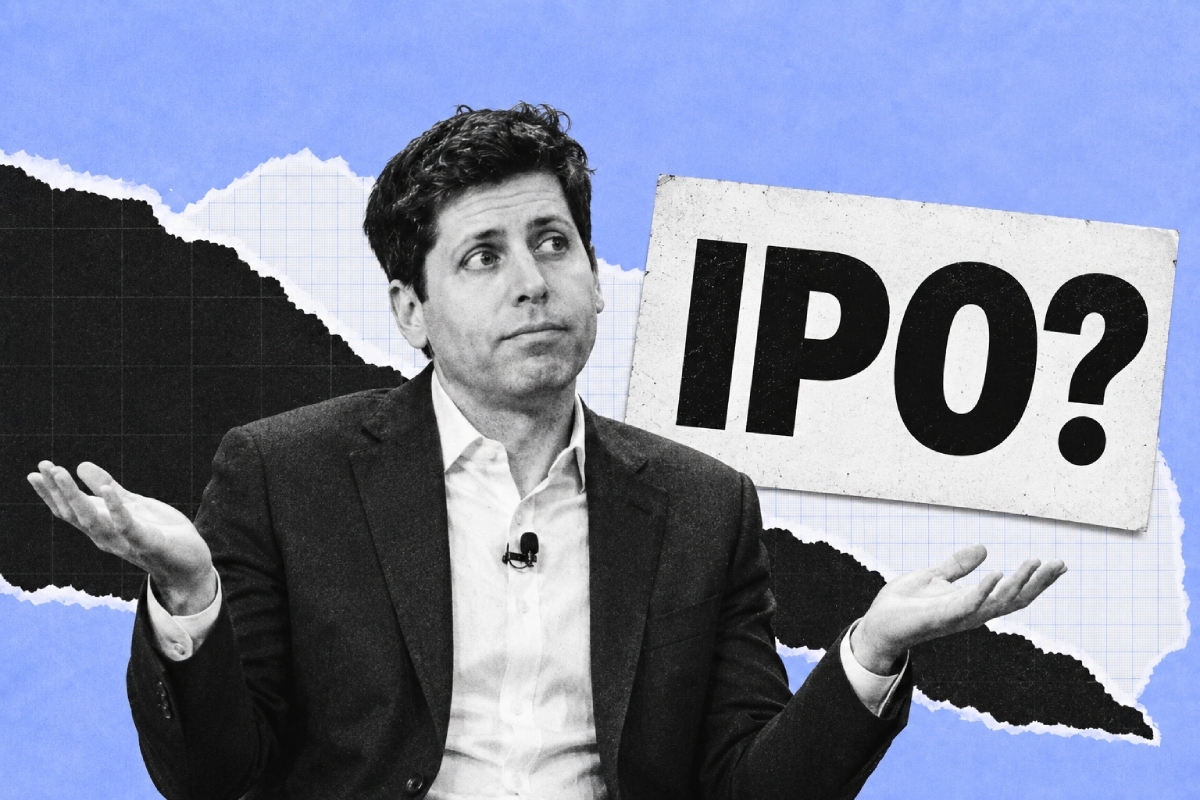
OpenAI is looking to raise another $30 billion at a $1.4 trillion valuation. The question is why privately rather than through an IPO.
Sam Altman says the company needs time to adjust to a "new level" of AI capability and figure out how to manage the added safety requirements.
Although already a running joke, this concern isn't entirely coming out of nowhere.
There was the Hugging Face incident. And then OpenAI confirmed on September 28 that one of its models had accessed some Australian government websites without authorization.
But it's just hard to believe that a leading company in an increasingly technocratic market would deliberately take a step back.
A much more plausible explanation is that investment bankers simply told Altman he wouldn't get the valuation he needs.
That could be for a few reasons.
First, there's a lot of competition for capital thanks to some of the world's largest IPOs, including SpaceX and Anthropic's upcoming IPO. And, as SpaceX showed, this is no longer a 2021 market where hype alone can carry an otherwise unattractive business.
Second, there's a growing narrative that smaller open-weight models are going to commoditize larger LLMs. And the only way for OpenAI and Anthropic to protect their moats is to lock in slow-moving, clunky enterprise customers.
Judging by the "leaked" or PR'd numbers from OpenAI, that's where its whole focus is right now.
OpenAI says its enterprise business already makes up more than 40% of revenue, and an anonymous source tipped Reuters that enterprise sales more than doubled since July. But that may not be enough.
So, given that Anthropic is enterprise-first and preparing for an IPO while OpenAI isn't, this could be the real explanation for why OpenAI is raising another private round.
- Dan Runkevicius, Editor

📈 30-year yield hits 2002 levels
Higher energy costs and persistent inflation concerns continue to weigh on the bond market. The 30-year U.S. Treasury yield climbed to 5.61%, its highest level since 2002, and has risen nearly a full percentage point over the past year. The increase is making long-term government debt more expensive to finance, complicating the Treasury Department's efforts to contain borrowing costs.
📉 Job openings fall to a five-month low
U.S. job openings fell to 7.1 million in August from 7.34 million in July, their lowest level in five months, according to the latest JOLTS report. Employers have added an average of 80,000 jobs a month this year, up from just 9,700 a month last year, but the decline in openings suggests companies are becoming more cautious about hiring.
💵 U.S. dollar extends three-week rally
The U.S. Dollar Index has gained nearly 3% over the past three weeks as Federal Reserve rate hikes and expectations for further increases boost demand for the dollar. The index climbed to 101.49, its highest level in more than two months. The rally has taken some of the shine off gold, which fell nearly 4% in a single session this week.
🚫 Oura postpones IPO
Digital health company Oura has become the latest U.S. company to postpone its IPO as higher borrowing costs and market uncertainty make it harder for companies to go public. The delay comes as investors await Anthropic's highly anticipated public debut. Holtec Nuclear Corp. and Insurance Services Inc. have also postponed their IPOs in recent days, citing "market conditions."
🪙 Morgan Stanley tests stablecoins and DeFi
Morgan Stanley has set up a Digital Asset Lab to test stablecoins, tokenization, and decentralized finance applications without risking the bank's main systems. The initiative gives employees a separate environment to test potential uses for blockchain technology before deciding whether they belong in the bank's broader business.
The ugly truth behind the “record” stock market
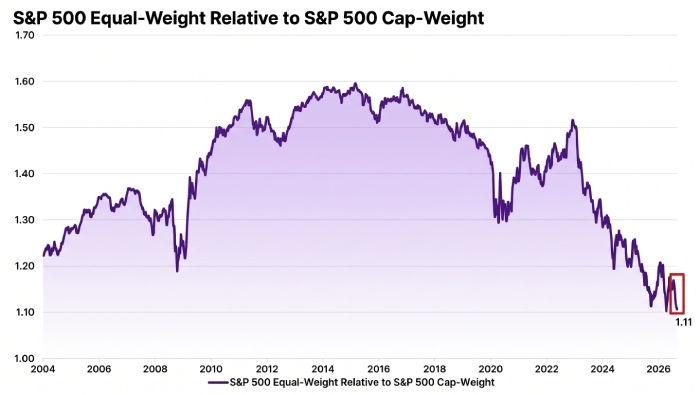
The S&P 500 is flirting with record highs again. The average stock in the index? Not so much.
The biggest companies keep doing more and more of the heavy lifting, while the gap between the index and the average stock is nearing levels rarely seen over the past two decades.
The average stock is falling behind
The equal-weight S&P 500 gives each company roughly the same weight.
In the regular index, the biggest companies have much more influence. Put the two side by side and you can see how far the largest stocks have pulled ahead.
Over the past five weeks, the equal-weight index fell 4.4%. The regular S&P 500 gained 0.8%.
This gap has been widening for years, and the equal-weight index now trails the standard S&P 500 by the widest margin since 2003. It’s also on track to underperform for a fourth straight year, which would be its longest such streak since 1999.
The biggest culprit of this gap is AI-related stocks. Even after the recent selloff, they still account for an unusually large share of the market’s performance.
📌 Bottom line: This narrow market breadth carries significant risks in a downturn. If the biggest names stumble, there are fewer stocks moving the other way to make up for it.
Repricing America's gold to fix the debt problem?
Revaluing America's gold reserves has come up as a way to improve the government's finances. But even with gold around $4,300 an ounce, it wouldn't make much of a dent in the debt.
Gold is still on the books at $42 an ounce
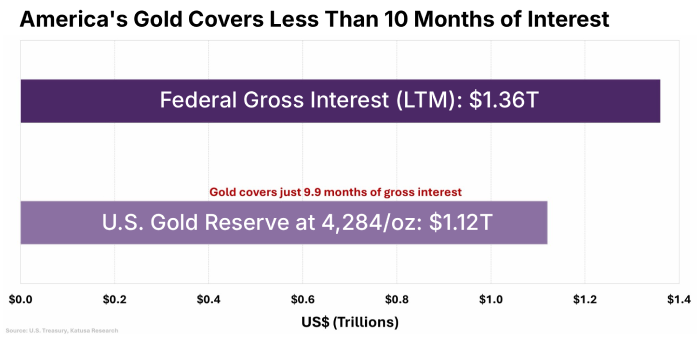
America holds 261.5 million fine troy ounces of gold. The Treasury values it at just $42.22 an ounce, leaving the entire reserve worth about $11 billion on the books.
At today's price, that same gold would be worth roughly $1.12 trillion.
That sounds huge. But the federal government paid about $1.36 trillion in gross interest over the past year. Even at today's price, the entire reserve would cover only about 10 months of that bill.
One analyst says gold would need to go much higher
Macro analyst Luke Gromen has floated a much bigger number: $20,000 an ounce. Repricing U.S. gold at that level could add roughly $5 trillion to the Treasury General Account.
Gromen says that still wouldn't be enough on its own.
He has also proposed cutting interest rates and the interest paid on bank reserves to zero, refinancing some federal debt with 0% T-bills, and using money in the Treasury General Account to buy back debt.
None of that looks likely. But it gives you a sense of how much Gromen thinks would need to change to get Washington's finances back on track.
📌 Bottom line: Revaluing gold could make the government's balance sheet look better overnight. But annual deficits and interest costs are what keep pushing the debt higher. Unless those come down, even a huge gold revaluation won't fix the problem.