Why Meta earnings matter so much

Morning Observers,
You've probably seen the headlines already.
Yes. Meta beat on both the top and bottom line. And yes, all the attention went to Meta's first negative free cash flow since 2012 because of, you've guessed it, AI spending.
But there were quite a few takeaways that give us much more context on where Meta and AI in general are heading.
For starters, we have the first real insight into the vision for Muse. And contrary to a lot of speculation, it's not Meta's answer to Claude.
Quite the opposite, they are building an agentic equivalent of Amazon. "The most common use case for Muse is shopping," Zuck said. In fact, 1 in 4 Muse users are already using it for shopping, with an average purchase size above $200.
This business direction is also evident in the fact that Meta is developing an agentic protocol with companies like Walmart, Stripe, and Shopify.
Zuck said Muse will be free for regular users, while Meta earns a commission on transactions. They expect this monetization model to generate more profit per user than Facebook, Instagram, or any other app.
The other part of Muse will focus on big enterprise clients to monetize "high-margin inference demand."
This just shows that Meta has learned the lesson from OpenAI and Anthropic on how expensive it is to run a general-purpose LLM without built-in commerce or enterprise applications.
That being said, Meta still has no idea when it will earn an ROI on all that capex, and its compute costs are going through the roof because of Muse agents. Even Zuck himself admitted Muse costs are "so high" that they can't roll it out globally yet.
On the flip side, they are confident they can make it 10x more efficient as soon as next year by simply performing some tasks with simpler models.
So lots of potential in the long run, even more costs in the short run. What's the plan in the meantime?
The short answer is to fund the growth by issuing stock. Meta announced a new class of non-voting shares that it said could help pay for acquisitions and other expenses without Zuck losing control of the company.
This follows Alphabet's stock issuance earlier this year, which means debt is becoming too expensive. And hyperscalers are likely to fund their AI growth through dilution moving forward.
- Dan Runkevicius, Editor

🚀 SpaceX results lift tech stocks
SpaceX stock surged more than 10% after Elon Musk’s rocket company reported stronger-than-expected results, helping boost AI-related companies. The Philadelphia Semiconductor Index gained 2%, its second advance in three sessions, after suffering its longest losing streak since 2008.
🤝 Musk weighs Tesla-SpaceX merger
Elon Musk said special committees have been formed to explore a potential merger between his two multitrillion-dollar companies, Tesla and SpaceX. He argued that there’s “a lot of merit to combining the companies,” citing their overlapping ambitions in artificial intelligence. However, he acknowledged that any deal would require shareholder approval.
🫧 Ken Griffin is the latest billionaire to warn of an AI bubble
Citadel founder Ken Griffin believes the market is “almost certainly” experiencing an AI bubble, despite encouraging results from SpaceX and Super Micro Computer this week. Griffin said corporate America has struggled to generate consistent returns from AI investments while paying higher bills to OpenAI and Anthropic.
📉 Netflix stock extends slide
A week after announcing mass layoffs, Netflix reported its slowest revenue growth in three years and forecast a fourth consecutive quarter of slowing sales growth. The stock fell nearly 5% following the results, extending its decline this year to nearly 31% and leaving it well behind the S&P 500.
📊 Two companies drive S&P 500 earnings growth
Nvidia and Micron are expected to account for 36% of the S&P 500’s third-quarter earnings growth, according to Citadel Securities and EventVestor data. Meanwhile, the 490 companies outside the index’s top 10 are projected to report an 11% year-over-year earnings decline, underscoring the widening gap between AI-driven names and the rest of the market.
Thanksgiving airfare is up 31%, but airlines have a bigger problem
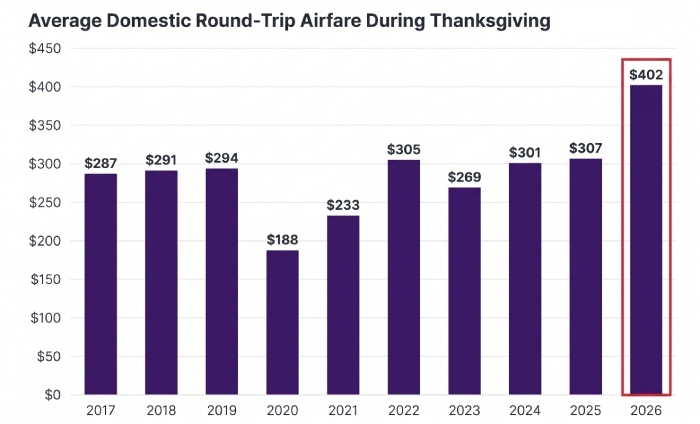
Thanksgiving flights are getting more expensive for Americans, but airlines charging record fares face even bigger bills because of fuel costs.
A $100 increase in one year
Average domestic round-trip fares for Thanksgiving have climbed to $402, up 31% from $307 last year, according to Hopper data cited by The Wall Street Journal/
It's the third consecutive annual increase, bringing the total rise since 2023 to $133, or 49%.
For comparison, Thanksgiving tickets averaged just $188 in 2020, when pandemic restrictions devastated air travel. Christmas fares are also up 23% from a year ago.
Airlines' $4 billion jet fuel problem
Jet fuel prices have surged 91% since the Iran war began, reaching $4.50 per gallon. The increase is taking a substantial bite out of airline earnings, even as carriers charge more for tickets.
United Airlines offers a striking example. Its third-quarter revenue rose 17% to $17.9 billion, but fuel expenses jumped 61% to $4.84 billion, up $1.84 billion from a year earlier.
Delta faced a similar problem. Its third-quarter revenue increased 21% to $20.2 billion, but fuel expenses surged 69% to $4.35 billion. Despite the revenue increase, net income fell 47% to $756 million.
Together, the two airlines spent roughly $9.2 billion on fuel in just three months, up $3.6 billion from a year earlier.
📌 Bottom line: The surge in fuel costs helps explain why airline stocks have struggled despite rising fares and revenues. The U.S. Global Jets ETF (JETS) is down nearly 7% this year, badly trailing the S&P 500.
Former Google CEO has a lot of skin in the AI game
Former Google CEO Eric Schmidt may have made one of the most lucrative investments in Silicon Valley history. His early bet on Anthropic could soon be worth $20 billion.
A 4,300-fold increase in valuation
Schmidt owns roughly 1% of Anthropic after investing in the startup in 2021, when it was valued at just $461 million.
Last week, investors suggested Anthropic could command a valuation of $1.8 trillion to $2 trillion. At the upper end, the company would be worth more than 4,300 times its Series A valuation.
Schmidt's stake alone would be worth about $20 billion, potentially lifting his personal fortune to nearly $80 billion, an increase of roughly one-third.
The staggering cost of Anthropic's growth
Anthropic's valuation has grown far faster than its ability to generate profits.
According to its draft IPO prospectus, the company reported a staggering $80.7 billion loss in the first half of 2026, although $72 billion came from a noncash accounting charge.
It also spent nearly $9 billion on computing infrastructure and has committed to spending at least $518 billion over the next decade.
Meanwhile, quarterly revenue reached $16.8 billion, up 45% from the previous quarter.
📌 Bottom line: Anthropic is expected to go public in mid-November, potentially before Thanksgiving. The debut of the first pure-play AI company will be a long-awaited test of how seriously investors take warnings of an AI bubble.