"When will the AI bubble pop?"


Morning Observers,
The price investors pay for each dollar of S&P 500 earnings is down ~13% year to date. That's this year alone.
If you go back to the end of 2025 when valuations peaked, the drop in multiples is close to 20%.
That means that from a pure valuation perspective, the market is on the brink of a bear market this year. And we're effectively back to pre-Covid “prices.”
So what gives?
Mostly, tech stocks. They were among the hardest hit by this multiple compression. Since peaking at the end of 2025, tech stocks have lost nearly 39% of their value!
Nvidia is an even more extreme example. Today the world's most important AI company is trading at a valuation more typical of an average utility company.
It also hasn't been this cheap since 2016, before every major GPU crunch, including two Bitcoin mega rallies and ChatGPT's launch.
There are a lot of reasons for this tech sell-off: insane capex spending, little proof of ROI, concentration risk, and rising rates.
But above all of this — and this is my personal speculation — the dot-com bust is so ingrained in our brains through personal experience or media fearmongering that investors are extra careful.
Does that mean we're out of the woods? Not necessarily.
For starters, the S&P 500 may be in one of the most profitable years in a few decades, but those earnings are heavily concentrated in a few companies.
There are also one-off boosts from unrealized investment gains, while federal support may be helping some companies.
Then valuation benchmarks typically use expected earnings, and those estimates always overshoot before a major downturn. Given all the creative financing and the concentration of earnings, the overshoot this time could be much, much bigger.
Either way, internet stocks kept getting more expensive throughout the dot-com boom right up until the bubble popped. And the fact that AI companies have already lost so much value without breaking the market is a positive sign.
A couple of small reality-check corrections could save the market from one giant dot-com-style unraveling.
- Dan Runkevicius, Editor

🪙 Bitcoin ETF daily inflows approach $1 billion
U.S. spot Bitcoin ETFs attracted $999 million on Monday, their largest daily inflow since October 2025 and ninth-largest since launching in January 2024. The inflows followed another $433 million on Friday despite the Senate’s failed CLARITY Act procedural vote last week.
💎 Diamond prices sink to a 25-year low
Natural diamond prices have fallen to their lowest level this century as lab-grown stones take a larger share of the market and demand for mined diamonds weakens. The average price of a 1-carat natural diamond fell to $4,200 in 2025 from about $6,000 in 2021, according to new data from BriteCo.
📈 Nasdaq 100 returns to record territory
The Nasdaq 100 returned to record territory for the first time since June as investors piled back into technology stocks, with Meta’s new Muse AI assistant adding to enthusiasm around AI. Falling oil prices have also helped, with Brent and WTI back below $100 a barrel amid signs that Middle East energy supplies could improve.
🤝 Trump doubles down on post-midterm Iran deal
Trump told the U.N. that he believes a deal with Iran could come after the November midterm elections, tying the timing of a possible agreement to a vote that could change control of Congress. Trump and Iranian President Masoud Pezeshkian are both in New York for the U.N. General Assembly, with several reports pointing to a possible meeting this week.
🤖 Ex-Anthropic researchers seek $5 billion valuation
Mirendil, an AI startup founded by former Anthropic researchers, is reportedly seeking a $5 billion valuation in a new funding round. The eye-popping figure shows how aggressively investors are still backing new AI companies, even as concerns grow over increasingly lofty valuations.
Oil is falling, but shipping costs have tripled
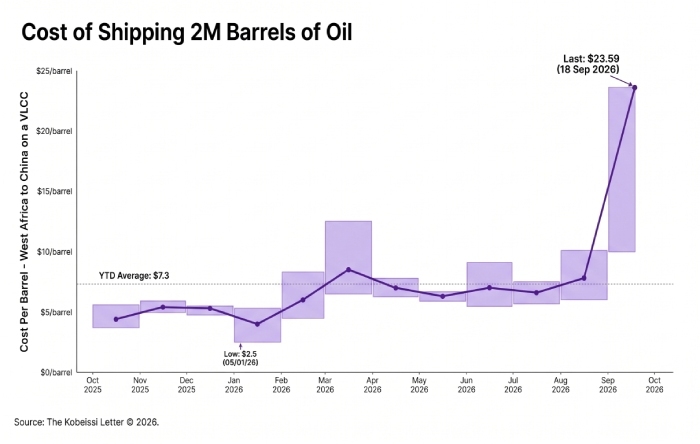
With U.N. meetings raising hopes of a breakthrough in Mideast peace talks, oil has fallen back below $100 a barrel. But the physical market is telling a different story.
The cost of shipping crude on a major route has more than tripled in two months, threatening to keep fuel costs higher even if the price of oil barrels keeps falling.
The $47 million trip
Shipping 2 million barrels of crude from West Africa to China now costs $23.59 per barrel, up from $6.50 in July and more than three times the 2026 average of $7.30.
At current rates, moving a single cargo costs about $47 million, compared with $13 million two months ago.
The route has become more important as Asian refiners turn to West Africa to replace disrupted Middle Eastern supply. The catch is that those barrels have much farther to travel, leaving refiners more vulnerable to soaring tanker rates.
Even the detours are getting hit
Saudi Arabia’s East-West pipeline provides one of the main ways to bypass the Strait of Hormuz, carrying crude across the country to the Red Sea.
But Houthi attacks have disrupted the route, while tankers continuing through the Red Sea still face risks around the Bab el-Mandeb Strait. The effects are also reaching refined fuels.
The EIA forecasts 1.3 billion barrels of cumulative oil supply losses this year, while U.S. distillate inventories are expected to fall below 100 million barrels and remain there through the end of 2026.
📌 Bottom line: Falling oil prices may not deliver the inflation relief investors are expecting if freight costs stay high.
Morgan Stanley: Large caps are the way to go after Fed hike
The Fed's first hike in years has investors worried that the economy is nearing the end of its current growth cycle. Morgan Stanley thinks those fears may be premature.
Strategist Mike Wilson believes the economy is in "mid-cycle" territory, leaving room for the bull market to continue. But the stocks driving the rally may be changing.
Big, profitable, and getting cheaper
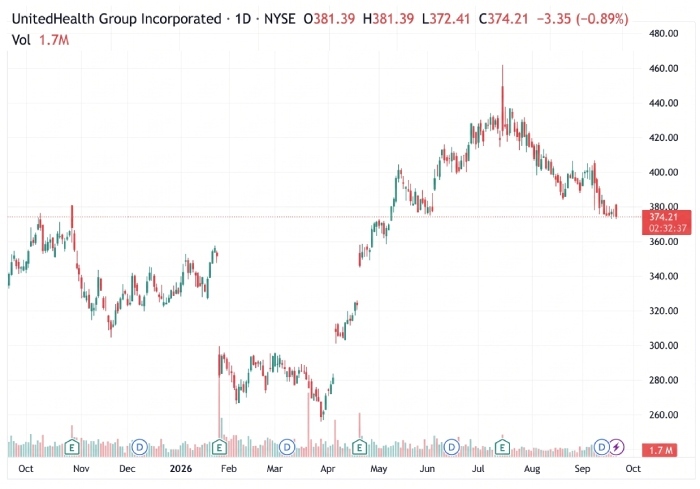
In a recent analyst note, Wilson identified 15 large-cap stocks that fit the bill, including Nvidia, Micron, and Apple, alongside beaten-down names such as UnitedHealth, ServiceNow, and Booking Holdings.
"Stick with large-cap quality stocks," Wilson wrote.
Morgan Stanley's criteria favor companies with improving earnings estimates, strong margins, and cash generation. Wilson sees the combination of rising profits and lower valuations as particularly attractive at this stage of the cycle.
Chip stocks take a back seat
While Wilson isn't calling an end to the chip rally, he sees other parts of the market catching up.
Healthcare, financials, and other technology stocks are among the areas Morgan Stanley now favors, after chips dominated much of the rally earlier this year.
Semiconductors have also lost some ground recently, with the Philadelphia Semiconductor Index down around 14% from its June record.
For Wilson, the pullback is another reason to look beyond the stocks that carried the market for much of the year.
📌 Bottom line: If Wilson is right, investors may need to look beyond the AI stocks that carried much of this year's rally.