When tariffs no longer bite



Morning Observers,
Not long ago, a new tariff announcement was enough to send markets into a tailspin.
This week, President Trump imposed 50% tariffs on Canadian hockey sticks, milk, alcohol, and other goods. Yet stocks barely reacted… even though the move reignited a politically charged trade dispute, with the White House accusing Canada of unfair treatment of U.S. cars, dairy, and alcohol.
The reason isn’t that tariffs have disappeared. It’s that markets increasingly view tariff headlines as political theater rather than an immediate economic shock.
According to Apollo Asset Management, the U.S. effective tariff rate — a trade-weighted average across all imports — has fallen from roughly 11% at its peak last fall to between 6% and 7% today. That reflects exemptions, trade deals, court rulings, and shifting import patterns, leaving the economy with a much smaller tariff burden than investors once feared.
The financial sting has also faded. Earlier this year, Washington refunded roughly $81 billion in tariffs after the Supreme Court ruled portions of the program unconstitutional. That reversal returned billions to importers and underscored just how much the tariff landscape has changed in a matter of months.
Tariffs remain central to the Trump administration’s agenda, but markets have largely stopped treating them as the dominant macro risk.
Unless new duties materially alter inflation, profit margins, or consumer spending, investors appear willing to tune them out. Earnings, AI spending, and the outlook for interest rates now carry far more weight.
Let’s get to it.
— Sam Bourgi, Interim Editor
|
|


📈 TSMC plans price hikes
Taiwan Semiconductor Manufacturing Co., the world’s largest contract chipmaker, is expected to raise prices for some services by up to 10% starting next year, according to reports. The move could help offset rising costs and points to continued demand for advanced chip manufacturing. It also suggests leading chipmakers still have the pricing power to pass higher costs on to customers.
🤖 The AI trade is becoming more selective
U.S. chip stocks surged on Tuesday, with the Philadelphia Semiconductor Index climbing more than 5% for its best day in over a month. But investors are becoming more discerning about which AI companies they back. UBS Asset Management’s Rob Haworth said the days of broad-based AI gains may be fading, with future performance likely to depend more on earnings growth than AI narratives alone.
💰 Earnings season is off to a strong start
Second-quarter earnings are off to an encouraging start. More than 90% of S&P 500 companies that have reported so far have beaten profit estimates, according to Bloomberg data. On Tuesday, 3M, General Motors, and Hasbro all topped expectations, adding to signs that corporate profits remain resilient despite rising energy costs and shaky consumer spending.
🇨🇳 Chinese AI models are drawing more attention
Executives at OpenAI and Anthropic have warned that low-cost Chinese AI models could pose security concerns, even as their adoption continues to grow among U.S. companies. Their lower prices are prompting questions about how well premium AI providers can maintain their lead, while policymakers continue to debate whether additional restrictions on Chinese AI companies are needed.
🏦 Schwab says the trading boom is here to stay
After JPMorgan Chase and Goldman Sachs reported record earnings, Charles Schwab CEO Rick Wurster said elevated trading activity reflects a lasting shift in investor behavior rather than a temporary trend. “I think you’ve seen a structural shift in people wanting to be engaged and wanting to invest,” Wurster told analysts after Schwab also posted a record quarter, suggesting active markets are likely to remain a key driver for Wall Street.
Did semiconductors have the shortest bear market ever?
Semiconductor stocks officially entered a bear market last week.
The Philadelphia Semiconductor Index (SOX) briefly fell more than 20% from its recent high, meeting Wall Street’s technical definition of a bear market. But beneath the surface, investors were doing the exact opposite of what bear markets usually inspire: buying aggressively.
Investors bought the bear market
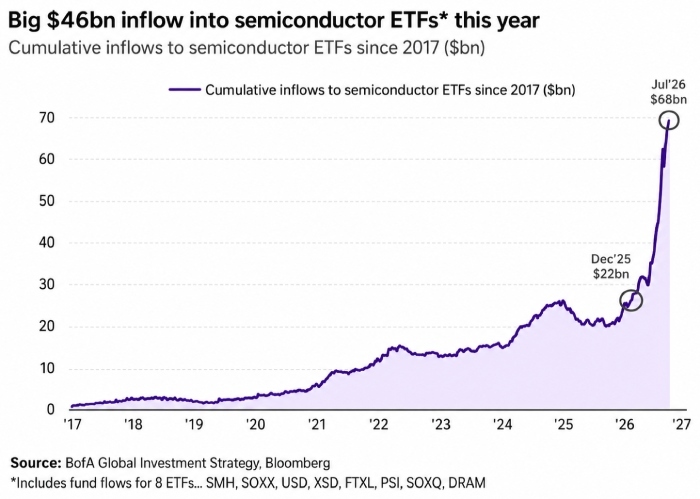
U.S. semiconductor ETFs have attracted a record $46 billion in inflows this year, according to new data from BofA Global Research. That’s already more than the combined inflows recorded between 2017 and 2025.
Even more striking, investors added another $2.3 billion last week as headlines declared the sector had turned bearish. Cumulative inflows have now climbed to $68 billion, putting 2026 on pace for the strongest year ever for semiconductor ETF demand.
For many investors, a 20% correction wasn’t a reason to sell… it was an opportunity to increase their exposure, even after SOX’s 110% rally over the past year.
Now comes the real test
The next week could determine whether that optimism holds.
Alphabet, Microsoft, Meta Platforms, and Amazon all report earnings over the next week, and analysts say one metric matters more than most: AI capital spending.
“What we definitely need to see continue [...] is hyperscalers’ capex,” said Seema Shah, chief global strategist at Principal Asset Management. “Their earnings need to be strong.”
📌 Bottom line: A technical bear market usually sends investors running, but this one attracted massive inflows instead. The next round of earnings will show whether Big Tech is still spending enough to justify that optimism.
Whatever happened to sector rotation?
For decades, investors could count on one thing: no sector stays on top forever. Eventually, leadership rotates, valuations cool, and money flows somewhere else.
Technology wasn’t supposed to dominate for this long. Yet every time investors expected the cycle to turn, the sector found another reason to stay in front.
Now, it’s rewriting one of the stock market’s oldest rules.
The rotation that never came
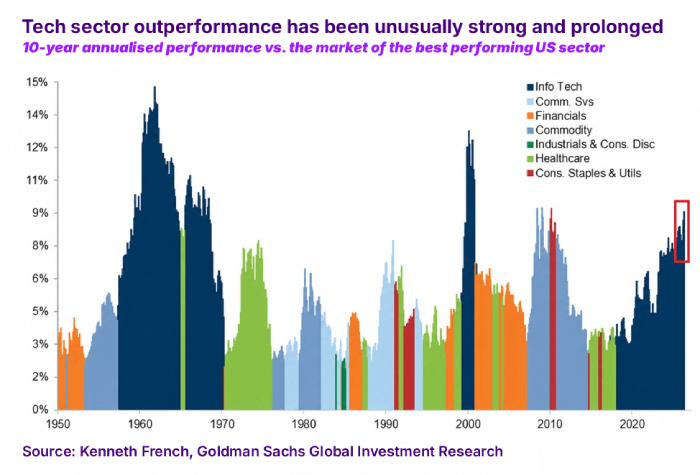
According to Kenneth French and Goldman Sachs, information technology has been the best-performing U.S. sector for seven consecutive years… the longest streak since the 1960s.
Its 10-year annualized return has climbed to roughly 9%, inching closer to the dot-com era’s 13%.
Normally, that kind of outperformance marks the late stages of a market cycle. Instead, tech has simply extended its lead.
Every time investors expected leadership to rotate elsewhere, technology found another earnings engine — from smartphones to cloud computing to AI.
Is this cycle different?
Technology is no longer just another sector. For decades, it competed for investment dollars alongside banks, energy producers, and manufacturers. Today, it increasingly underpins all of them.
That helps explain why information technology has reached a record 39% of the S&P 500 and why its influence extends well beyond that weighting, as nearly every sector is becoming a buyer of technology.
📌 Bottom line: If AI proves to be another extension of technology’s earnings cycle rather than its peak, owning “the next sector” could become a far less effective strategy than identifying the next wave within tech itself.