Was this a "forced" hike?

Morning Observers,
When Warsh took the reins of the Fed, he set out to completely reform the Fed and the way it conducts monetary policy.
In fact, he appointed a task force for basically every pillar of the Fed's policy:
- Balance-sheet management
- Communication/forward guidance
- The data the Fed relies on
- Productivity and jobs
- Most important of all, how inflation is measured
On the last one, he argued that the current inflation models are outdated in today's economy, and that everything from how data is sourced to how it's modeled should be rethought.
That obviously stirred up a lot of speculation. But in response to nearly every question during his first press conference in June, the answer was some combination of "no forward guidance" and "we've got a task force for that."
Fast-forward to July and then to yesterday. Treasury yields spiked, and Warsh suddenly became very straightforward.
At July’s meeting, he glossed over his rethinking of how inflation should be measured and returned to a hard 2% target. "There's only a target, and it's 2%."
He also started tossing out the Fed's textbook inflation measures: CPI, PPI, and PCE.
Another sign that Warsh may have been forced to hike is that neither the economic data nor the Fed's own projections have materially changed since he took over.
Back in June, the FOMC was coming off five years of above-target inflation. And Warsh himself admitted this:
"For more than five years, inflation has been running above target. The plain fact is that inflation is too high and has been for too long."
In Warsh's own words, productivity and economic growth "looked strong," just as they did yesterday. And the FOMC's median inflation projections for the rest of the year were nearly identical to yesterday's projections.
Yet, the Fed didn't budge on rates.
And whenever someone from the press challenged him on that, the answer was blunt: "I've got nothing more to say than the statement itself"; "We've got a task force for that."
Even though there's still not much information about those task forces, what we do know is that the Warsh didn't wait for their findings and hiked yesterday.
So whatever the real intention behind this reform is, the bond market may have really forced his hand on this one.
- Dan Runkevicius, Editor

📈 Fed hikes rates for the first time under Warsh
The Fed unanimously raised interest rates by 25 basis points, lifting its benchmark range to 3.75%-4% in the first hike under Chair Kevin Warsh. The move follows Warsh's Jackson Hole warning that inflation was proving harder to contain, with higher energy prices rippling through the economy. Fed officials also expect another quarter-point hike before the end of the year.
📉 Yardeni joins S&P 500 cuts
Longtime Wall Street bull Ed Yardeni has lowered his year-end S&P 500 target to 7,900 from 8,400 as rising bond yields make him more cautious about the next three to six months. Yardeni still expects the economy to avoid a recession, but the recent jump in yields has increased the risk of a downturn.
🇨🇦 Canada gets an unprecedented EU offer
Canada could become the European Union's first "associate member" under a proposal unveiled Wednesday by European Commission President Ursula von der Leyen. The offer comes as Prime Minister Mark Carney seeks closer economic ties with Europe following Canada's trade fallout with the United States. Von der Leyen said she wants to bring the relationship with Canada to "the highest level possible."
🤖 Microsoft's AI chief warns about "model welfare"
Microsoft AI CEO Mustafa Suleyman has warned against training AI models to behave as though they are conscious or have humanlike feelings. In a new essay titled "A warning about 'model welfare,'" Suleyman argues that embedding ideas about consciousness and rights into models such as Anthropic's Claude could make them more likely to resist being shut down or modified.
🥇 Chinese investors keep buying gold
Chinese gold ETFs added 11 tonnes in August, marking their second straight monthly increase, according to the World Gold Council. Total holdings climbed to 293 tonnes, the highest since April and the third-highest level on record, as gold futures jumped 1.5% on Thursday to nearly $4,400 an ounce.
Bitcoin investors are taking 3x the risk for the same return
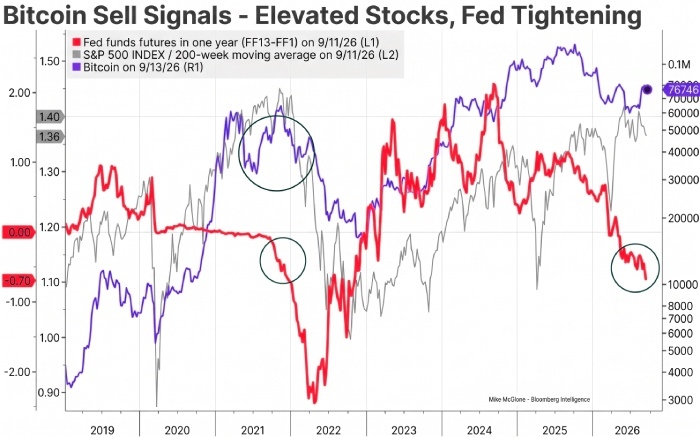
Bitcoin's correlation with the stock market has created an uncomfortable trade-off for investors: they're taking considerably more risk without getting better returns.
And Bitcoin's recent recovery to $80,000 doesn't change the equation.
Three times the volatility, similar returns
According to Bloomberg commodity strategist Mike McGlone, the case for accepting Bitcoin's extreme volatility becomes harder to make when it isn't producing outsized returns.
Over the past five years, Bitcoin has roughly matched the performance of the S&P 500 while experiencing nearly three times the volatility.
From a risk-adjusted return perspective, McGlone calls that a "dud."
Now the Fed enters the equation
McGlone sees three factors pointing to further downside for Bitcoin.
Bitcoin's recent rebound has met stiff resistance around $80,000, fed funds futures are pricing in 70 basis points of rate hikes over the next year, and the S&P 500 remains at historically high levels relative to its 200-week moving average.
If higher rates send stocks lower, Bitcoin's close correlation with the S&P 500 gives investors little reason to expect it to move in the opposite direction.
📌 Bottom line: Bitcoin's volatile profile only works for investors if it outperforms. Over the past five years, it hasn't.
Silver miners just broke a decade-long pattern
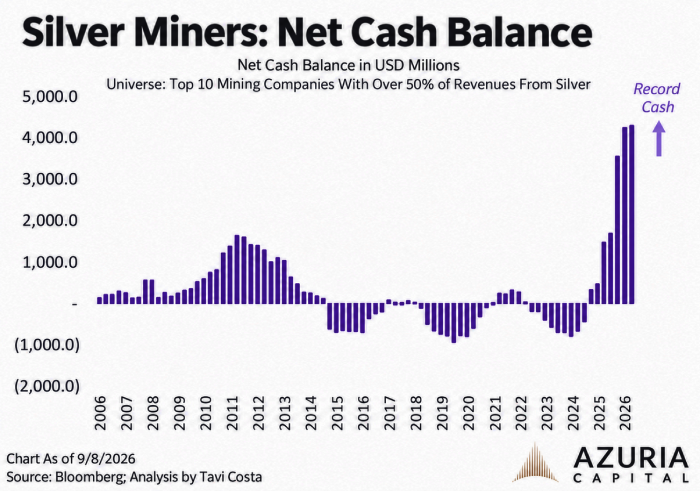
Silver miners spent much of the past decade carrying more debt than cash. Now they're sitting on a record cash pile, putting mining stocks in a much stronger position to cash in on higher silver prices.
Miners' record cash
The combined net cash of the 10 largest miners that generate more than half their revenue from silver reached a record $4.2 billion in Q2 2026, according to Azuria Capital.
That's a radical change from 2014-2024, when debt exceeded cash across the group during most quarters. For comparison, net cash never topped $2 billion even during silver's 2010-2011 rally.
Azuria attributes the buildup to higher silver prices, which have boosted margins and allowed miners to set aside more cash.
Why miners could have more room to run
Mining stocks are essentially a leveraged bet on silver.
Their costs don't rise dollar for dollar with the gray metal. Once production costs are covered, additional gains in silver can translate into much larger increases in miners' profits.
For investors looking to capture that upside across the sector, the Global X Silver Miners ETF (SIL) offers broad exposure to major silver producers.
The fund had about $5.1 billion in net assets as of Sept. 10 and has gained more than 38% over the past year.
📌 Bottom line: Record cash gives silver miners more room to invest, buy back shares, and return money to shareholders. After a decade dominated by debt, that's a major change for the sector.