Warsh's strategy is working

Morning Observers,
Fed chair Kevin Warsh's strategy appears to be working. He effectively lowered Washington's long-term borrowing costs with a rate hike.
Last Wednesday, the Fed decided to hike rates by 25 bp, and the 10-year Treasury yield fell 7 bp.
To understand why Treasury yields now move in the opposite direction to Fed rates, we should take a step back and look at how the 10-year yield got to 5% in the first place.
Between ~1.5% in early 2022 and 5% last week, the 10-year yield went through three stages.
Stage one was the period between 2022 and the 2024 presidential election. The 10-year yield rose from 1.5% to roughly 3.5%, largely because of inflation and the Fed's hiking cycle.
It was a mechanical reaction to the expectation that short-term rates would simply stay higher for longer
Then, between the election and 2026, the yield rose another 55 bp to ~4.2%. All of this increase came from the term premium because of uncertainty around Trump's policies, including a potential Fed shakeup.
The last stage was from 2026 onward, and the causality behind the 10-year yield's trajectory during this period was probably the most misunderstood.
Pundits blamed Trump and term premium, but the market was actually betting on the opposite.
The yield rose by another 80 bp to 5%, and most of that increase came from higher expected short-term rates over the long run, again. The term premium barely budged during this period.
That means the market was betting that Warsh would not bow to Trump and instead would keep rates higher for longer.
Before the Fed's decision, I speculated that Warsh would hike because that helps him hit two birds with one stone: fix the Fed's credibility and lower the term premium.
Whether this was his intention or not, it's working. After his first hike, the 10-year yield dropped 7 bp, and all of the decline came from a lower term premium.
The good news for Trump is that, for now, Warsh can hike while lowering Washington's borrowing costs because of how much term premium is priced into longer-dated bonds.
The 10-year term premium (ZCTERM10YR) is up 60 bp since prediction markets crowned Trump the next president in 2024.
- Dan Runkevicius, Editor

🏦 Kansas City Fed explains rationale for rate hike
Kansas City Fed President Jeff Schmid said he supported the central bank's decision to raise interest rates by 25 basis points last week, arguing the move was necessary to rein in rising inflation. "The Fed has work to do on inflation," he said in a speech, while leaving the door open to further hikes.
₿ Bitcoin tops $81,000 after CLARITY setback
The crypto market rebounded late last week as investors moved past the failed CLARITY Act and turned their attention to regulatory developments from the CFTC and SEC. Bitcoin climbed above $81,000, although analysts say the cryptocurrency still faces resistance around the May high of $82,000 before it can move higher.
📉 Wells Fargo downgrades Netflix
Netflix received its first negative downgrade in months after Wells Fargo warned that the streaming giant is struggling with user engagement. Wells Fargo Securities downgraded Netflix to underweight from equal weight and slashed its price target to $57 from $80, sending NFLX stock down nearly 5%.
⚛️ Westinghouse eyes $50 billion-plus IPO valuation
Westinghouse Electric, one of the world's largest nuclear technology companies, is seeking a valuation of more than $50 billion in a U.S. initial public offering. The proposed valuation suggests investors remain willing to back large IPOs despite mounting concerns across broader markets, particularly in tech.
🇨🇳 U.S.-China talks signal desire to make up
U.S. and Chinese officials described their latest talks on artificial intelligence, trade, and investment as "very successful" and "candid, in-depth, and constructive," signaling a mutual desire to stabilize relations ahead of a summit between Donald Trump and Xi Jinping. The two sides agreed to create a formal U.S.-China AI dialogue to develop a shared understanding of the technology's benefits and risks.
Airlines are finding $4.70 jet fuel too rich to fly
American Airlines, United Airlines, and Southwest Airlines have reported that they are cutting flights or scaling back planned capacity because of rising fuel costs.
United has already cut some December flights and could extend those reductions into the first quarter of 2027. Southwest has cut its planned 2026 capacity growth by half and is planning further cuts.
This leaves travelers with fewer options heading into the busy holiday season.
Record jet fuel costs
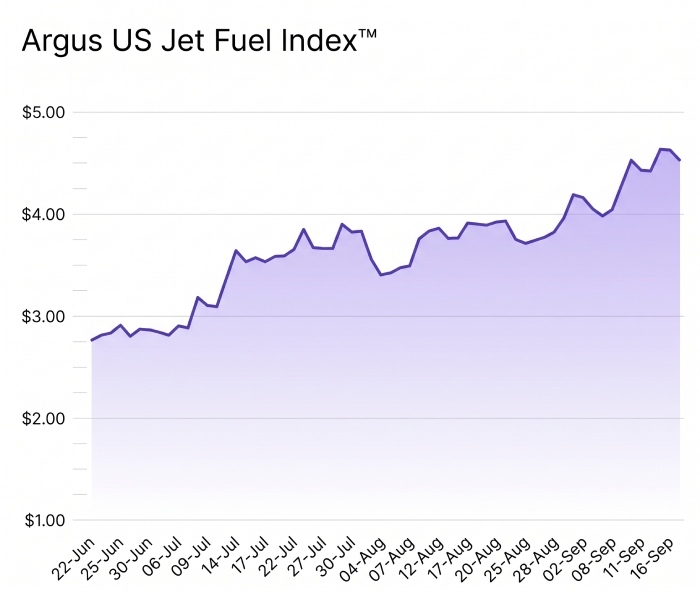
U.S. Gulf Coast jet fuel prices reached $4.70 per gallon last week, up from roughly $2.26 before the Iran war, according to EIA data. That's a nearly 110% increase.
American Airlines burned nearly 4.5 billion gallons of fuel last year, so even small price changes can quickly add hundreds of millions of dollars to its expenses.
In fact, the jump in fuel prices is expected to add roughly $1 billion to American Airlines' fourth-quarter costs alone.
Full planes, fewer flights
What makes the capacity cuts unusual is that airlines aren't responding to weak demand.
American expects third-quarter revenue to rise 16% to 19%, while United says demand remains resilient and premium travel continues to perform well.
Instead, $4-plus jet fuel is changing which flights are worth operating. United CFO Michael Leskinen said routes near the bottom of the airline's profitability rankings can quickly become money-losers because of fuel costs.
Airline stocks have already had a difficult year. The U.S. Global Jets ETF, which tracks major U.S. and international airlines, is roughly flat so far in 2026.
📌 Bottom line: Airlines are still seeing healthy demand, but $4.70 jet fuel is making some routes too expensive to operate profitably.
Fed rate-hike history points to a 6% 10-year Treasury yield
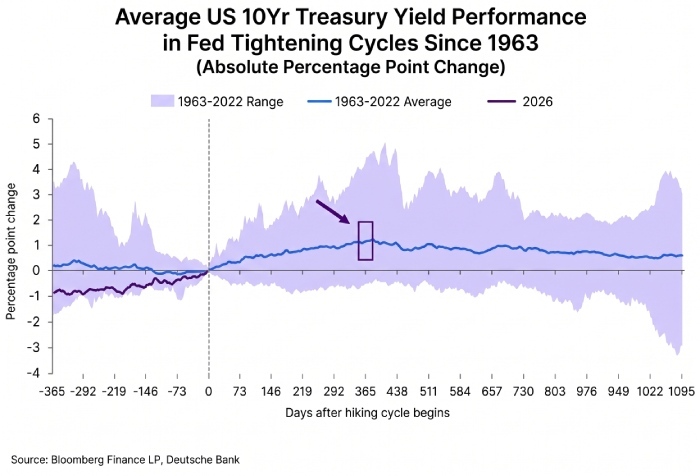
After last week's hike, analysts looked at how previous hiking cycles could affect bond yields. And the historical record doesn't look too promising.
The 10-year has typically climbed after the first hike
Going back to 1963, the 10-year Treasury yield rose by an average of 50 basis points during the first six months after the central bank began raising rates.
Over the following 12 months, the average increase was 110 basis points.
The average masks some enormous differences between hiking cycles. In the most extreme cases, the 10-year yield rose by as much as 400 basis points during the 12 months after the first hike.
Other cycles produced declines of as much as 70 basis points over the same period.
Even without another large move higher, a 10-year yield around 5% is already feeding into borrowing costs across the economy, including mortgages, corporate debt, and Washington's massive interest bill.
📌 Bottom line: If the Fed's hiking history repeats itself, yields could rise much further. On the other hand, Warsh could cushion some of that increase by lowering the term premium.