Wall Street is picking new AI winners

Morning Observers,
Software ate the world. AI is eating software moats.
Huang's firing and politics have drowned out many interesting developments, and one of them is changing Wall Street's perception of the big AI winners.
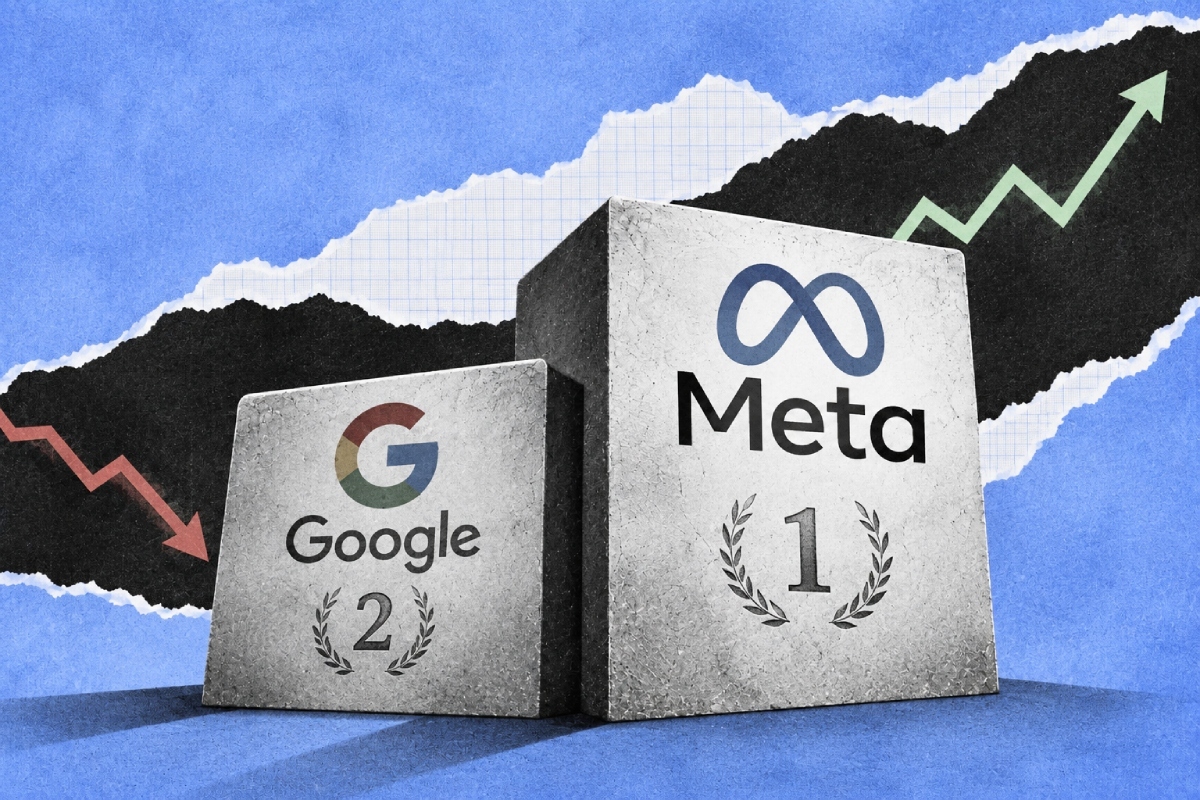
Last week, JPMorgan dropped Alphabet from its preferred internet stock list and replaced it with Meta. The swap had less to do with Muse and more with how AI is affecting these companies' moats.
What we learned from this earnings season is that AI appears to be making Meta's ad business more profitable at the same time that Google's AI search is proving harder to monetize than traditional search.
That divergence is growing to such an extent that Meta is expected to overtake Google's search in quarterly ad revenue for the first time ever.
A year earlier, Google's search was approximately $6.5 billion ahead. Meta has closed roughly 96% of that gap in just four quarters.
One way to think about why AI is augmenting Meta's ad business while threatening Google's is that the two platforms serve different buyer journeys.
Google captures demand; Meta creates demand. AI has much more room to improve ad efficiency on Facebook and Instagram because Meta must predict what people want, while Google already knows what they're looking for.
Citrini Research's famous Substack post made the case that the digital economy rests on friction. And much of tech earnings come from solving it through personalized algorithms, multi-sided platforms, marketplaces, or, in Google's case, smart indexing.
AI is removing much of the friction on the indexing side.
Instead of browsing through a bunch of pages (and ads along the way) to get an answer, you call up an AI chatbot and get it in one quick interaction.
And while Google has caught up with other leading LLMs in answering queries, it hasn't yet shown that AI search can make as much money as traditional search.
During Friday's sell-off, Meta was the only Big Tech company to finish higher. Does that say something about Wall Street shifting its focus from monetizing AI directly to how Big Tech can protect or strengthen its moats using AI?
- Dan Runkevicius, Editor

📈 Morgan Stanley is "max overweight" on global stocks
Morgan Stanley strategists have recommended a "max overweight" position in global stocks heading into 2027, anticipating strong returns following the latest Nvidia- and AI-led correction. "With risk assets having cheapened, we embrace risk," the strategists wrote, adding that AI-related growth opportunities are expanding beyond hyperscalers to companies adopting the technology.
🏦 Deutsche Bank warns of higher rate risks
Deutsche Bank thinks investors are underestimating the risk of further central bank rate hikes as inflation remains above target. Markets are now pricing in 113 basis points of Fed hikes by September 2027, up from 95 basis points before the latest round of increases began. Another quarter-point increase is expected next month.
🚀 Anthropic IPO is sucking the air out of the room
Bank of America CEO Brian Moynihan said companies are postponing deals until next year as Anthropic's anticipated IPO crowds out smaller offerings. Capital markets activity by year-end "will be up a chunk, but it's been very bumpy," Moynihan said. Anthropic will go public tomorrow with an expected valuation of more than $1.4 trillion.
🤖 Is Baidu a sign of things to come for Google?
The Chinese search giant reported its sixth straight quarterly revenue decline, with September-quarter sales falling 1% to $4.6 billion. More alarmingly, its online advertising revenue plunged 22% as it struggles to monetize AI search and fend off competition in China's increasingly crowded AI market.
📉 Nvidia extends losing streak
Nvidia shares continued to fall at the start of the week, declining in six of the past eight trading sessions following Jensen Huang's scandal. The chipmaker has now shed $2 trillion in market value since its Oct. 6 peak.
Is the sell-off in copper miners premature?
While investors remain fixated on Big Tech, copper mining stocks are suffering a historic losing streak.
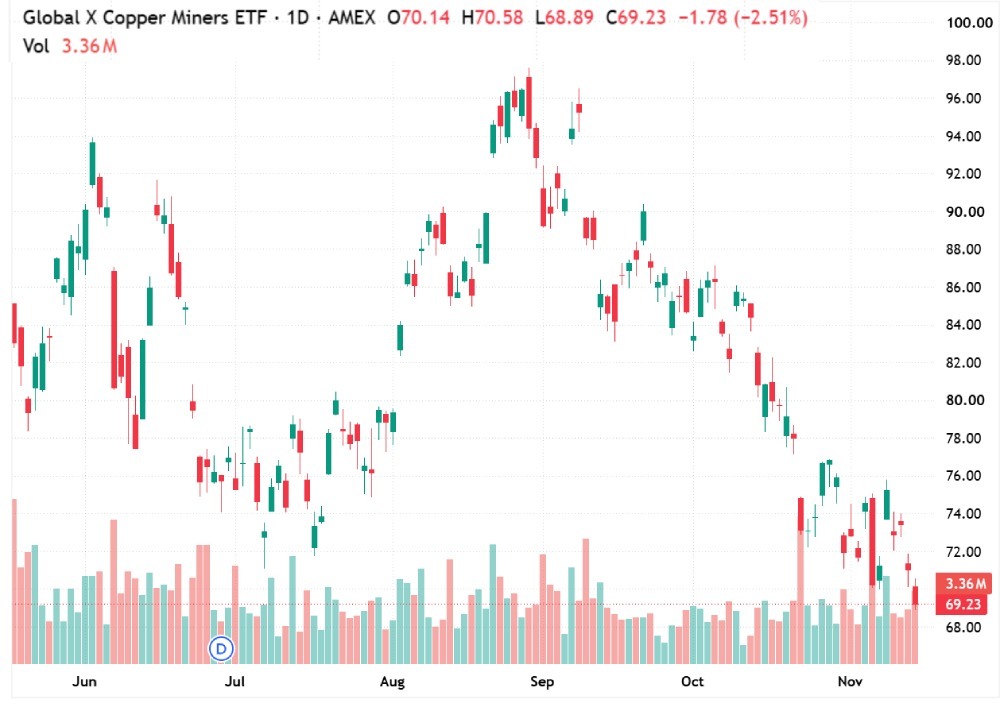
The Global X Copper Miners ETF (COPX) has fallen for 12 consecutive weeks, its longest losing streak in recent memory. That's despite signs of a copper shortage in China, the world's largest consumer of the metal.
Investors are selling, but China is buying
COPX has lost more than 26% during its 12-week slide. The ETF is now down 4.5% year-to-date after being up as much as 34.8% in August.
The sell-off follows growing skepticism about AI spending and concerns about demand for industrial metals. (Copper is widely used in data centers, electrical equipment, and manufacturing.)
But while investors have been trimming their copper holdings, Chinese buyers are scrambling to snap up scarce supplies, according to industry insiders cited by Reuters.
Copper inventories on the Shanghai Futures Exchange recently fell to a three-year low, while the premium Chinese buyers pay for imported copper reached a record $230 per ton.
The shortage is partly the result of U.S. stockpiling ahead of a potential new round of tariffs, which has drawn copper away from other markets.
📌 Bottom line: Copper miners have lost more than a quarter of their value in 12 weeks, even though the world's largest copper market faces a growing shortage of the metal.
Nvidia's leadership shakeup poses an existential threat to neoclouds
Nvidia has lost nearly $2 trillion in market value since the beginning of Jensen Huang's scandals, raising questions about companies that depend on Nvidia's financial backing.
The neocloud unwind
The Nvidia sell-off has quickly spread to neoclouds, companies that rent out computing power built around Nvidia's AI chips.
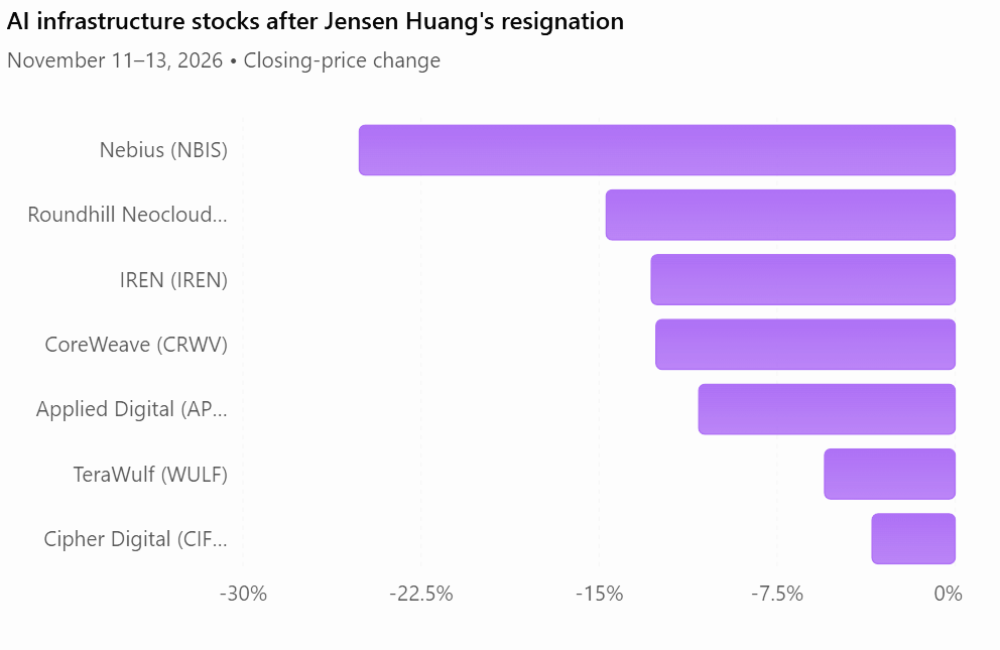
Between Nov. 11 and Nov. 13, Nebius (NBIS), IREN (IREN), Applied Digital (APLD), and TeraWulf (WULF) lost between 5% and 25% of their market value.
The Roundhill Neocloud ETF (NCLD) also plunged nearly 15%.
Some of these companies have received direct investments or other financing support from Nvidia to help fund their data centers.
Nvidia's backing is now in question
Nvidia's financial backing has made it easier for some AI infrastructure companies to borrow by giving lenders greater confidence in their ability to repay.
With Huang gone and CFO Colette Kress serving as interim CEO, investors are questioning whether Nvidia will stand by those arrangements.
For neoclouds carrying substantial debt and spending billions on infrastructure, losing that support could mean much higher borrowing costs or even insolvency.
📌 Bottom line: Nvidia's leadership crisis has second-order implications for companies that have built their expansion plans around its financial support.