TSMC beats earnings!

Morning Observers,
TSMC offers AI stocks a breath of fresh air after reporting better-than-expected top- and bottom-line numbers. Revenue rose 51% and earnings 69% from a year ago.
Perhaps the most important clue is that all of the sales growth came from high-performance computing (HPC), which is the category TSMC puts AI chips under.
So if there's one takeaway, it's that AI spending didn't let up, at least through the end of September. But how does that connect with news of CoreWeave?
Along with a handful of other neocloud providers, CoreWeave stock has crashed 25% in a few days, and its bonds are now priced like distressed debt.
The reason is that investors are becoming increasingly paranoid about its debt pile now that interest rates are at multi-decade highs.
So this apparent contradiction between the sell-off over the past few days and today's good news from TSMC comes down to this:
AI buildout is becoming increasingly debt-dependent > debt is becoming more expensive > smaller, more leveraged players get flushed out.
Meanwhile, TSMC's sales are concentrated among major chip designers, such as Nvidia, and hyperscalers with their custom chips. These companies have much deeper pockets and much less leverage than neoclouds.
Now all eyes turn downstream to hyperscaler earnings, then to Anthropic.
As I wrote yesterday, the AI trade now hinges on AI labs proving they can ROI on capex while helping their clients ROI on inference.
- Dan Runkevicius, Editor

📈 Inflation is fueling rate-hike bets, again
The odds of an October Fed rate hike jumped to 70% in futures markets after September inflation came in hotter than expected. The Consumer Price Index (CPI) rose 3.7% from a year earlier, up from 3.4% in August and above forecasts of 3.6%. Core inflation, which excludes food and energy prices, climbed 2.6%, slightly ahead of economists' projections.
🏦 Bank of America sheds $30 billion
Bank of America stock plunged more than 8% on Wednesday after the lender was fined $1.2 billion for money-laundering violations. Analysts also pointed to rising inflation and the prospect of higher interest rates, which could weigh on lending activity, as reasons for the decline. The selloff wiped roughly $30 billion off the bank's market capitalization in a single day.
🥇 Gold, silver and Bitcoin join the selloff
Yesterday was an all-out sell-off. Stocks, bonds, and debasement assets all tumbled after the CPI report. Gold fell 1.8% to $4,104 per troy ounce, while silver plunged nearly 7% to below $56. Bitcoin fell nearly 2%, slipping below $82,000.
📉 CoreWeave bonds flash distress signal
CoreWeave, a former crypto miner turned AI infrastructure provider, has seen its bonds fall to distress levels. The development caught the attention of Elon Musk, who responded "yikes" to a social media post by billionaire investor Chamath Palihapitiya. Shares of CoreWeave, which rents out access to high-performance AI chips, fell as much as 17% on Wednesday.
🚀 Anthropic gears up for massive IPO
Anthropic was said to meet with prospective investors Wednesday as it prepares for a possible November IPO. Formal marketing could begin as early as the week of Nov. 9, with investors reportedly discussing a valuation between $1.8 trillion and $2 trillion. The AI company is also reportedly targeting an offering that could rival or exceed the size of SpaceX's IPO.
Brazilian stocks are breaking 15-year losing streak against S&P 500
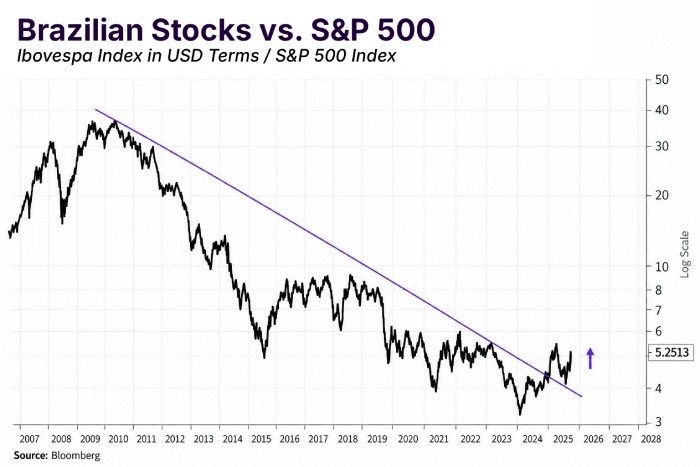
The next major bull market could be taking shape in Brazil, where the benchmark Ibovespa Index has broken a 15-year downtrend against the S&P 500.
The last time something similar happened was in 2002, ahead of a six-year bull market that saw Brazilian stocks rise 20-fold in dollar terms.
The downtrend finally breaks
According to analyst Oguz Erkan, the ratio between the two indexes has climbed to roughly 5.25, up from lows near 3.3 in 2024. A rising ratio means Brazilian stocks are outperforming their U.S. counterparts.
Erkan pointed to the 2002–2008 period, when Brazilian stocks enjoyed a six-year bull market. He believes the latest breakout could mark the beginning of another extended period of outperformance.
Brazil's election adds another catalyst
The technical breakout comes as Brazilian stocks are already surging.
The Ibovespa reached new highs this month, while Brazil's currency jumped 4% after Flavio Bolsonaro unexpectedly led the first round of the presidential election, potentially opening the door to a more business-friendly government.
Investors also welcomed gains by Bolsonaro's congressional allies, raising expectations that a potential administration could pursue spending cuts, privatizations, and lower taxes.
📌 Bottom line: Investors looking to capitalize on Brazil's rally can gain exposure through the iShares MSCI Brazil ETF (EWZ), which trades on U.S. exchanges. Because returns are measured in dollars, a stronger Brazilian real could provide an additional boost.
Uranium is near recent highs, yet mining stocks are still on sale
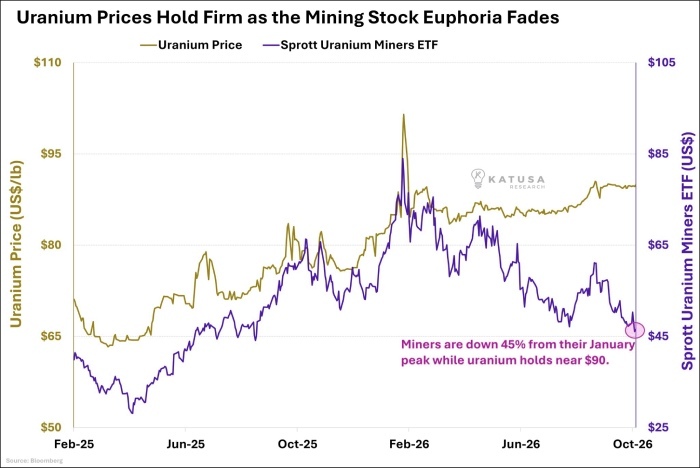
Uranium prices are hovering near $90 a pound, yet the companies that mine the metal have taken a beating, with the Sprott Uranium Miners ETF (URNM) down roughly 45% from its January peak.
The selloff could present a major buying opportunity, especially with demand for uranium continuing to grow.
A familiar gap between uranium and miners
Katusa Research identified a similar divergence in spring 2025, when uranium traded near $65 a pound while mining stocks suffered a steep selloff.
Over the following nine months, URNM nearly tripled, climbing from roughly $30 to more than $80 by early 2026.
The episode highlights how mining stocks can lag behind uranium prices before catching up, sometimes with much larger gains.
Nuclear demand keeps growing
Uranium demand continues to grow because countries build more nuclear reactors, and utilities compete to secure long-term supplies.
According to the World Nuclear Association, global uranium requirements are projected to more than double, from 69,000 metric tons in 2025 to more than 150,000 tons by 2040.
Meanwhile, uranium mines can take a decade or longer to open because of permitting, financing, and construction, limiting how quickly producers can increase output.
📌 Bottom line: The Sprott Uranium Miners ETF (URNM) offers a way to invest in a potential recovery across uranium mining stocks without picking individual companies. A return to its January peak would represent roughly 80% upside from current levels.