📈 Trump's 1,000+ trades


Morning Observers,
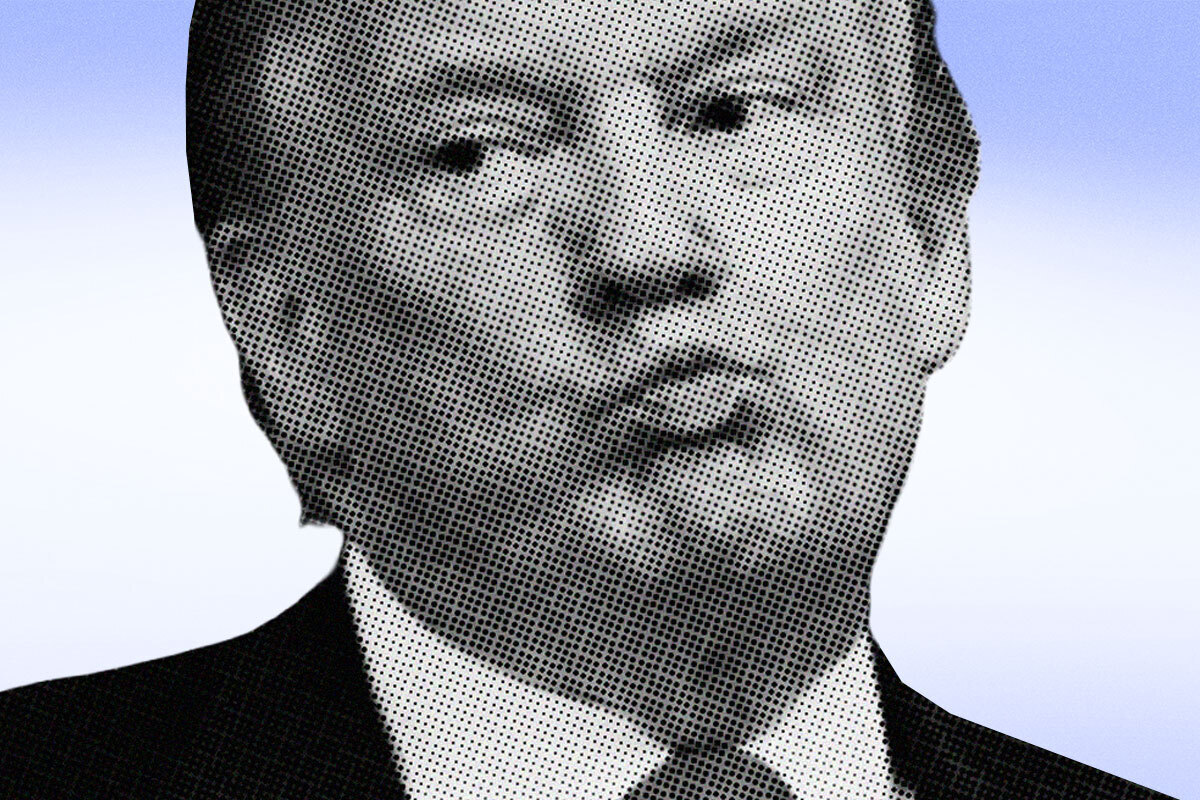
There’s a lot of controversy around Trump’s 1,000+ trades disclosed over the weekend.
According to the filing, Trump made 1,051 trades in June worth up to $263 million, including some surprisingly large bets in Berkshire Hathaway, Visa, Mastercard, and The Home Depot.
Insider trading in Washington is already a hot-button topic, so more than a thousand trades by a sitting president over the course of a month naturally stir up the imagination.
But if there’s one thing we can definitely rule out here, it’s insider trading.
In fact, many of the biggest trades happened after major public announcements or macro events.
For example, Trump carried out the biggest cluster of transactions by dollar value on June 18-22 (buy: BRK, V, MA, CTAS, and HD; sell: META, MSI, PLTR, NFLX, and MCD).
That period started one trading session after two huge macro events he surely had prior knowledge of: 1) Trump’s Iran agreement, and 2) Warsh’s hawkish shift at his first FOMC meeting.
One layer deeper down the speculation rabbit hole is the White House’s own explanation. It says Trump’s money is managed through “computer-based model portfolios” designed essentially for “direct indexing.”
Direct indexing means taking an index like the S&P 500 and trading its constituents individually usually for tax-loss harvesting.
Does that explanation check out? At first glance, yes.
In an earlier filing, Trump bought $5–25 million worth of Vanguard Dividend Appreciation ETF (VIG).
In the new filing, Trump closed the position, reporting a sale of $5–25 million worth of Vanguard Dividend Appreciation ETF (VIG).
Then he bought a bunch of individual stocks, and several of his biggest June buys, including Home Depot, Mastercard, Visa, and Cintas, are VIG constituents.
Plus, many of the biggest trades by dollar value happened around June 18 and June 22, which was right in the middle of an index-rebalancing period for Russell.
There’s just one problem: the weights don’t match at all.
On average, Trump’s purchases of Home Depot, Mastercard, Visa, and Cintas were about 16× larger than what you’d expect if his model portfolios were simply replacing VIG stock by stock.
And one of his top buys, Berkshire Hathaway, doesn’t even belong in VIG because Berkshire doesn’t pay a dividend.
That means this isn’t simply a computer unpacking one ETF into its constituents.
Instead, Trump’s portfolio looks more like a model-driven strategy with active tilts. Or, alternatively, his managers could be directly indexing several broad benchmarks, while VIT was more like a tactical bet.
- Dan Runkevicius, Editor

📈 Nasdaq 100 snaps five-day skid
The Nasdaq 100, which tracks the largest nonfinancial companies listed on the Nasdaq, rose 0.3% on Friday, snapping a five-session losing streak. The pullback had been driven in part by renewed concerns over stretched valuations in AI and other technology stocks, though the index remains up sharply over the past year.
🏛️ All eyes on Bessent’s next move
Treasury Secretary Scott Bessent will provide more details on the Treasury Department’s plans on Monday, following its decision to at least double the size of certain long-dated bond buybacks. Bessent may be forced to take further steps to contain long-term interest rates, which are hovering at their highest level since 2007.
💰 Broadcom eyes $60 billion AI financing deal
Broadcom is in talks with lenders to raise more than $60 billion in debt to finance AI chips for Anthropic and other companies. The proposed financing could include roughly $30 billion of junior debt alongside a $60 billion to $70 billion senior-secured tranche, underscoring the massive capital flows into the AI infrastructure buildout.
🧹 Citadel unwinds Situational Awareness portfolio
Ken Griffin’s Citadel has shed more than 80% of the aggregate risk from the portfolio it acquired from Situational Awareness, the AI-focused hedge fund founded by former OpenAI researcher Leopold Aschenbrenner. Situational was forced to unload most of its public-stock portfolio after leveraged bets on AI-related stocks triggered margin calls in July.
🚀 Anthropic eyes an IPO to rival SpaceX
Anthropic expects its planned initial public offering to match or exceed the size of SpaceX’s record IPO. SpaceX raised $86.2 billion in its offering, suggesting the Claude developer could target a raise approaching $100 billion when it makes its expected market debut by the end of the year.
Is the dollar about to get yen’d?
For years, Japan tried to keep borrowing costs under control at the expense of a cheaper yen.
Now some investors think the U.S. could be heading down a similar path after the Treasury Department announced it will at least double its buybacks of longer-term government bonds.
The debasement trade is back
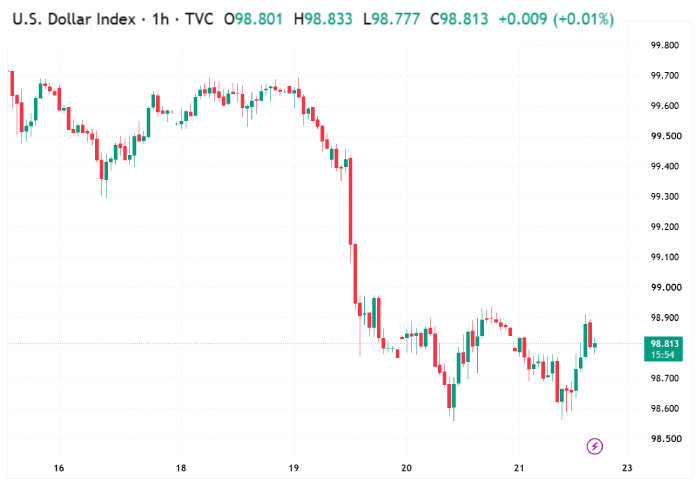
The market reaction to the Treasury’s announcement was immediate. Treasury yields initially fell, while the dollar sank to a three-month low and gold rallied, reviving talk of the “debasement trade.”
Robin Brooks, a senior fellow at the Brookings Institution, called the buybacks the “clearest sign yet” that the U.S. is following Japan toward currency debasement. He said the administration is “playing with fire.”
Standard Bank’s Steven Barrow sees the same problem. Buybacks can work as a temporary solution, but they can't fix the deficits that are pushing those yields higher.
A weaker dollar has consequences
The risky trade-off is that the Treasury “traded lower yields for a weaker dollar,” according to economist Peter Schiff.
The end result is inflation. A falling dollar makes imports and foreign-produced goods more expensive, potentially feeding into consumer prices just as policymakers are trying to keep borrowing costs down.
That could leave Washington chasing its own tail. Buybacks lower yields, the dollar weakens, inflation risks rise, and yields come back up again.
📌 Bottom line: The U.S. isn’t Japan… yet. But if Washington starts prioritizing lower yields at the expense of the dollar, the yen may be a preview of what comes next.
JPMorgan: The memory boom has years left to run
After SanDisk (SNDK) surged more than 480% this year and Micron (MU) gained 237%, it’s only natural to conclude that the memory boom is nearing its peak.
JPMorgan thinks otherwise.
The peak keeps moving
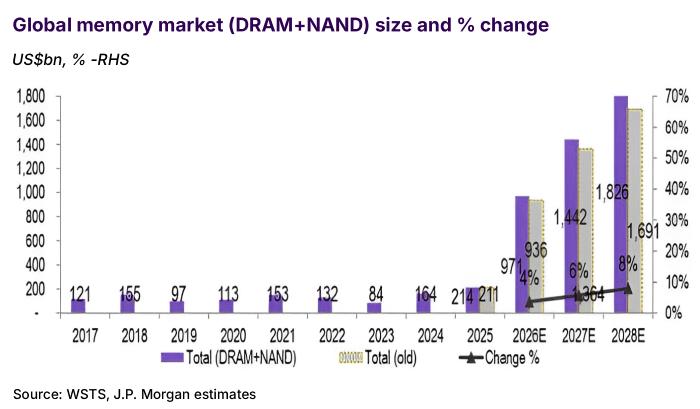
JPMorgan estimates the global DRAM and NAND market will grow from about $211 billion in 2025 to $1.83 trillion in 2028. That's a dramatic upgrade from earlier forecasts.
Not surprisingly, AI is driving much of the shift.
Advanced AI chips need huge amounts of memory, straining supply and helping keep prices high. The rapid buildout of AI data centers is also driving demand for storage.
JPMorgan estimates that AI-related demand alone could account for roughly $70 billion of the NAND market by 2028.
What it means for the stocks
Memory booms have historically ended the same way. High prices encourage manufacturers to produce more, supply catches up with demand, and profits eventually fall.
JPMorgan’s forecast suggests that the process could take longer this time.
If demand keeps growing through 2028 while supply remains constrained, peak earnings for Micron, SanDisk, and SK Hynix (SKHY) could still be further away than investors expect.
So while the stocks aren’t necessarily cheap, this year’s enormous gains don’t mean the memory boom is nearing its end.
📌 Bottom line: The bet here isn’t that memory stocks are cheap. It’s that investors may still be underestimating how long AI can sustain the memory boom.