Trump made $1.4B from crypto

Morning Observers,
Trump, the president of the United States, made more money from memecoins than from nearly anything else.
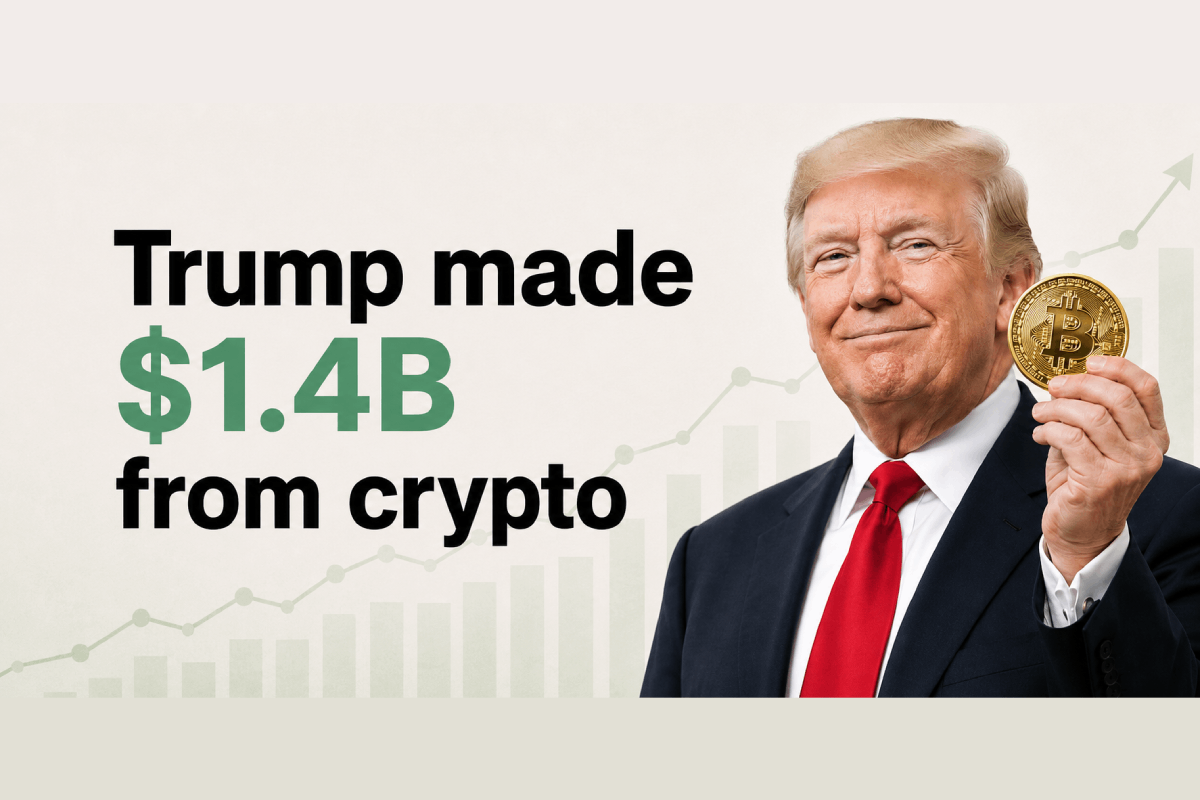
According to Trump’s latest filings, his crypto and memecoin businesses generated at least $1.4 billion in 2025. And the wild part is that crypto was by far the biggest source of his income.
Trump reported more than $594 million from World Liberty Financial, a crypto firm connected to Trump, his sons, and Steven Witkoff, one of the top diplomats in his administration.
Most of that money came from selling Ethereum, Bitcoin, and other tokens.
His memecoin business, CIC Digital, generated another $636 million, mostly through royalties from a licensing agreement. He also made nearly $197 million from an equity sale of Stablecoin Holdco.
Ironically, the most powerful people driving regulation and the narrative around digital assets are also sitting on massive financial exposure to the industry. And Trump has already cashed out a fortune from it.
Meanwhile, the platform he used to promote crypto has largely gone nowhere:
- Full crypto regulatory overhaul — not done
- Strategic Bitcoin reserve — not done
- Tax overhaul / no capital gains on crypto — not done
- “Bitcoin made in America” — not done
Let's dig in!
- Dan Runkevicius, Editor
|
Five things to know before opening bell
🇺🇸 Chipmakers post best-ever quarter
Chip stocks just wrapped up their strongest quarter on record. The Philadelphia Semiconductor Index surged more than 83% between April and June, signaling that AI hardware remains the biggest investment theme. Goldman Sachs projects that hyperscalers alone will spend more than $6 trillion on AI infrastructure by 2030.
📈 Tech powers S&P 500 to best quarter since 2020
The rally in chip stocks helped push the Nasdaq Composite up 1.5% on Tuesday, while the S&P 500 gained 0.8% to close out its best quarter in six years. The period was especially notable for the S&P 500, which put together a nine-week winning streak through the end of May.
☀️ Solar stocks surge on potential FCC ban
U.S. solar stocks rallied after Reuters reported that the Federal Communications Commission is considering banning imports of certain foreign-made power inverters over national security concerns. Officials reportedly fear China could exploit the devices to disrupt the U.S. power grid. SolarEdge Technologies rose 11%, while Sunrun is up 7%.
🇪🇺 Inflation cools across key Eurozone economies
Inflation slowed more than expected in Germany, France, and Italy in June as lower energy prices continued to fall. Germany’s annual inflation rate fell to 2.4% from 2.7%, France’s dropped to 2% from 2.8%, and Italy’s eased to 3% from 3.2%. The data comes after the European Central Bank recently raised interest rates to curb inflation across the eurozone.
🙂 U.S. consumer sentiment improves
Americans grew slightly more optimistic in June thanks largely to lower gasoline prices. The Conference Board’s consumer confidence index rose to 91.2 from 90.6 in May. The report followed a separate sentiment reading from the University of Michigan last week, which showed that consumer confidence was starting to rebound from record lows.
There are still no signs of AI profit outside tech
The AI investment boom rests on the idea that AI will make the economy more productive. But so far, companies are spending tons of money on the technology without any measurable ROI.
The profits are staying in Big Tech
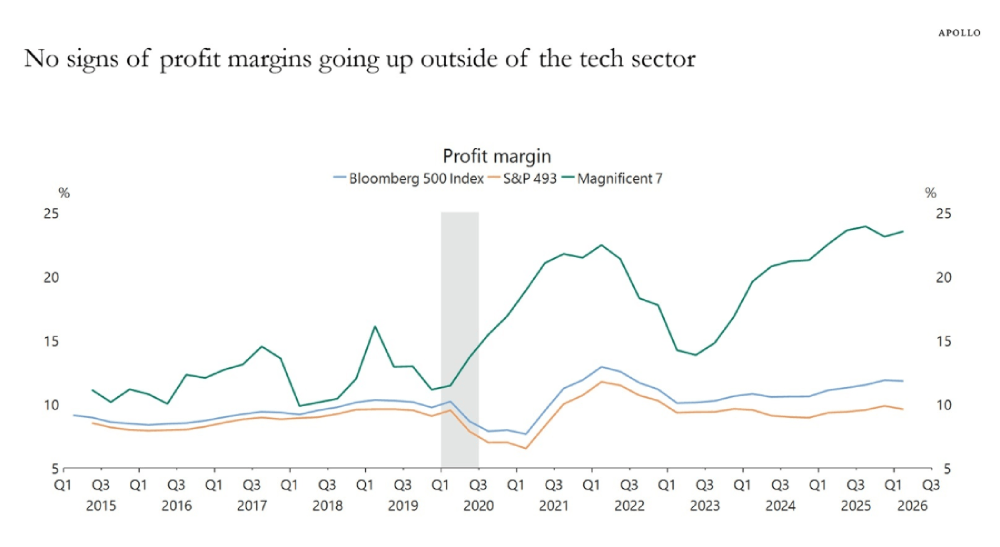
Before the pandemic, the Magnificent Seven, which today includes Apple, Microsoft, Nvidia, Amazon, Alphabet, Meta, and Tesla, generated operating margins of roughly 11% to 13%.
Since ChatGPT launched in late 2022, those margins have climbed to nearly 24%, the highest level in Apollo’s dataset. Outside of Big Tech, almost nothing has changed.
Profit margins for the other 493 companies in the S&P 500 remain stuck around 10%, almost exactly where they were before the AI boom began.
That’s a striking disconnect. Companies across healthcare, banking, manufacturing, retail, and industrials have spent the past two years rolling out AI software and cloud services.
Yet those investments haven’t produced any measurable improvement in aggregate profit margins.
Apollo’s data is consistent with broader research. Last year, an MIT study found that 95% of generative AI pilots failed to produce a measurable improvement in profitability.
One explanation is that many companies are using AI to improve existing workflows rather than fundamentally changing how they operate.
The market is still betting on the productivity promise
Apollo chief economist Torsten Slok said profitability outside of tech is “ultimately what we are waiting for because the value of AI companies today rests entirely on the promise that margins in the S&P 493 will eventually climb.”
So far, that promise has yet to be fulfilled.
But despite the lack of progress, corporate America continues to adopt AI. McKinsey found that 88% of companies now regularly use AI, suggesting that businesses continue to invest even as the financial payoff remains elusive.
📌 Bottom line: If AI still isn’t lifting profit margins by next year’s budgeting season, companies may start slowing AI spending and shift their focus elsewhere.
How 2026’s "easiest" trade unraveled in 5 months
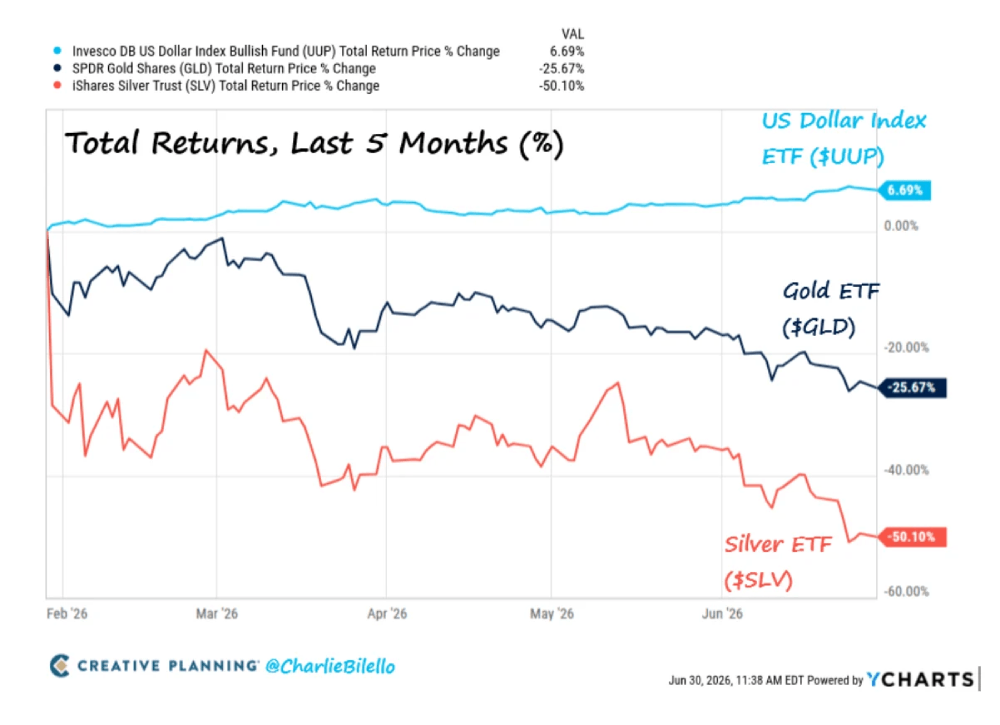
Five months ago, betting against the U.S. dollar looked like one of the easiest trades on Wall Street.
The Trump administration openly favored a weaker currency. The Fed was expected to cut interest rates. Investors were piling into the “debasement trade,” which is basically the bet that the dollar would keep losing value and investors would pile into hard assets like gold, silver.
For a while, that trade looked unstoppable. Gold and silver surged to $5,600 and $120 per ounce. And then the dollar refused to die. So what happened?
Real yields became the dollar’s wrecking ball
The anti-dollar trade broke because the bond market started offering investors a better reason to own U.S. assets again.
Since the start of May, Treasury yields have moved higher primarily because of a rise in real yields, according to State Street data. The 10-year TIPS yield climbed from 1.72% to 2.18%, one of the biggest increases this year.
That matters because higher real yields make the dollar more attractive.
Global investors can now earn better inflation-adjusted returns by holding U.S. government debt. That pulls money back into dollar-denominated assets and makes the dollar harder to bet against.
Gold and silver were simply the other side of that trade.
A stronger dollar makes precious metals more expensive for overseas buyers. At the same time, higher real yields make Treasurys a more compelling alternative to assets that pay no income.
Unlike Treasury bonds, gold and silver pay nothing. So when investors can earn more after inflation by holding U.S. government debt, there's less incentive to hold gold.
📌 Bottom line: Investors stopped betting on a weaker dollar and started betting that higher real yields would keep money flowing into U.S. assets.