This sell-off is very different

Morning Observers,
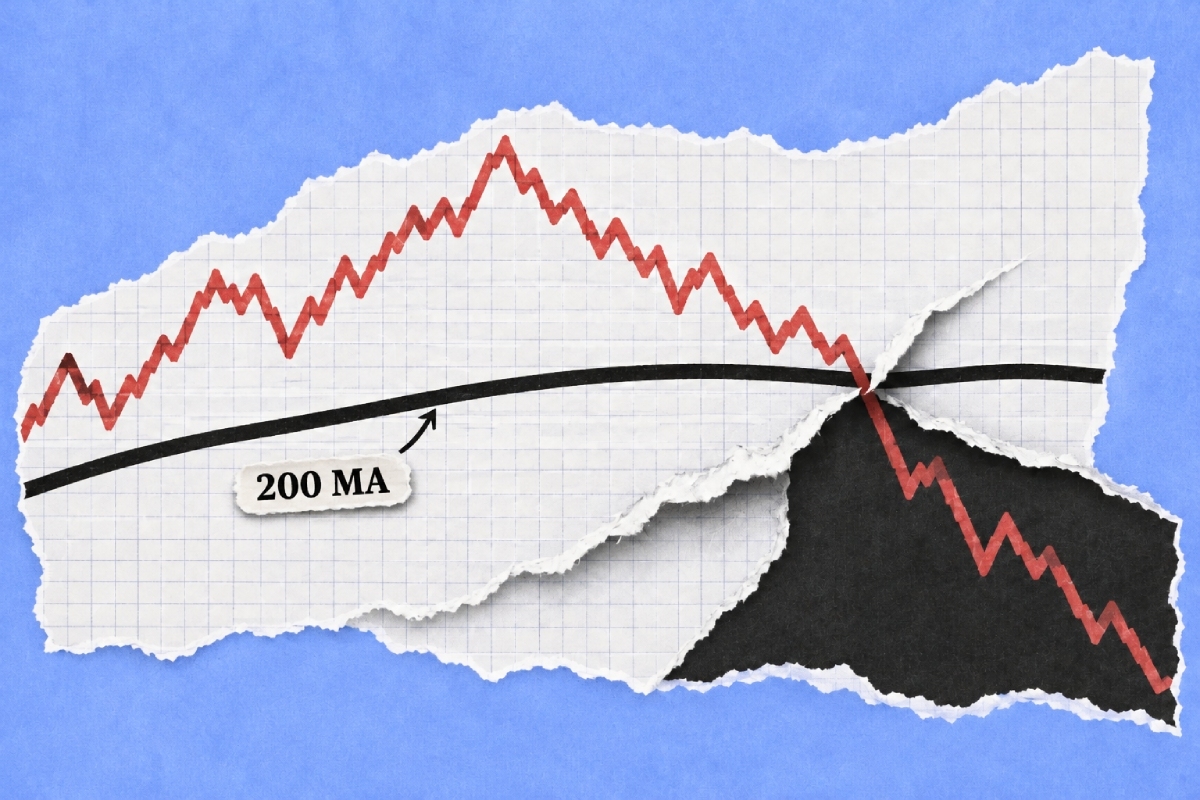
Last week marked the third time since 2023 that the S&P 500 has fallen below its 200-day moving average (200 MA).
This matters because many trend-following strategies effectively buy or sell based on this indicator. And as long as the market stays below that line, some investors who might otherwise become marginal buyers won't step in, no matter what.
That may explain why there's less dip buying now, even after a huge day like Monday and today's news that Trump is floating a pardon to save Huang's butt.
Not the first technical break in recent years, but this episode is very different from Liberation Day and the start of the Iran War.
Those were “orange swans,” unpredictable shocks with scenarios ranging from a global economic collapse to just another Trump bluff. In both cases, it took little more than ruling out the worst-case scenarios for the stock market to get back on its feet.
This time, the S&P 500 gave out after a more gradual souring on AI companies that culminated in Huang’s ousting. Bringing him back helped, but not enough to lift the index above the trend line.
That means it may take more than Trump pushing his executive power limits to convince investors that AI is too big to fail.
On the positive side, my inbox is filling with more and more takes that this sell-off is overdone.
A couple of noteworthy stats:
- Defensive consumer staples stocks are trading at their highest valuation since the dot-com bubble, and twice tech's valuation
- Tech valuations are back to 2019 levels, before the AI and Covid booms. Semis are the cheapest on record
- This correction has already flushed out some of the most hyped AI stocks: CoreWeave (-75%), Oracle (-68%), SanDisk (-68%), Nebius (-66%), Intel (-61%), Arm (-60%), Seagate (-52%) — and the list goes on.
- Bloomberg's alternative inflation index is tracking November CPI at 0% (MoM), suggesting that inflation may have peaked
All eyes are on earnings revisions now. There's a lot of growth priced in for next year, and any downward changes to those expectations could deal another blow to the AI trade.
- Dan Runkevicius, Editor

📉 AMD's collapse underscores the cost of short-seller accusations
AMD has lost more than $200 billion in value since Hunterbrook Media accused the chipmaker of circumventing U.S. export controls in a Nov. 19 report. AMD has denied the allegations, and even Hunterbrook acknowledged that its findings didn't confirm an export-law violation. Yet AMD shareholders have suffered losses of nearly 30%, while Hunterbrook Capital, an investment firm affiliated with the media outlet, just disclosed a short position in the stock.
⚖️ Will Trump's new tariff gambit backfire again?
The Trump administration is preparing to unveil new tariff proposals targeting 16 economies, including China, Japan, the EU, and Mexico. The last time Trump imposed sweeping tariffs, the Supreme Court struck them down, triggering more than $127 billion in refunds. This time, the administration is relying on Section 301 of the Trade Act of 1974, which explicitly authorizes tariffs in response to "unfair trade practices." Trump's next round of tariffs could prove much harder to overturn in court.
🏠 U.S. home prices are falling behind inflation
The U.S. housing slowdown has produced an unusual phenomenon: home prices are rising well below the rate of inflation. According to the latest S&P Case-Shiller National Home Price Index, home prices grew 2.1% in September, compared with a 3.7% annual reading for the Consumer Price Index (CPI). Economists estimate that CPI approached 4% in October. In real terms, American homes are losing value.
📉 Semiconductor stocks surrender most of their 2026 gains
The Philadelphia Semiconductor Index (SOX) plunged 7.9% on Tuesday, erasing half of the previous day's rebound. The index is now down 39% from its June high, leaving it with a year-to-date gain of just 24%. At the height of the semiconductor rally, the index had more than doubled in value this year, gaining 106%.
📊 Inflation expectations are declining rapidly
New York Fed President John Williams said this week that 2027 will be a year of lower inflation, and investors appear to agree. As of Tuesday, the two-year inflation swap rate, which reflects market expectations for annual inflation over the next two years, had fallen to 2%, its lowest level since September 2024. The recent decline in energy and agricultural commodity prices is adding to expectations that inflation has already peaked.
Value stocks are staging a historic comeback
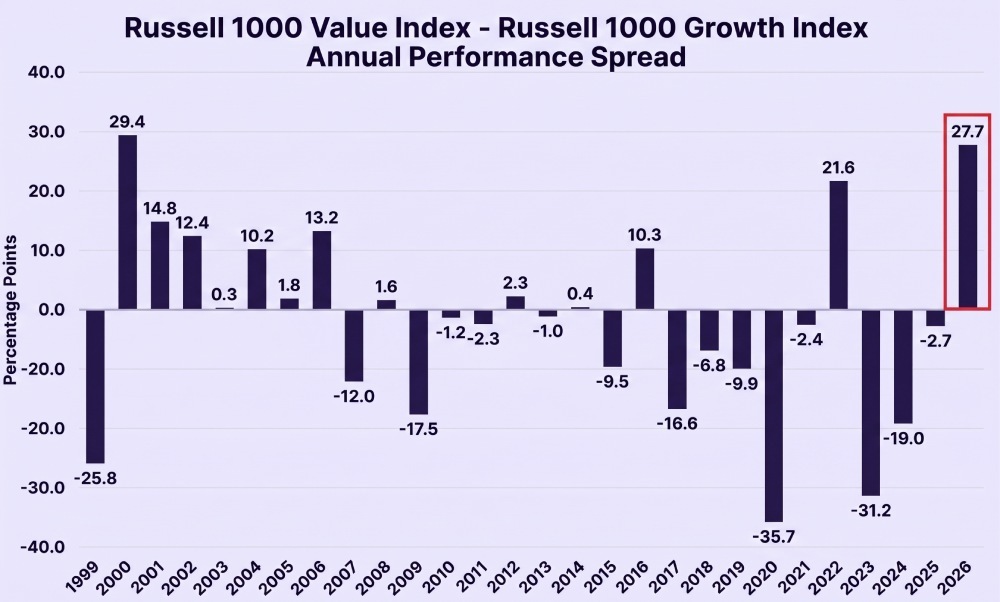
With Big Tech shedding trillions of dollars in market value over the past month, value stocks are enjoying their best year relative to growth stocks in more than two decades.
Value's resurgence
According to TradingView data, the Russell 1000 Value Index has outperformed the Russell 1000 Growth Index by 27.7 percentage points so far in 2026, its widest lead since 2000.
The value index has gained 24.8% this year, while the growth index has fallen 2.9%. It's a major reversal from 2023 and 2024, when growth stocks outperformed value by 31.2 and 19 percentage points, respectively.
Whether the AI bubble has actually burst could have major implications for value investing in the coming years.
Following the dot-com crash in 2000, value stocks outperformed growth until the global financial crisis eight years later, according to Morningstar.
The case for "value" investing
Value stocks are companies trading at relatively low prices compared with their earnings. Growth stocks, by contrast, tend to command higher valuations based on expectations of future profits.
Although value stocks remain cheaper than growth stocks, the valuation gap has narrowed.
According to LSEG, the Russell 1000 Growth Index traded at a 74% premium to the Russell 1000 Value Index in September 2025, based on forward P/E ratios. By September 2026, the premium had fallen to 25%, even before the latest technology selloff.
Several ETFs provide exposure to value stocks, including the iShares Russell 1000 Value ETF (IWD), Vanguard Value ETF (VTV), and iShares Core S&P U.S. Value ETF (IUSV).
📌 Bottom line: Value stocks have been some of the best diversifiers during an AI-led stock rout this year.
Boomers won the housing market. Now they're winning the pension game, too
The generational wealth gap is usually measured in terms of housing affordability and job security. But another divide is emerging in retirement.
Boomers win again
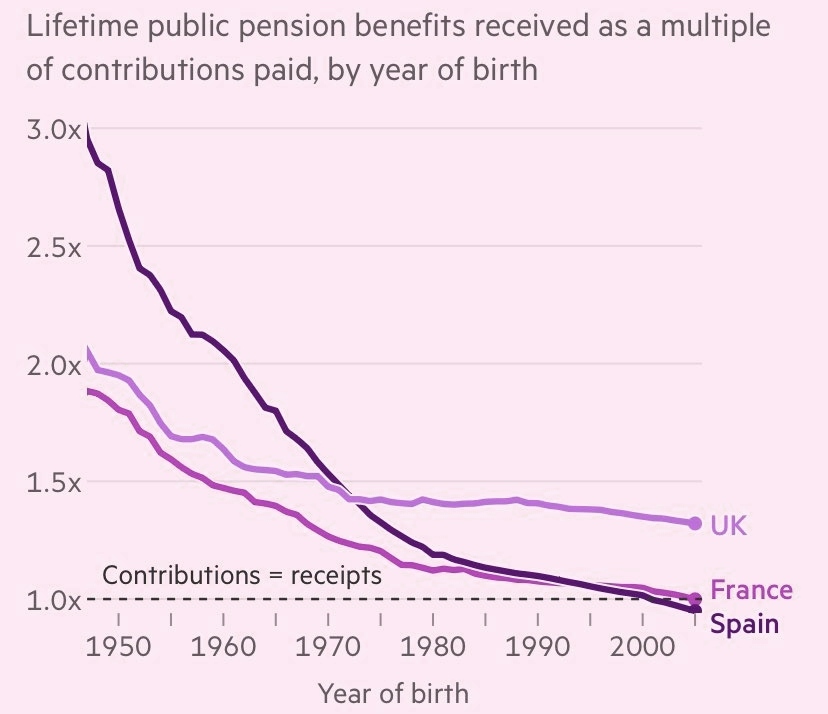
A recent Financial Times analysis found that retirees in several wealthy Western countries are receiving significantly more from public pensions than they paid into the system.
In Spain, Boomers born in the late 1940s are projected to receive nearly three times their lifetime pension contributions in benefits. For Millennials and Gen Z, the ratio has fallen to roughly one-to-one.
In France, older generations are projected to receive nearly twice as much in pension benefits as they contributed, while younger generations are expected to receive about as much as they paid in.
Similar trends exist in the U.K. and other European countries.
As more Boomers retire, there are fewer working-age adults relative to the number of pensioners. Across OECD countries, there were 22 people aged 65 and older for every 100 working-age adults in 2000. By 2025, there were 33.
Inequality built into the pension system
Public pensions in these countries largely operate on a pay-as-you-go basis, meaning today's workers finance the benefits of current retirees.
But aging populations and slower workforce growth mean younger generations are unlikely to receive the same benefits relative to their contributions.
The imbalance is already showing up in household incomes. The average pensioner now has a higher disposable income than the average working-age person in the U.S. and several European countries.
Younger Americans face a similar problem with Social Security.
The 2026 Social Security Trustees Report found that, without legislative changes, incoming revenues would cover just 78% of scheduled retirement and survivor benefits in 2032 and 62% by 2100.
📌 Bottom line: Younger generations are paying for retirement benefits they may never receive themselves.