The recession that never came

Morning Observers,
The Iran war was supposed to break the global economy. Instead, it stress-tested it.
Close the Strait of Hormuz, send oil into triple digits, reignite inflation, and push the U.S. and Europe into recession. It was one of the few macro calls that almost nobody questioned.
Instead, the International Monetary Fund released a report Monday calling the global economy “overall resilient” after absorbing the largest energy shock in decades. Growth has slowed but not stalled, while inflation remains concentrated in energy rather than spreading across the economy.
Unsurprisingly, Wall Street is starting to sound a lot less worried.
Wellington Altus chief market strategist James E. Thorne isn’t surprised. Markets dismissed the odds of a U.S.-Iran deal, he said, but now “they’ve spun on a dime and declared it a buy signal.”
They’re also looking past the April-May inflation scare. Durable goods remain in deflation, while a lasting Middle East peace deal could send crude back toward $60 a barrel.
“The doomers were wrong again,” Thorne said.
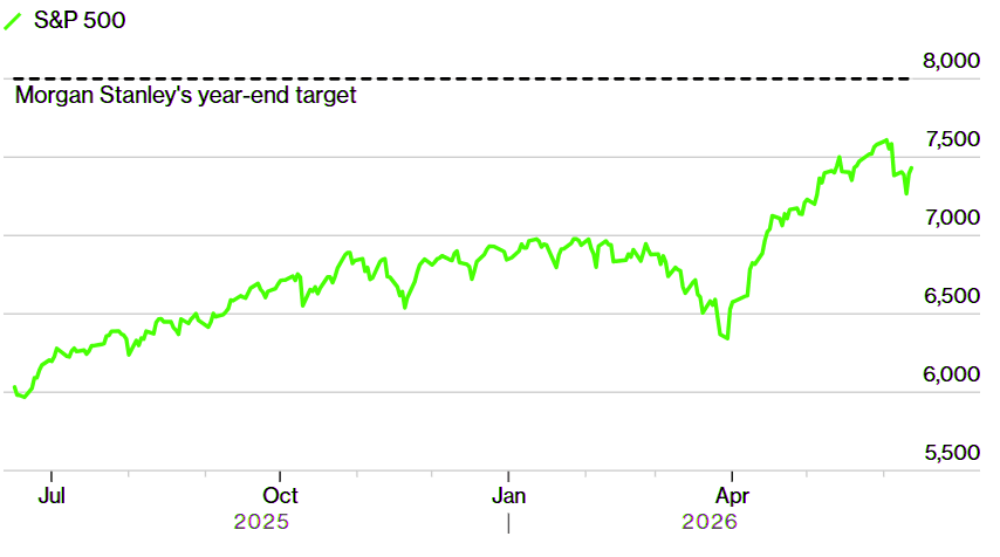
Morgan Stanley is leading the consensus shift. The bank reaffirmed its 8,000 price target for the S&P 500 and expects cyclical stocks, not AI, to drive the next leg higher. Think transports, consumer companies, and regional banks that benefit from a stronger economy.
The consensus is that a peace deal changed the outlook overnight. A more interesting possibility is that the economy proved far more resilient than anyone expected, and markets are only now catching up.
Let’s get to it.
- Dan Runkevicius, Editor
|
Five things to know before opening bell
🤝 Stocks surge, oil sinks on U.S.-Iran deal
Markets rallied after the United States and Iran agreed to reopen the Strait of Hormuz, easing fears that the energy shock would spill into the second half of the year. The S&P 500 climbed 1.7% for one of its biggest gains since April, while the Nasdaq jumped 3.1%. Oil moved the other way, with U.S. crude falling 5% to around $80 a barrel and Brent slipping below $83 as traders priced in improving supply conditions.
🚀 SpaceX’s historic rally continues
SpaceX extended its historic debut with another 19% gain on Tuesday after jumping more than 19% in its first trading session last week. The rally pushed Elon Musk’s rocket company to a market capitalization of nearly $2.5 trillion, cementing its place among the world’s ten most valuable public companies and underscoring investors’ appetite for AI and space-related growth stories.
📺 Fox acquires Roku for $22 billion
Fox agreed to acquire Roku in a roughly $22 billion deal, including debt, creating a television and streaming giant with a major foothold in ad-supported video. Roku now reaches 100 million streaming households worldwide and has expanded beyond North America into markets including Mexico, Brazil, and the U.K., giving Fox a much larger global distribution platform.
🇪🇺 ECB says inflation pressures aren’t going away
European Central Bank policymaker Joachim Nagel warned that reopening the Strait of Hormuz won’t provide immediate inflation relief because it could take months for global oil supplies to normalize. The comments come just days after the ECB raised interest rates for the first time in nearly three years, reinforcing the view that policymakers expect energy-driven price pressures to remain a challenge.
💼 Anthropic heads to Washington
Anthropic executives are meeting with Trump administration officials after the government moved to block foreign access to the company’s most advanced AI models on national security grounds. According to Bloomberg, the discussions focus on recent restrictions affecting Fable 5 and Mythos 5 and could shape how the U.S. regulates access to advanced artificial intelligence going forward.
Morgan Stanley: The “cyclical” comeback nobody was waiting for
For the past two years, investors have had one strategy: buy anything with an AI story attached to it. But the next winners may be companies that make loans, ship goods, and sell refrigerators instead of chips, according to Morgan Stanley.
It's part of a “catch-up” trade that paused during the Iran war and may finally be resuming.
The laggards are waking up
With a U.S.-Iran peace deal sending oil prices sharply lower, the bank says the market is entering a different phase. It still expects the S&P 500 to reach 8,000 by year-end but thinks the next gains will come from banks, retailers, and transport companies instead of the usual AI leaders.
Consumer discretionary stocks are down 2% this year, even as the S&P 500 has gained nearly 10%. Transports and regional banks have also underperformed, both during the Iran conflict and over the past several years.
Markets move in cycles. After years of rewarding technology, investors often start looking at banks, retailers, airlines, and transport companies when the economy improves.
The timing also fits the economic data. Recent PMI reports suggest parts of America’s industrial economy, including manufacturing, are expanding despite war, tariffs, and uncertainty.
Main Street isn’t convinced
Wall Street may be rotating into cyclicals, but individual investors are starting to get cold feet. Vanda data shows retail investors sold stocks for three consecutive days last week — the first such streak since the pandemic — with Monday marking the biggest outflow since November 2023.
Notably, the biggest selling came from AI names, including Micron, AMD, and Marvell… the same stocks that dominated the market’s recent rally.
That’s worth watching. Retail investors have become one of the market’s most reliable sources of demand, consistently buying dips and funneling fresh money into stocks through automatic investment plans. If that bid disappears, the market may lose one of its biggest supporters.
Nevertheless, if oil keeps falling and the economy keeps expanding, Wall Street’s rotation into cyclicals may look less like a trade and more like the start of a broader shift. Retail investors who just sold AI stocks at a profit could end up chasing the very move they initially ignored.
Bottom line: Bull markets rarely keep rewarding the same stocks. If the economy avoids a slowdown, the next winners could be the companies investors have spent years ignoring rather than the ones they already own.
AI’s most underrated benefit? Making oil matter less
For all the criticism around AI’s enormous electricity appetite, it may be quietly making the U.S. economy less dependent on fossil fuels.
That’s because the fastest way to power the AI boom isn’t building more coal plants… it’s building more solar.
America’s grid is changing faster than people realize
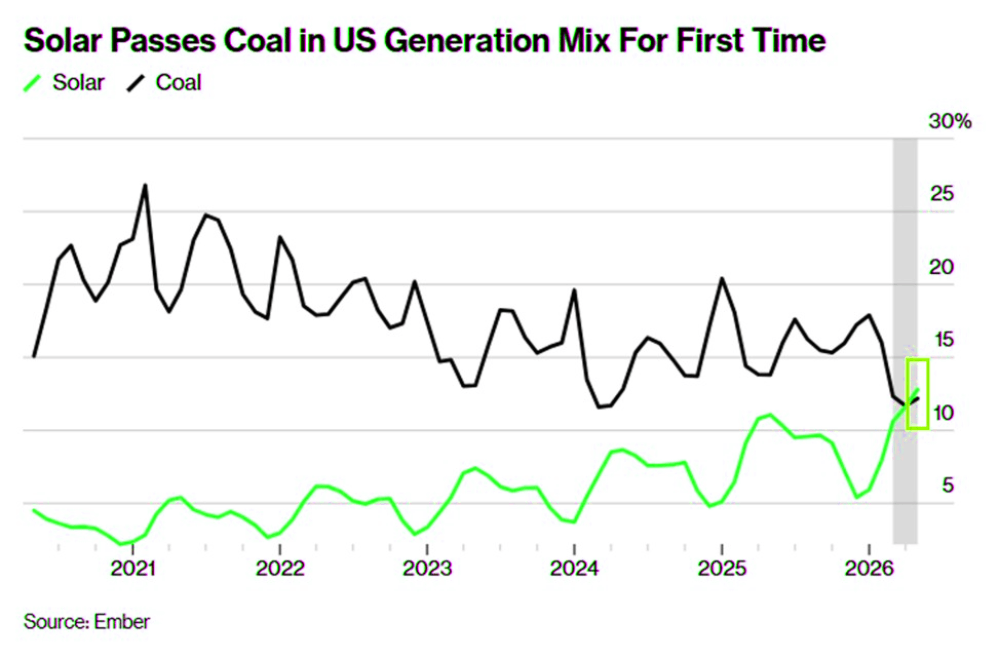
According to new data from Ember, solar generated 12.8% of U.S. electricity in May, surpassing coal’s 12.2% share for the first full calendar month on record.
The shift has been years in the making. Solar generation jumped 17% from a year ago while coal output fell 11%.
Natural gas still dominates the grid at roughly 37%, with nuclear and wind accounting for another 18% and 11%, so fossil fuels aren’t disappearing anytime soon.
But every percentage point gained by solar means a larger share of electricity comes from a fuel that can’t be embargoed or shipped through geopolitical chokepoints like the Strait of Hormuz.
Data centers are rewriting the energy mix
The AI boom is usually framed as a strain on the grid, but it’s also creating one of the biggest incentives in decades to build new power capacity. In the first quarter of 2026, solar and battery storage accounted for 91% of all new U.S. power capacity additions.
Investors have noticed: the S&P 500 solar sector is up roughly 16% this year, about double the broader market. The gap has widened further over the past 12 months, with solar stocks gaining 58% compared to the S&P 500’s 24%.
The irony is that AI’s biggest contribution to the economy may not be limited to productivity gains. It may be accelerating investment in an electricity system that’s increasingly insulated from commodity shocks.
Bottom line: Oil shocks used to threaten both the gas pump and the power grid. Increasingly, they're becoming a transportation problem rather than an electricity problem. If AI keeps accelerating investment in solar and battery storage, every new data center could make the next energy crisis a little less painful than the last.