The Nasdaq’s dot-com déjà vu


Morning Observers,
Is the Nasdaq getting cheap, or is it on the precipice of a dot-com-like downturn? It might sound hyperbolic, but there’s evidence to suggest both.
On the one hand, the Nasdaq 100’s forward price-to-earnings ratio has fallen back to 2022 levels, unwinding much of the froth that built up during the AI mania.
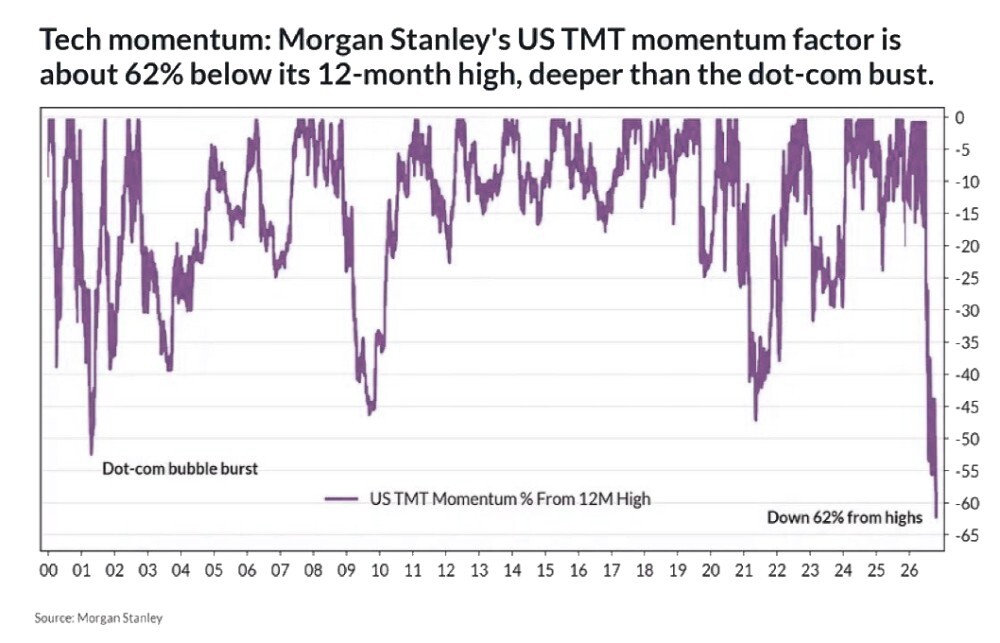
On the other hand, a key measure of tech stock “momentum” has fallen further than it did during the dot-com bust. In other words, the stocks that drove much of the market’s rally have lost their advantage.
And given how far some of those stocks had climbed, perhaps the reversal was long overdue. Charlie Bilello of Creative Planning recently showed that semiconductor stocks had surged 237% over 14 months, surpassing the 234% gain seen during the dot-com bubble. If there were signs of another AI bubble, this was certainly one of them.
The Philadelphia Semiconductor Index rebounded sharply on Friday, but so far, it looks more like a relief rally than a recovery. The index had plunged a staggering 15% over the previous two sessions alone. After a run-up of historic proportions, the pullback may have more room to go, especially if Democrats’ reported plans to curb data center development gain traction.
Let’s get to it,
- Sam Bourgi, Interim Editor

📉 Musk winds down Cybertruck as sales plunge
Elon Musk announced Friday that Tesla will wind down Cybertruck production at its Texas factory by mid-2027 to make room for more Cybercab production. Although Musk didn’t mention weak sales, industry estimates suggest demand has fallen well short of expectations. Tesla originally planned to produce 250,000 Cybertrucks annually, but recent sales have been running at about a tenth of that pace.
📊 Record market losses leave investors on edge
Although stocks rebounded Friday, investors are still reeling from Thursday’s historic selloff, when the Nasdaq Composite lost $2.5 trillion in market value. According to Dow Jones data, it was the largest single-day loss on record, surpassing the $1.46 trillion wiped out during the March 16, 2020, Covid crash.
💼 U.S. hiring improves, but productivity steals the show
The U.S. economy added 165,000 jobs in October, exceeding economists’ expectations and well above the average monthly gain of 48,000 over the past year. Separate Labor Department data showed that worker productivity increased at an annualized rate of 3.6% in the third quarter, surpassing forecasts of 2.9%. Some economists believe AI is beginning to contribute to productivity gains, although its precise impact remains difficult to measure.
🤖 Investors rethink Anthropic’s IPO valuation
Thursday’s bruising technology selloff has investors reconsidering how much Anthropic is worth. According to Bloomberg, some prospective investors are now discussing a valuation of $1.2 trillion to $1.3 trillion, well below the $2 trillion floated last month. The company is still aiming to go public before Thanksgiving, although the final price and timing remain unclear.
💻 TSMC considers making advanced memory chips
Taiwan Semiconductor Manufacturing Co. is weighing expanding into advanced memory chips, a business currently dominated by Samsung, SK Hynix, and Micron. According to The Information, TSMC has begun planning to manufacture a new type of memory called 3D DRAM at the request of Nvidia, its largest customer. The move would take TSMC beyond its traditional role of manufacturing processors and give it another way to profit from demand for AI hardware.
The Nasdaq is cheap, but one indicator is worse than the dot-com bust
Last week’s tech wipeout has left Wall Street with an uncomfortable question about the AI boom. Technology stocks are trading at valuations last seen during the 2022 bear market, yet one closely watched indicator suggests the reversal has been even more extreme than during the dot-com bust.
Nasdaq’s valuation reset
According to Citadel Securities, the Nasdaq 100’s forward price-to-earnings (P/E) ratio has fallen to 19x, meaning investors are paying $19 for every dollar of expected annual earnings.
The multiple is 25% below its January peak and roughly 22% below its five-year average of 24.2x. The index hasn’t traded at such a low valuation since October 2022, during the last major tech bear market.
Tech momentum has fallen further than during the dot-com crash
The decline in valuations is only part of the story. Investors have also been selling many of the technology stocks that previously led the market, reversing years of strong performance.
Morgan Stanley tracks this through its U.S. technology, media, and telecommunications (TMT) momentum factor. The measure compares stocks based on recent performance, showing whether past winners continue to outperform.
The indicator has plunged 62% from its 12-month high, compared with a 52% decline during the 2000–2002 dot-com crash. It’s also a steeper drop than during the 2008 financial crisis or the 2022 tech selloff.
📌 Bottom line: The selloff has taken some of the hype out of AI stocks, but lower prices don’t necessarily mean better bargains.
Goldman quietly predicts a Fed U-turn on interest rates
Goldman Sachs recently lowered its year-end gold forecast in an analyst note, but a more surprising prediction was buried in the fine print.
The bank expects the Federal Reserve to resume rate cuts next year, even as markets brace for further hikes.
Rate cuts back on the table?
In its recent note reviewed by Investing.com, Goldman’s economists predicted that the Fed will begin cutting interest rates in late 2027 and continue into early 2028.
The forecast was part of Goldman’s gold outlook. Lower interest rates generally make gold more attractive because investors earn less from bonds and savings accounts. They can also make gold more appealing to investors worried about currency debasement.
The outlook contrasts with current expectations for another Fed rate hike in December, potentially followed by further increases early next year.
Inflation expectations are falling
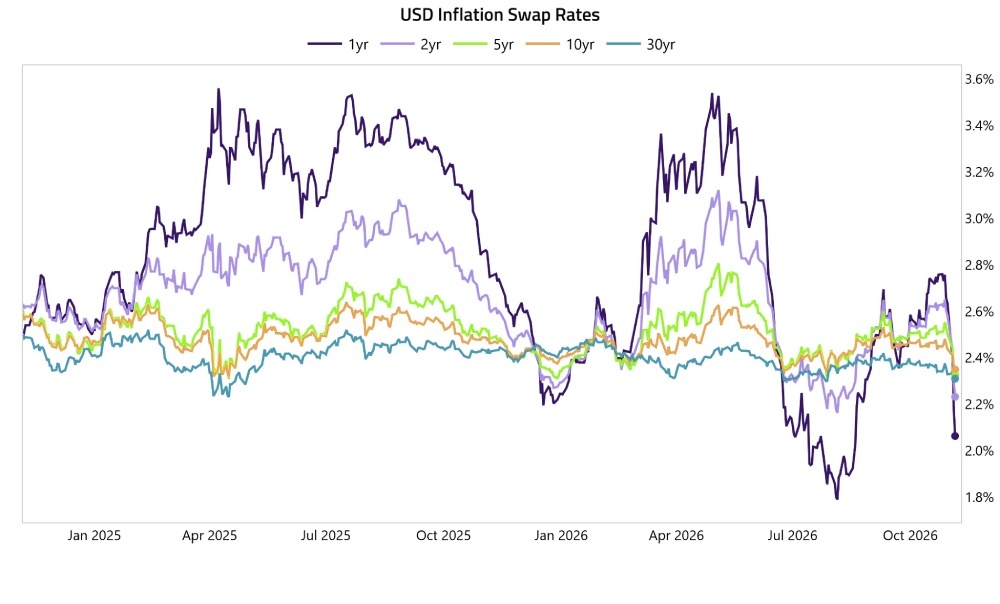
Goldman’s outlook may not be as far-fetched as it sounds. Data from Augur Infinity show that the one-year inflation swap rate has fallen from nearly 2.8% to below 2.1%.
The rate reflects market expectations for inflation over the next 12 months. Its decline suggests traders expect inflation to slow, even as the Fed prepares to raise rates again in the near term.
📌 Bottom line: Goldman economists believe the Fed’s current round of rate hikes may be short-lived. But the bank is sticking its neck out by predicting rate cuts more than a year in advance.