The great sell-off paradox

Morning Observers,
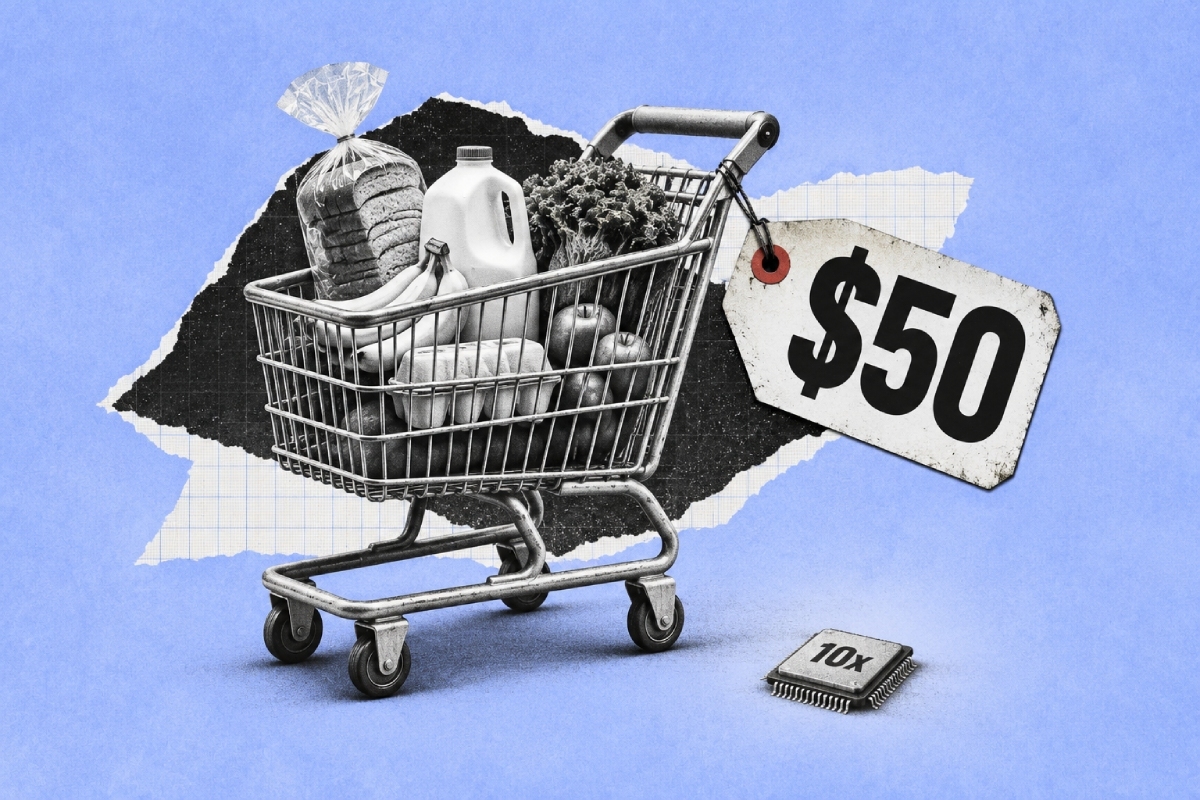
Is selling groceries at 50 times earnings a safer bet than Nvidia at 10 times earnings?
Last week, the Nvidia-led AI rout quickly turned into what looked like an indiscriminate flight to safety.
Even sectors and assets that were supposed to offer a counterweight to AI fell. That, and the fact that gold (often one of the first assets liquidated to cover losses) took such a beating, suggests technical selling and forced liquidation may explain at least part of this bloodbath.
There was only one sector that came out almost unscathed: consumer staples.
That part isn't surprising. Consumer staples are typically stable, low-growth, low-valuation stocks that do well when markets start repricing the future of high-growth companies.
What's surprising is that some companies in this sector that are supposed to protect against multiple compression are now trading at multiples nearly 5x higher than Nvidia and other big AI winners.
For example, Costco is now valued at nearly 50 times its earnings.
Sure, it's one of the world's best subscription businesses with an almost impeccable track record of growing earnings. But that growth is in the low double digits, so it's not like Costco can quickly grow into its multiple the way some tech stocks can.
All it would take for Costco to enter a correction is for its multiple to fall to Walmart's 43 times earnings.
Costco isn't just a cherry-picked example, either. The sector as a whole is trading at its highest multiple since 1999. It's 44% more expensive than tech and more than twice as expensive as Nvidia.
Nobody knows exactly where we are in the cycle. But it's particularly intriguing that the market seems to think selling groceries at 50 times earnings is the safer bet.
- Dan Runkevicius, Editor

📉 Anthropic's post-IPO sell-off
Anthropic stock sank as much as 17% on Friday, just one day after the Claude developer's record-breaking IPO. The sell-off raised questions about whether the IPO's stock allocation gave institutional investors a chance to cash out at the expense of retail investors. Even after Friday's drop, Anthropic remains one of the world's 10 most valuable publicly traded companies.
🌎 Emerging market stocks extend their losing streak
Emerging market stocks fell for a seventh straight day on Friday, their longest losing streak since 2024. The MSCI Emerging Markets Index dropped 3.2%, bringing it close to bear market territory. Asian stocks were hit particularly hard, with the MSCI Asia Pacific Index also falling for a seventh consecutive day.
🏦 Citi says interest rates are already too high
The Fed is expected to raise interest rates again in December, but Citigroup strategists are warning that borrowing costs are already "unusually high," especially now that the AI sell-off and falling stock prices threaten economic growth. Citi expects one more rate hike in December before the Fed starts cutting rates in late 2027.
🥇 Gold overtakes Treasuries in central bank reserves
Gold has fallen below $3,600 an ounce, but central banks keep buying it. According to data from Augur Infinity, gold now makes up 26.6% of global central bank reserves, compared with just 10.7% for U.S. Treasuries. It's the first time since the late 1990s that gold has overtaken Treasuries as a share of reserves.
🍎 Apple is working on its own AI agent
Apple is developing an AI agent that can carry out tasks on behalf of users, entering a fast-growing market where OpenAI and Anthropic are already competing. Apple's stock has largely escaped the recent AI sell-off, but its latest plans could put it in more direct competition with the biggest names in AI.
Anthropic's record-breaking IPO was supposed to breathe new life into the AI trade. But Bloomberg Economics' Anna Wong thinks it might actually mark the top.
Anthropic is losing its pricing advantage
According to Wong, Anthropic's effective price per million tokens, a unit used to measure AI usage, has roughly halved since late July.
Demand for its models has surged over that period, but Wong's analysis found that Anthropic hasn't gained market share. Its share of token usage actually fell.
In other words, Anthropic is charging less for its technology without gaining ground on competitors.
And it's not just Anthropic. According to data from corporate spending platform Ramp, AI token usage across the companies it tracks grew 27% over a recent four-week period, but spending on those tokens increased just 12%.
That's great news for businesses using AI. For companies selling it, the math is a little more complicated. "Anthropic IPO may mark the end of the AI trade," Wong wrote.
The catch behind Anthropic's explosive growth
What's particularly interesting is that Anthropic's own financials already show how difficult it can be to turn that growth into profits.
In the third quarter, revenue jumped 47% from the previous quarter to nearly $17 billion. But spending on computing and infrastructure grew even faster, from $5.6 billion to $9.9 billion.
As a result of rising costs, the company swung from a $974 million operating profit to a $567 million operating loss.
And there's a lot more spending ahead. Anthropic has disclosed roughly $900 billion in long-term purchase commitments and leases, most of them tied to computing infrastructure.
Of course, cheaper tokens don't necessarily mean smaller profit margins. The cost of running AI models is also falling, and Anthropic could make up for lower prices through efficiency gains and higher usage.
The question is whether it can do that fast enough.
📌 Bottom line: Anthropic's quarterly earnings will be an important test of whether leading AI developers can maintain their profit margins as competition drives down prices.
Americans locked in low rates, Uncle Sam didn’t
As economists and Fed officials warn that interest rates may need to go even higher, some borrowers are better prepared to handle the extra cost than others.
Washington missed the cheap money era
According to Apollo chief economist Torsten Slok, one of the biggest losers is Uncle Sam.
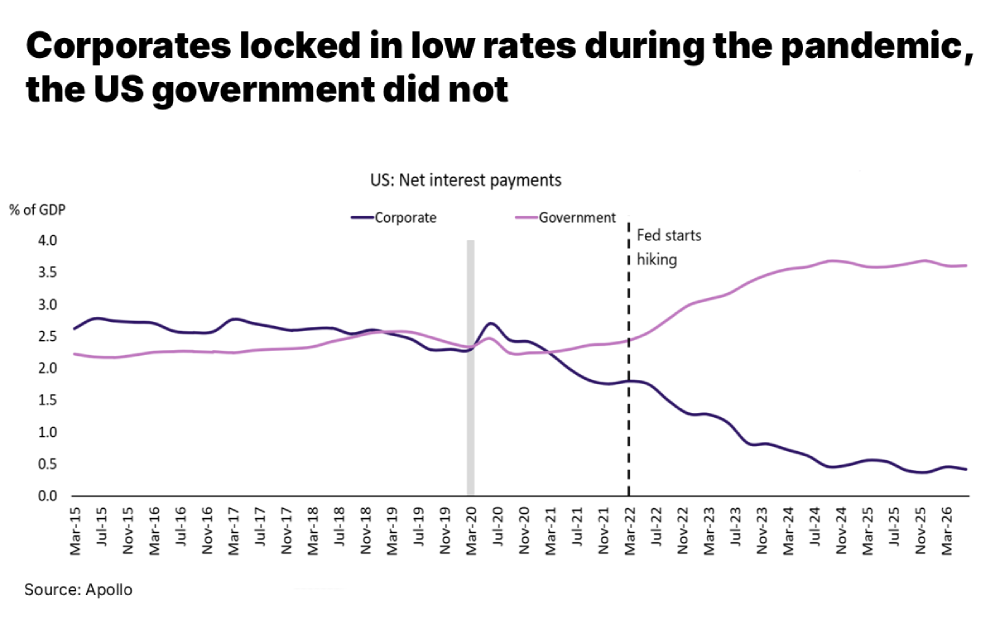
"Corporate America and households both locked in low rates during the pandemic," Slok wrote, referring to businesses that refinanced their debt and homeowners who secured low fixed-rate mortgages.
"Washington didn't," he said.
With Treasury yields climbing, annual interest expenses on U.S. government debt have ballooned from $500 billion in mid-2020 to $1.25 trillion today. That's more than the U.S. spends on defense each year.
Higher rates are making America's debt problem worse
Every time the Treasury refinances maturing debt or borrows to cover new deficits, it has to pay much higher interest rates than it did during the pandemic.
And now that Uncle Sam is issuing more and more short-term debt, that refinancing window is getting even shorter.
Goldman Sachs analysts have warned that higher rates will push up the government's debt-to-GDP ratio, meaning that "deficit reduction becomes necessary sooner to stabilize the debt."
Meanwhile, the ongoing sell-off in U.S. government bonds is making it even more expensive for Washington to borrow.
📌 Bottom line: Unlike homeowners with 30-year fixed-rate mortgages, Washington has to refinance large portions of its debt every year. So even if the Fed stops raising rates, the government's interest could keep growing.