🇨🇳 State-sponsored Nasdaq?


Morning Observers,
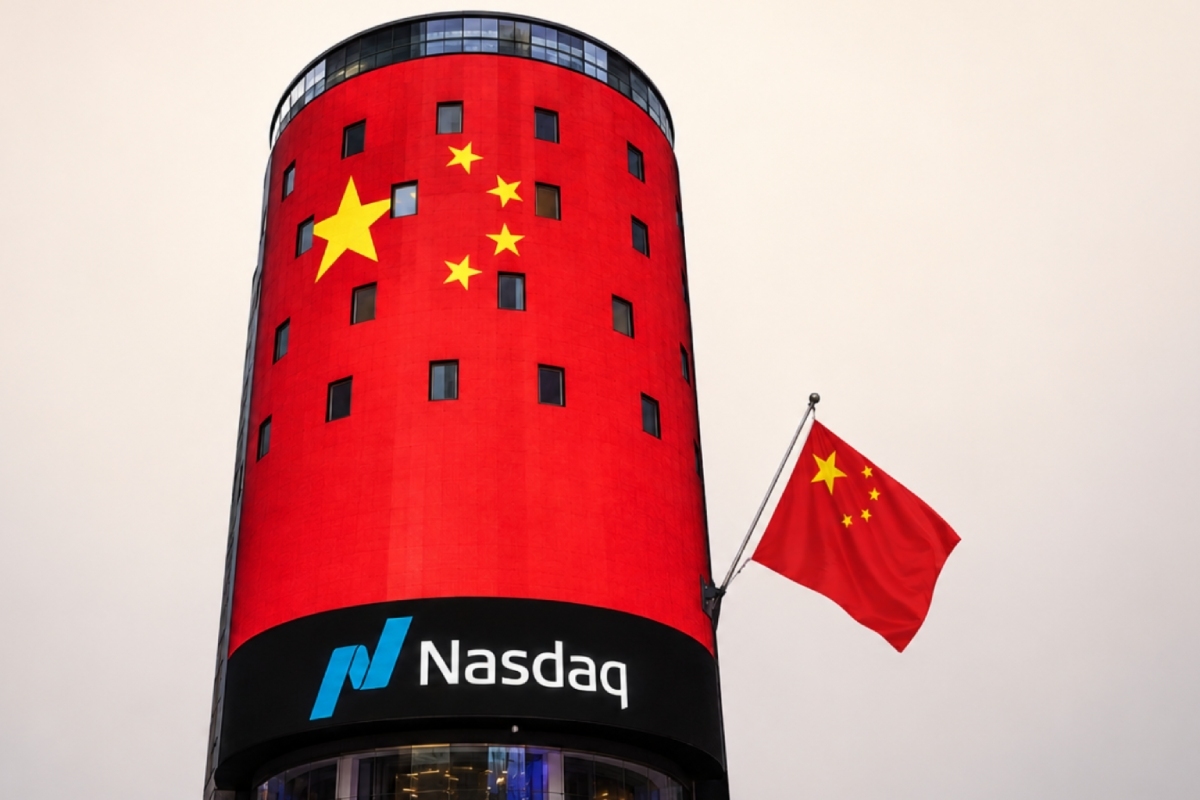
China is quietly building what seems to be a state-sponsored Nasdaq.
Last month, the CCP expedited the IPO of memory maker CXMT and pumped so much liquidity into the stock market that the stock surged 500% within a few hours.
It wasn’t a direct cash injection into CXMT.
Chinese tech had been in something of a bear market, and there were concerns that it could derail the debut of one of China’s most important AI companies.
So Beijing’s state-owned capital market operators deployed around $8.9 billion into Chinese tech to prop up the broader market. (Officially any link to the IPO was denied.)
But this wasn’t an isolated event because China is now manufacturing the entire launchpad for tech IPOs.
Beijing starts way before the companies go public.
For example, China formally launched its state-sponsored VC fund called the National Venture Capital Guidance Fund. The fund is expected to mobilize about $144 billion!
The government supplies anchor, risk-bearing capital and then tries to pull local governments, SOEs, banks, and private investors in behind it.
There’s also a massive $47.5 billion fund called Big Fund III for chip companies, with China’s Ministry of Finance and a few state banks as its largest shareholders.
Then Beijing built a special stock exchange called the Shanghai STAR Market.
STAR is essentially China’s equivalent of the Nasdaq, except it comes with a lot of exemptions for companies the CCP considers critical to its national goals.
For example, the exchange allows qualified tech companies to list without meeting normal revenue or profitability requirements. It also has a "pre-review" system that lets these companies iron out the paperwork before the formal process begins.
Finally, the CCP is now pumping liquidity into these debuts.
Public mutual funds were told to increase their Chinese stock holdings by at least 10% every year for three years. And state-owned insurers are instructed to invest 30% of their incremental annual premium income into stocks.
With that much capital directed to a relatively small number of tech companies, it’s not surprising that STAR trades at 105x earnings. But Beijing has thought through even that problem.
The People’s Bank of China introduced a swap facility in case that liquidity dries up.
It effectively allows select large financial institutions to use Chinese stocks as collateral to obtain government bonds, borrow cash against them, and redeploy that cash into the stock market.
The PBOC also allows listed companies to borrow money specifically for the purpose of buying back their own stock. And the financing is deliberately cheap. Banks could initially charge no more than 2.25%.
The reason behind all of this is that China is trying to mimic the American model where innovation is funded primarily through capital markets instead of state subsidies.
Only there’s a state-sponsored twist to it. At least for now.
- Dan Runkevicius, Editor

📉 Hiring just went negative
The U.S. economy unexpectedly lost 23,000 jobs in July, making it the third-worst month for hiring since the pandemic began in 2020. The unemployment rate edged lower, but largely for the wrong reason: 264,000 people left the labor force. Wage growth also slowed to 3.2% annually, its weakest pace in five years.
📉 Rate-hike bets collapse
Friday’s jobs report just made the Federal Reserve’s balancing act even harder. Policymakers are still dealing with inflation, but now they have a weakening labor market to worry about, too. Prediction markets responded quickly, with the odds of a September rate hike plunging to around 40% from more than 70% earlier in the week.
🥇 Gold is getting real money behind it
Gold futures are back above $4,400, and the rally isn’t being driven by rate speculation alone. Physical gold-backed ETFs attracted $3 billion in July, their biggest monthly inflow since April, lifting holdings to 4,068 tonnes. That’s a U-turn after a combined $11 billion flowed out in May and June.
🚀 SpaceX gets a Buy
Argus Research upgraded SpaceX to “Buy,” arguing that its heavy spending on AI infrastructure could pay for itself in less than a year as demand for computing capacity surges. The upgrade comes as SpaceX signals it’s on track to approach a $100 billion annualized revenue run rate by year-end, putting more attention on the economics behind its AI expansion.
🧠 SK Hynix is sending an AI signal
SK Hynix stock plunged more than 19% last week, but its spending plans tell a different story about AI demand. The chipmaker is planning a 54 trillion won ($38 billion) expansion of its South Korean manufacturing facilities as it races to roughly double production capacity and ease the global memory-chip shortage. The stock may be falling, but the company is still preparing for much more AI-driven demand.
The defense boom has an $846 billion receipt
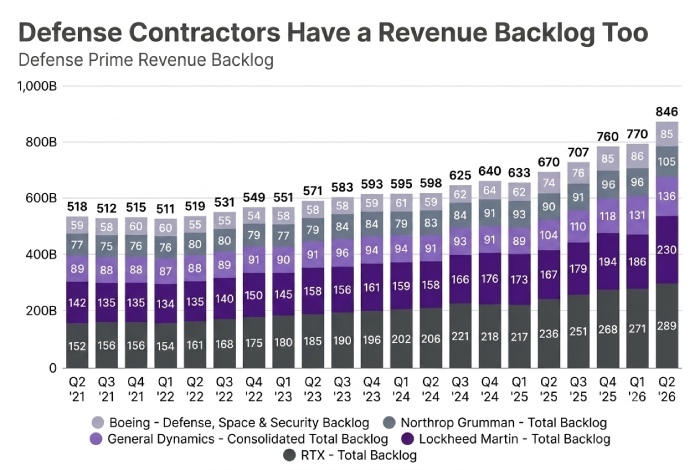
The AI boom gets all the attention for its eye-watering spending commitments. But one of the biggest backlogs in corporate America is quietly piling up somewhere much less fashionable: defense.
Defense’s backlog boom
The combined backlog at RTX, Lockheed Martin, General Dynamics, Northrop Grumman, and Boeing’s defense business reached roughly $846 billion in Q2 2026, according to Fiscal.ai data.
That’s up from $595 billion in early 2024 and just over $500 billion in 2021.
In other words, five defense giants are now sitting on roughly $250 billion more future business than they were just two years ago.
And those orders are already reaching the factory floor. U.S. defense orders and shipments have risen roughly 60% since 2020, with much of that increase coming over the past 18 months.
Wall Street isn’t buying everything
Defense stocks aren’t exactly undiscovered. The Dow Jones U.S. Select Aerospace & Defense Index is up around 12% this year, but the boom has produced some wildly different winners.
Boeing, for example, is up less than 2% this year as its commercial aviation problems continue to overshadow the defense boost, though shares have roughly doubled from their 2022 low.
By comparison, Lockheed Martin is up about 17% this year, while RTX has surged 42%.
That gap shows the limits of the backlog story. Having billions of dollars of orders is one thing, turning them into profitable production is another.
📌 Bottom line: Defense demand is hitting contractor order books and production lines, and companies that can add capacity fastest stand to benefit most.
The U.S. economy has an AI dependency problem
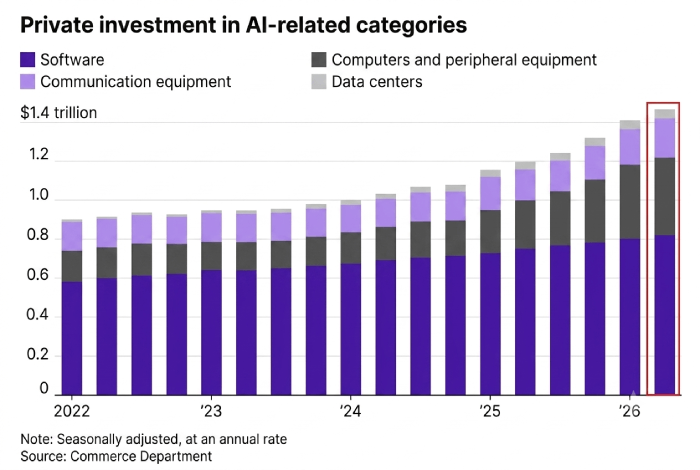
While economists debate what AI will eventually do to jobs and productivity, the money that is spent to build it is already moving GDP.
AI-related business investment is approaching a staggering $1.5 trillion annualized rate, up 25% from a year ago and about 50% in two years, according to Commerce Department data.
Computers and peripheral equipment have led the surge, with investment more than doubling in two years, alongside rising spending on software, communications equipment, and data centers.
The remarkable part is how much that now matters to the overall economy. AI-related investment has accounted for roughly 25% to 33% of recent U.S. GDP growth.
That makes AI spending less of a tech-sector story and increasingly a macroeconomic one.
Data centers just passed offices
AI's economic impact is also showing up in AI-adjacent industries, and perhaps the clearest evidence is in construction.
U.S. data center construction spending surged 46% year over year to a record $68 billion in June. Meanwhile, annualized office construction spending has fallen to $43 billion.
The reversal is striking. In 2022, office construction exceeded data center spending by roughly $57 billion. Today, data centers are ahead by about $25 billion.
That means America is quite literally building more places for computers than places for people to work. And this shift is driving real change across a number of industries and jobs.
But what happens if the AI narrative suddenly falls apart?
📌 Bottom line: AI spending is becoming large enough that a pullback would no longer be contained to Nvidia earnings or Silicon Valley valuations.