SK Hynix pulled biggest foreign IPO


Morning Observers,
SK Hynix just pulled off the largest US market debut by a foreign company in history.
The South Korean memory-chip maker raised $26.5 billion, topping Alibaba’s record-setting American debut and becoming the third-largest stock listing of any kind in history.
And investors did not need a discount to be convinced.
SK Hynix priced the deal at roughly a 3% premium to its shares in Seoul. Despite that, the offering was more than seven times oversubscribed, with investor demand reportedly approaching $200 billion.
That tells us something important about how dramatically the market’s perception of memory stocks has changed.
For decades, companies such as SK Hynix were treated as cyclical businesses, rising and falling alongside demand for PCs and smartphones.
But artificial intelligence has turned memory into something closer to critical infrastructure.
SK Hynix now controls an estimated 57% of the global market for high-bandwidth memory, which Nvidia and other AI companies need to connect their most powerful processors.
Investors are betting that this demand is not merely another semiconductor cycle.
And with $200 billion reportedly chasing just $26.5 billion worth of shares, investors appear increasingly desperate for new ways to play the AI infrastructure boom.
Let's dig in!
- Dan Runkevicius, Editor
|
Five things to know before opening bell
💾 Chip stocks rebound on AI optimism
Semiconductor stocks rebounded on Thursday, with the Philadelphia Semiconductor Index jumping 3% after Micron Technology pledged to boost spending on new U.S. manufacturing plants to $250 billion and SK Hynix’s U.S. pulled the biggest foreign IPO on record.
🤖 Meta finds new ways to monetize AI
Meta Platforms’ stock climbed on Thursday after the company unveiled a paid version of its most advanced AI model for developers, marking the first time businesses will pay for access to its flagship models. CEO Mark Zuckerberg said the offering will be among the industry’s most affordable, giving Meta a new revenue stream as competition in generative AI intensifies.
🛢️ Oil prices pull back despite Persian Gulf flare-up
Oil prices retreated Thursday even as the United States and Iran exchanged strikes, suggesting investors were looking beyond the latest escalation. U.S. West Texas Intermediate crude fell about 2% toward $72 a barrel, while Brent crude slipped nearly 2% to around $76.55 after briefly topping $80 earlier in the week.
🇨🇳 Chinese inflation sends mixed message
China’s latest inflation data painted a mixed picture. Consumer prices rose 1% in June, below economists’ expectations of 1.1% and down from May’s 1.2% pace, pointing to cooler consumer demand. At the same time, producer prices climbed 4.1% from a year earlier, the fastest increase in nearly four years.
🏦 Fed’s Williams keeps focus on inflation
New York Fed President John Williams said Thursday that inflation remains the greater risk to the Fed’s dual mandate, signaling that interest rates may need to remain higher for longer. Williams reiterated that the Fed remains committed to returning inflation to its 2% target and said policymakers would respond if inflation picks up.
Silver just flashed one of its rarest "buy" signals
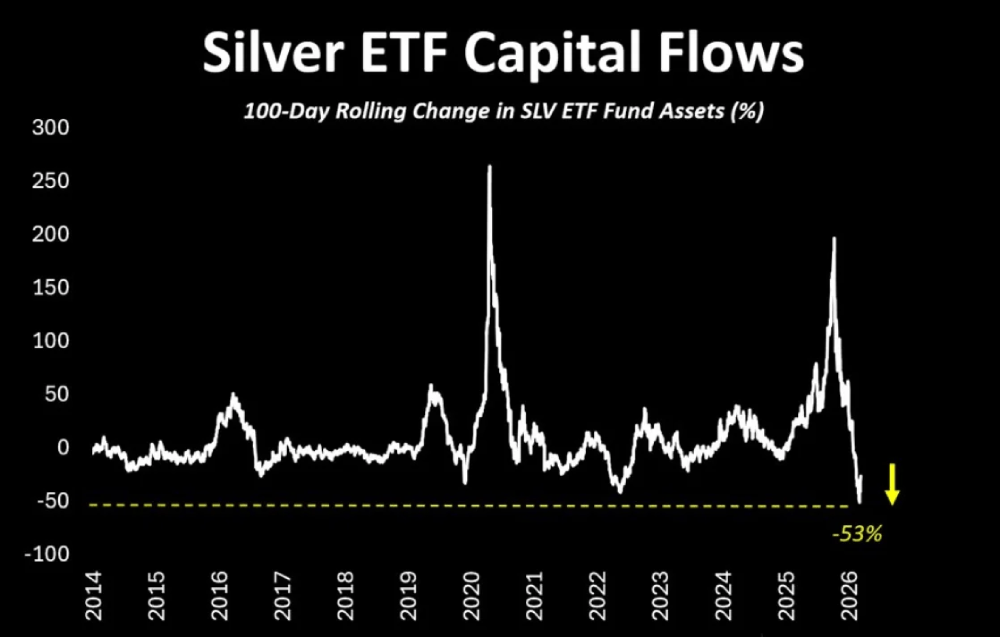
Following a historic six-month reversal, investors are waiting for silver to find a bottom.
But the bigger story may be how quickly they’ve abandoned the precious metal. Historically, that kind of capitulation has occurred near the end of major sell-offs rather than the beginning.
Investors have never abandoned silver this fast
Silver ETF holdings have fallen 53% from their 100-day peak, marking the largest drawdown on record in both percentage and dollar terms, according to data from Azuria Capital and Bloomberg.
A similar sell-off occurred near the market lows in March 2020 and 2022, suggesting investor pessimism has rarely reached these levels outside major turning points.
The futures market tells the same story. Silver has fallen nearly 50% from its January peak near $116 per troy ounce.
Silver demand remains strong
For long-term investors, silver looks considerably more attractive at today’s prices than it did six months ago, even though another leg lower remains possible, says Jan Skoyles, head of research at GoldCore.
Skoyles argues the crash hasn’t altered silver’s “core demand story,” with more than half of global demand coming from industrial applications.
For now, a stronger dollar, higher Treasury yields, and shifting Fed expectations continue to weigh on prices. But those factors can change quickly, while silver’s structural demand story remains intact.
📌 Bottom line: Investors have rarely dumped silver this aggressively outside major market lows. That doesn’t mean the bottom is in, but history suggests much of the panic selling may already be over.
The yen is breaking Japan... and boosting Wall Street
The Bank of Japan has spent months trying to support the yen, which has fallen to 40-year lows against the U.S. dollar. Yet every failed attempt keeps one of the world’s biggest trades alive.
Japanese businesses are taking the hit
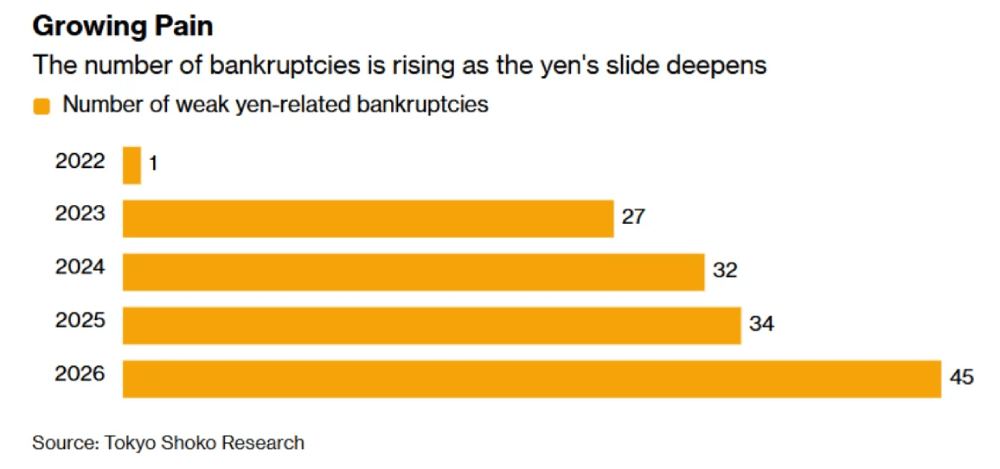
The yen’s slide has pushed corporate bankruptcies linked to currency weakness to their highest level since at least 2022, according to Tokyo Shoko Research.
45 companies failed during the first half of the year due to a sliding yen, up more than 30% from a year ago, with wholesalers among the hardest hit because they rely heavily on imported goods.
Large exporters can offset some of the damage by earning more overseas. Smaller companies don’t have that luxury, leaving many squeezed by rising import costs they can’t easily pass on.
The yen carry trade
The irony is that higher Japanese interest rates were supposed to strengthen the yen. The opposite happened instead, keeping the yen carry trade alive.
The carry trade works by borrowing cheaply in yen and investing in higher-yielding assets elsewhere.
Higher Japanese rates make those loans more expensive, but a weaker yen reduces the cost of repaying them once investors convert their profits back into Japanese currency.
As long as the yen keeps falling, that exchange-rate benefit can outweigh the higher borrowing costs.
By any measure, the yen carry trade is massive. Estimates range from hundreds of billions of dollars in direct borrowing to several trillion dollars once derivatives and broader speculative positions are included.
📌 Bottom line: A weak yen continues to bankroll global markets' growth, while domestic Japanese businesses are struggling to survive.