SK hynix crushes earnings!

Morning Observers,
As might have been expected from early indicators, AI earnings are flipping the "peak growth" narrative.
There were two telltale signs that AI spending wasn't letting up before Big Tech started reporting.
First, exports from South Korea and Taiwan are surging. These economies control two of the biggest AI bottlenecks - memory and chip foundries - so surging exports are a strong indication that demand is still high.
Second, the world's biggest chip "factory," TSMC, beat on both the top and bottom lines earlier this month.
Perhaps the most important clue was that more of the sales growth came from high-performance computing (HPC), which is the category TSMC uses for AI chips.
Today we got another win from South Korea. The world's second-biggest memory maker, SK hynix, beat already astronomical expectations.
Profits grew nearly sevenfold. Both volumes and prices are rising, and the company now earns a record 80 cents on the dollar at an operating level!
You just can't have that pricing power if demand is past peak growth.
There's been a lot of talk about how the AI trade will go off the rails, and those are very valid concerns. But let's just play devil's advocate for a moment and talk about what could go well, in particular for Big Tech:
- Against all expectations, the 10-year yield at 5.3% didn't break the stock market. On the contrary, we're coming up on the fifth consecutive week of net inflows into stock funds, and yields have now come back to sub-5% levels
- My back-of-the-envelope estimate is that Trump accounts for 0.6 percentage points of the 10-year term premium. A blue wave could de-Trump some of that
- Rental rates for older-gen GPUs are rising (h/t to Peter Berezin), which supports Big Tech's argument that capex can be depreciated over a longer timeframe
- AI training costs are flatlining relative to direct AI revenue. Anthropic's training expenses were 159% of its revenue a year ago. Now they're half its top line
- As Meta shows, Big Tech is successfully augmenting its core products with AI, and the resulting incremental revenue helps with ROI math
Next up are Microsoft and Alphabet reporting after the close today.
- Dan Runkevicius, Editor

✈️ Boeing loses $15 billion in market value
Boeing stock plunged more than 10% after the aircraft manufacturer reported a third-quarter net loss and lowered its forecasts. The selloff wiped $15 billion off the company's market value, putting the stock on track for its worst daily decline since April 2025.
🤖 JPMorgan sees AI spending reaching $5.5 trillion
Fears of an AI spending bubble haven't shaken JPMorgan's outlook on the sector. In a new report, the bank projected global AI capital expenditures will reach $5.5 trillion by 2030, up from $900 billion in 2026. If those forecasts hold, semiconductor makers and other AI infrastructure suppliers could see enormous demand for years to come.
📊 U.S. consumer confidence rebounds
Americans grew more optimistic about the economy in October, with the University of Michigan's Consumer Sentiment Index rising seven points to 72.7. It was the index's first increase in four months. Consumers reported better views of the job market and business conditions, while the measure of current economic conditions reached its highest level since April.
🏗️ America's AI boom is running out of warehouses
The data center construction boom is creating an unexpected shortage of industrial space. Texas billionaire and real estate developer Ross Perot Jr. said the number of vacant U.S. warehouses larger than 1 million square feet and suitable for data center equipment has fallen to just 15–20, from a typical inventory of around 50. "You've got this industrial boom going on in the United States, and we're running out of warehouses," Perot said.
📈 Investors pour another $28 billion into global stocks
Higher borrowing costs and escalation in the Persian Gulf haven't stopped investors from buying stocks. Global equity funds attracted $28.2 billion in the week ending Oct. 21, their fifth consecutive week of inflows, according to new LSEG data. Over those five weeks, investors poured a combined $138.6 billion into equity funds.
Meta just made $65 billion. So where did all the cash go?
Meta's advertising business has generated billions in cash every quarter for years, giving Mark Zuckerberg plenty of room to pursue his ambitions.
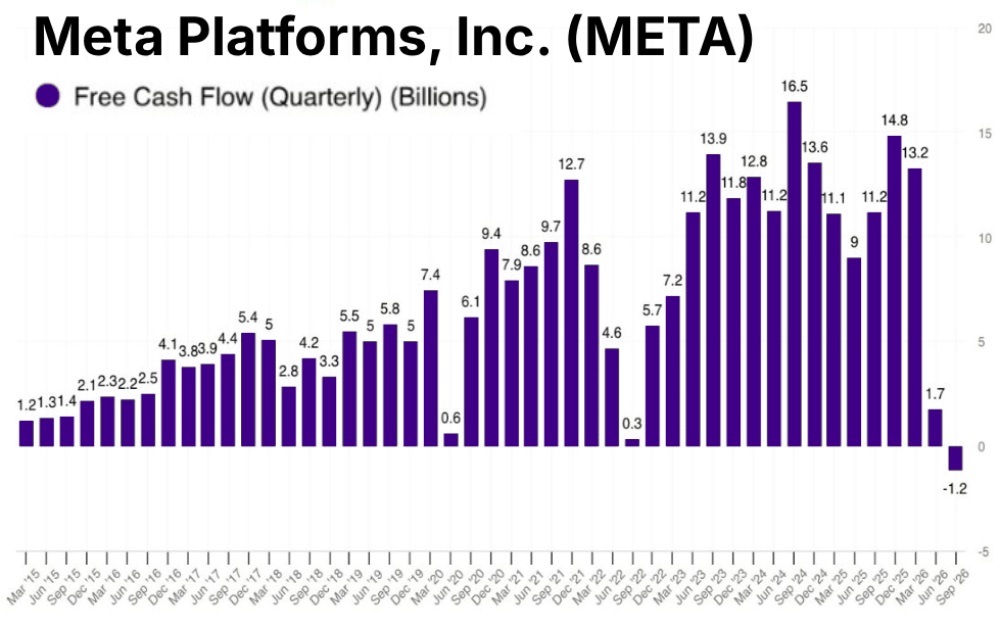
That engine is still growing fast, but AI spending has now pushed Meta's free cash flow into the red.
Meta's cash flow turns negative
During its latest quarter, Meta reported negative free cash flow of $2.1 billion. Excluding finance lease principal payments, the shortfall was roughly $1.2 billion.
By comparison, Meta routinely generated more than $10 billion in quarterly free cash flow in recent years.
Free cash flow measures the cash left after capital expenditures. Meta's reported figure also subtracts finance lease principal payments.
A negative reading means the company spent more on those items than it generated in operating cash that quarter.
The cost of Meta's AI ambitions
The cash flow reversal came despite another blockbuster quarter. Meta generated $64.6 billion in revenue, up 26% from a year earlier.
The problem is how much Meta is spending. Capital expenditures totaled $34.9 billion during the quarter, largely driven by its massive investment in AI infrastructure.
Meta has also raised the lower end of its full-year capital expenditure forecast to $135 billion, with the upper end remaining at $145 billion.
The payoff is still ahead
As we wrote earlier this week, Meta plans to monetize Muse through shopping commissions and high-margin AI inference for enterprise clients.
But so far, the model is too compute-hungry to roll out to a wider audience, and Meta hasn't given a timeline for when its AI investments will earn a return.
Meta believes it can make Muse 10x more efficient as soon as next year. In the meantime, the infrastructure bill continues to eat into its cash flow.
📌 Bottom line: Meta's advertising business remains highly profitable, and Muse could open up new ways to make money. But the AI investment is consuming cash now, while the payoff is yet to come.
Brazil's bond market is in free fall
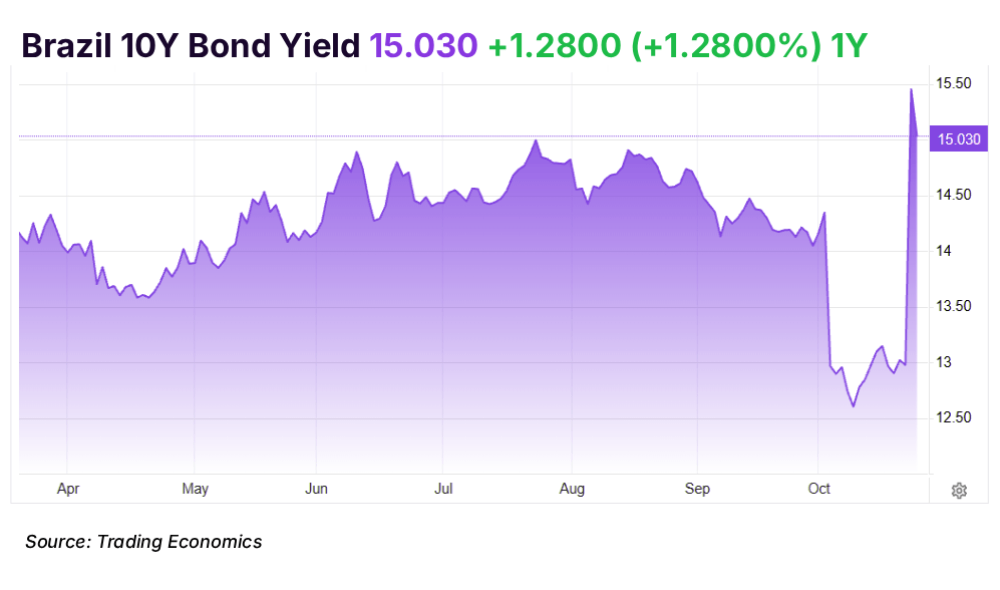
Brazil had its own "Black Monday" this week after Lula da Silva's election victory. The country's main stock index plunged 17%, small-cap stocks fell 30%, and the Brazilian real tumbled 12%.
But the biggest bloodbath was the bond market where yields surged to levels that would normally set off alarm bells well beyond Brazil.
Bond market carnage
Brazil's 10-year government bond yield surged 300 basis points in a single day, approaching 16%.
Lula's victory over Bolsonaro has raised concerns about higher government spending, particularly among investors who had expected Bolsonaro to pursue greater fiscal restraint.
"The fiscal side has always been Brazil's Achilles heel, and a 7-8% budget deficit and 70% net debt-to-GDP ratio leave Brazil vulnerable in a global bond sell-off," wrote ING strategist Chris Turner.
Higher yields also mean Brazil will have to cope with higher borrowing costs, potentially exacerbating fiscal problems investors are already concerned about.
No contagion (yet)
Perhaps the most surprising development is how little the turmoil has affected markets elsewhere.
Despite Brazil's position among the world's largest economies, there has been "virtually no corresponding reaction across global stock markets, cryptocurrencies, precious metals, or safe havens," according to analyst Michael Gogel.
Brazilian bond turmoil has spilled over into other markets before, mainly across emerging economies.
For example, after Brazil devalued the real in 1999, short-term interest rates rose by as much as 500 basis points in Argentina and Mexico, and bond spreads widened across the region.
The shock was brief, however, and the IMF reported little impact on advanced economies.
📌 Bottom line: So far, the spillover looks limited. Brazil’s real and stocks recovered some ground on Tuesday, and analysts reported little contagion across the region.