Should you fear S&P 500’s top 10 stocks?

Morning Observers,
There's been a lot of talk about market concentration and its dangers to passive/ETF investors. So let's put things in perspective.
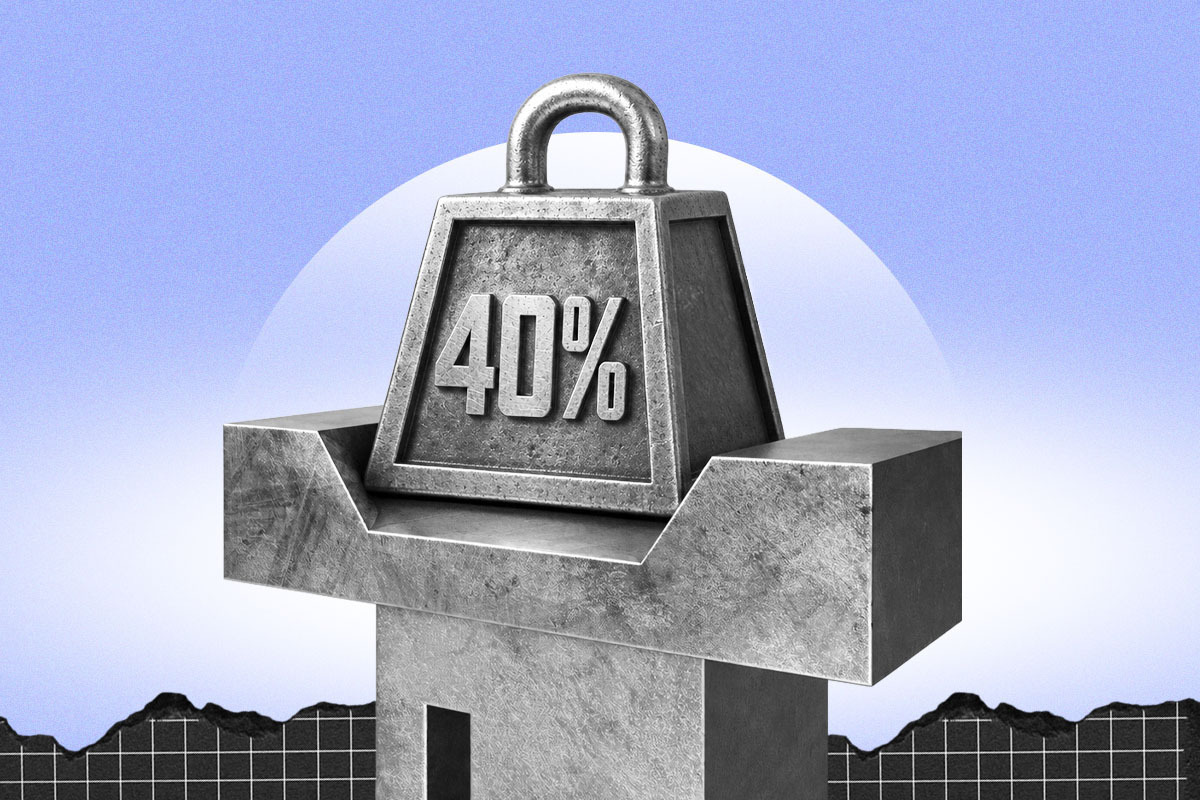
As of today, the 10 biggest stocks in the S&P 500 make up around 40% of the index, the highest share on record.
Not only is concentration at its highest, but the stock market has narrowed at a pace never seen before. The top 10's share has nearly doubled since ChatGPT launched.
And, not surprisingly, all the constituents at the top are tech stocks.
Now although unprecedented in the U.S., this concentration is on the lower side globally. In fact, nearly all stock markets in developed economies have higher concentrations.
So why has the U.S. market suddenly narrowed down to tech stocks?
Some people call it AI euphoria and liken it to the dot-com concentration in tech stocks. But this time around, tech stocks are proving their place at the top with financials.
During the dot-com boom, the top 10 stocks claimed a 27% share of the S&P 500 but contributed only 15% of its earnings, most of which came from non-tech stocks.
Today the top 10 stocks claim roughly 40% of the S&P 500, and they contribute nearly the same share of earnings: 38.7%.
Perhaps more surprising, the trajectory of concentration growth is almost in line with the trajectory of the top 10 stocks' earnings contributions.
That means the top 10 stocks aren't rising on multiple expansion (or, in pundits' lingo, euphoria), but on the actual economic output they create.
So the real question isn't whether the stock market's concentration holds, but whether the economy and policies supporting it can hold.
There's a bearish and bullish take on this.
The bearish case is that tech companies overestimated AI's economic effect in the near term and got ahead of themselves. Just like telecom companies laying out fiber optics only to scrap 80% of them after the dot-com bust.
The bullish case is that we underestimate AI's effect on the economy and, perhaps more importantly, geopolitics. If AI is turning into an arms race, the top 10 companies driving it are simply too big and important to fail.
Normally, companies with such moats and pricing power would eventually be broken up by regulators or diminished by global competition. Not in an arms race.
Washington's investment in Intel is a good example of how the state is bankrolling a chip foundry that would otherwise be economically unattractive and uncompetitive.
Interesting fact: the U.S. had its longest stretch of high market concentration during the Cold War, dominated by capital-intensive, strategically important industrial companies.
- Dan Runkevicius, Editor

🇵🇱 Polish stocks are leaving bigger markets behind
Poland has quietly become one of the world’s stronger stock markets this summer. The benchmark WIG20 has jumped 15% over the past two months and closed at a record high Friday, thanks to improving corporate earnings and foreign capital flowing into the country’s $1 trillion economy. Since June, Polish stocks have outperformed the S&P 500, the Stoxx Europe 600, and the MSCI Emerging Markets Index.
📉 JPMorgan says buy the dip
JPMorgan strategists believe investors should use any near-term pullback in stocks as a buying opportunity, arguing that strong corporate earnings can keep the rally intact even as central banks move toward rate hikes. The bank remains positive on stocks and says moderate rate hikes shouldn't derail the market unless inflation expectations begin to worsen.
🚕 Uber taps Europe’s debt market
Uber is turning to Europe’s bond market to help finance its growing footprint in the region. The company is selling euro-denominated debt with maturities stretching from three to 20 years, joining a surge in U.S. borrowers raising money in euros this year. The move follows Uber’s $14.8 billion agreement to buy German food-delivery company Delivery Hero, whose board recently approved the offer.
🧠 Nvidia CEO says AGI has arrived
Nvidia CEO Jensen Huang says OpenAI’s GPT-6 Astra, trained on more than 100,000 Nvidia Grace Blackwell GPUs, marks the arrival of artificial general intelligence. AGI broadly refers to AI that can handle a wide range of intellectual tasks rather than being built for a specific purpose. Huang also said another 400,000 GPUs are coming online, adding to the enormous amount of computing capacity already being built for AI.
📈 Copper breaks another record
Copper surged to an all-time high on the London Metal Exchange, with three-month futures reaching $14,533 a tonne and surpassing the previous record set in January. The latest rally has been driven partly by expectations that Trump could extend U.S. tariffs to refined copper imports.
The inflation indicator nobody is watching
The Fed may have a bigger inflation problem than CPI suggests.
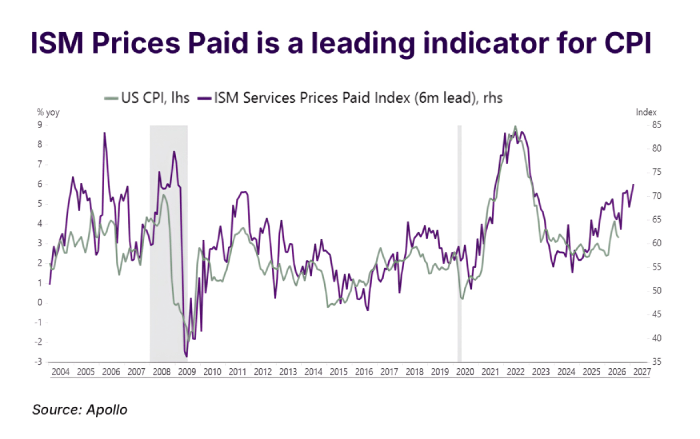
One obscure indicator is back near levels seen during the 2021-2022 inflation surge, and it could help explain why some Fed officials are suddenly talking about another rate hike.
ISM's prices paid index
The ISM Services PMI rose to 55.4 in August from 54.1 in July, its strongest reading in six months. But the bigger story may have been the under-the-radar prices paid index, which measures what businesses are paying for inputs.
Apollo's Torsten Slok points out that the index is approaching levels last seen in 2022, when inflation was spiraling out of control.
Slok compared the prices paid index with CPI six months later, based on the historical tendency for higher business costs to eventually reach consumers.
The two have tracked surprisingly closely, suggesting today's rise in input costs could show up in inflation readings later this year. "We now expect the FOMC to raise rates at its September meeting," Slok wrote.
A split Fed
That may explain why the Fed is suddenly sounding more divided on what comes next.
Chair Kevin Warsh warned at Jackson Hole that progress on inflation has stalled. Cleveland Fed President Beth Hammack went further last week, saying it's time to act to contain consumer prices.
Other members, including Christopher Waller, aren't there yet. They are leaning toward holding rates this month unless inflation data surprises to the upside.
📌 Bottom line: A hot CPI print would be easy to dismiss as one bad month. ISM's prices paid index suggests the inflation comeback may already be underway.
The silver lining behind bond armageddon
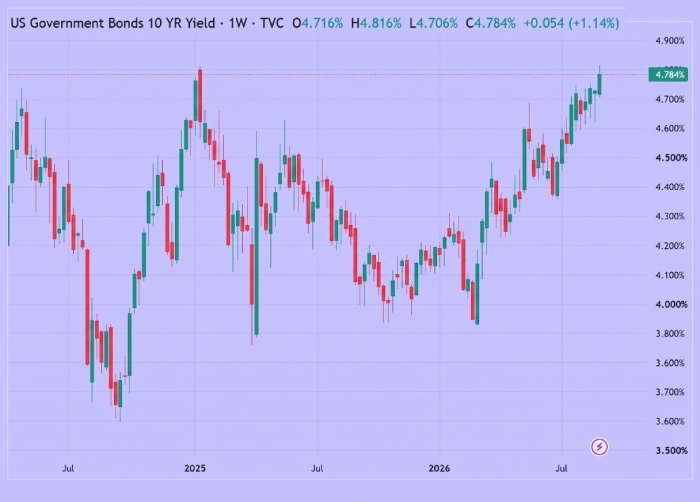
The market is sweating about rising bond yields, but JPMorgan thinks they may be sending the opposite message: the economy is stronger than investors expect.
Higher yields aren't always bad news
In a recent note to investors, JPMorgan strategist Mislav Matejka said he doesn't expect rising yields to derail the global stock rally.
The reason comes down to what's driving them.
JPMorgan believes much of the move reflects stronger economic growth rather than another inflation shock. That leaves corporate earnings growing without forcing central banks into the kind of aggressive rate hikes that would threaten stocks.
"We do not expect rising bond yields to present an insurmountable obstacle for stocks, as most of the up-move should be reflecting stronger activity momentum," Matejka wrote.
JPMorgan expects the rally to spread beyond AI as a result, favoring stocks that benefit from a stronger economy.
Earnings are doing the heavy lifting
It's an interesting call considering what stocks have already absorbed this year. The Iran war, resurgent inflation, and rising bond yields have all failed to derail the rally, with the S&P 500 up 13% this year.
Earnings may explain why.
The S&P 500's blended year-over-year earnings growth rate reached an estimated 52% in the second quarter, its strongest growth since 2021, according to FactSet data.
📌 Bottom line: JPMorgan's bullish case depends on growth and earnings staying strong enough to outrun higher yields. With inflation already running hot, that cushion could get tested quickly.