🚀📉 Scary day for SpaceX



Morning Observers,
So here’s what actually happened with Situational Awareness, according to anonymous sources “familiar with the matter.”
This 24-year-old former OpenAI researcher wrote a viral 165-page essay on superintelligence and convinced a lot of rich people in Silicon Valley to bankroll his new hedge fund.
The fund invested exclusively in AI companies, including both private (holds a $3.5B stake in Anthropic) and public.
What eventually got Aschenbrenner into trouble was the fund’s public positions bought with a lot of leverage. By many accounts, Situational Awareness borrowed roughly $3 to $4 for every $1 of investor capital, plus options.
The biggest bets were AI infrastructure plays, including SK hynix, Sandisk, CoreWeave, Bloom Energy, and Nebius, which got wiped out during the latest AI sell-off.
The fund also took short positions, again using margin and options, in stocks like Adobe that they thought were on the chopping block.
The irony is that Situational Awareness got margin-called on the same day Amazon released earnings that flipped AI sentiment. Since then, many of the same stocks the fund was forced to dump have reversed.
And the Citadel fund that bought most of the public portfolio at a 10% discount gained 14.2% in July for its best month on record.
So, in one way, Situational Awareness got incredibly unlucky and was just a hair from getting out of its margin hole.
This story carries many classic takeaways about leverage risks, but the bigger message here is that, so far, this AI boom appears to be successfully cleansing itself of excesses.
And that alone inspires confidence.
- Dan Runkevicius, Editor

📉 S&P 500 snaps its winning streak
The S&P 500’s four-day winning streak ended Wednesday after early gains faded late in the session. Meanwhile, earnings remain strong. Nearly 90% of companies that have reported so far have beaten Wall Street estimates.
🚀 SpaceX’s $101 billion supply wave
Elon Musk’s SpaceX is facing a major supply event on Thursday when roughly $101 billion worth of shares become eligible for trading. Up to 911.5 million shares held by early investors and employees could hit the market, raising the risk of a major sell-off.
💾 Retail investors are cashing out of chip stocks
Retail traders are taking profits in semiconductor and memory stocks, according to new data from Citadel Securities. Investors sold the group at roughly 20 times the normal weekly pace during the week ended July 30. It was the third week of net selling in the past month after 10 straight weeks of buying.
⚠️ AMD beats estimates, but the outlook disappoints
AMD reported better-than-expected second-quarter results, but the stock still fell after management issued a more cautious revenue outlook for the current quarter. The forecast came in below some of Wall Street’s more bullish estimates, showing just how high expectations have become for anything tied to AI.
👷 Weak jobs data points to a cooling labor market
U.S. private payrolls rose by just 44,000 in July, according to ADP, well below expectations for 70,000. The report points to a slowing labor market ahead of Friday’s closely watched jobs report. But for now, it still looks more like a gradual slowdown, giving the Fed little reason to rush into a policy change.
The S&P 500’s secret AI accounting boost
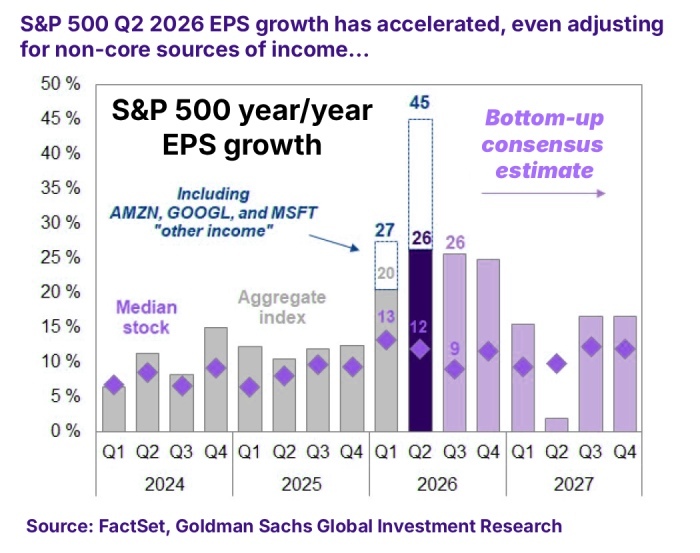
The S&P 500 is posting one of its strongest earnings seasons in years.
The catch is that a surprising share of that growth didn’t come from selling more products or services but rather from companies reevaluating their investments.
The AI markups
S&P 500 earnings are on track to grow 45% year-over-year in the second quarter, far exceeding the 22% growth analysts had expected, according to Goldman Sachs.
But roughly 19 percentage points of that growth came from Alphabet and Amazon’s combined $151 billion in “other income,” primarily gains on equity investments rather than core operations.
Many of those gains were linked to appreciating investments in the AI segment.
Amazon’s stake in Anthropic has surged in value, while Alphabet booked sizable investment gains across its equity portfolio, including SpaceX.
If we strip those gains out, and S&P 500 earnings growth falls to 26%, not far from the consensus estimate.
AI is inflating earnings, not just stock prices
Investors have spent two years watching AI inflate valuations. This quarter, it started inflating the profits used to justify those valuations.
Although Alphabet and Amazon inflated this figure, that still marks a seventh consecutive quarter of double-digit growth. There’s also much less concentration in earnings growth.
Companies outside of the Mag 7 grew earnings at 22.8%, their strongest pace since 2021. And four of the five biggest earnings contributors were also outside the Mag 7.
📌 Bottom line: The AI trade is starting to show up in a new place: corporate income statements. That makes it more important than ever not to take earnings at face value.
Did central banks put a floor on gold prices?
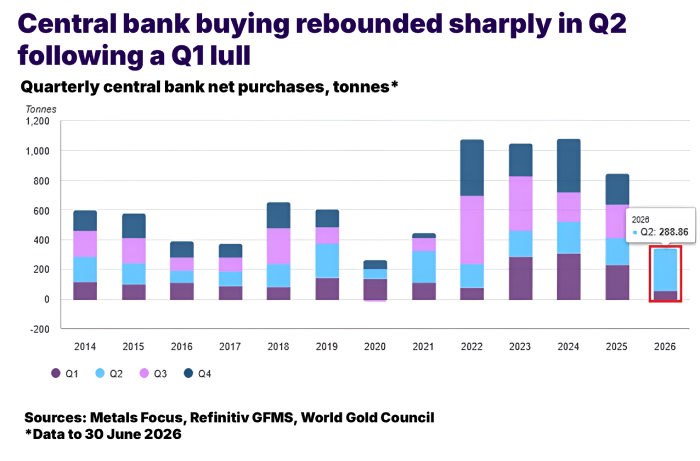
Gold’s months-long correction left investors searching for a floor. The latest central bank buying data suggests they may have already found one.
Central banks’ quiet accumulation
Central banks bought 289 tonnes of gold in the second quarter, a 407% jump from the previous quarter and the strongest pace of official buying since late 2024, according to the World Gold Council and Refinitiv.
Poland, Uzbekistan, and China led the purchases as central banks continued diversifying reserves away from the U.S. dollar.
The buying spree suggests central banks remained firm buyers even as gold briefly dipped below $4,000 in June, a 28% correction from its January peak.
Peak pessimism over?
According to GBI chief economist Trey Reik, sentiment toward gold is the most bearish he has seen in four decades. And the speculative excess that fueled January’s rally has likely now been fully flushed out.
Investors spent much of the correction pricing in higher oil prices from the Iran war and higher-for-longer interest rates. But that narrative also flipped on Wednesday.
That helps explain gold’s recent surge and adds confidence that the worst may already be behind it.
📌 Bottom line: The latest central bank reserve data suggests central banks may have put a floor under gold prices during the most bearish stretch for the metal in years.