📈 Record high (not AI FOMO)

Morning Observers,
The stock market is back at an all-time high, and for once in years, it has nothing to do with AI FOMO.
By far the biggest reason is that corporate America is making far more money than anyone expected.
86% of companies have beaten earnings, which is the strongest beat rate since 2021. And earnings grew at an insane 47.4% compared with a year ago.
Although Alphabet and Amazon inflated this figure, and if we strip those two out, S&P 500 earnings growth drops to 28.8%, that still marks a seventh consecutive quarter of double-digit growth.
There’s also much less concentration in earnings growth.
Companies outside of the Mag 7 grew earnings at 22.8%, their strongest pace since 2021. And four of the five biggest earnings contributors were also outside the Mag 7.
Another reason is that most of this earnings growth came from margin expansion.
Last quarter, corporate America had its most profitable stretch in history. The S&P 500’s net profit margin hit a record 15.7% in the second quarter, up from the previous record of 14.8%.
Even excluding Alphabet’s giant investment gain, margins would still land at a very healthy 14.4%.
Tech companies are obviously doing much of the heavy lifting thanks to the digital nature of their businesses and still minimal marginal costs.
But seven sectors outside tech reported higher margins than a year ago, and eight are above their five-year averages.
The risk is that margins tend to eventually mean-revert. Tech is vulnerable to rising depreciation from all its AI investments, while other sectors are relying on a strong consumer against all odds.
Finally, investors are so paranoid about a dot-com-style crash that the fear itself is unwinding many of the excesses. Take South Korea and chip stocks in general.
Lenders are also getting picky and demanding stronger protections.
High-tech bond issuance surged nearly 160% during the first half of 2026, but credit spreads are widening with each new round of borrowing.
That financial discipline is forcing the market to separate companies already converting AI into earnings from those selling little more than an expensive promise.
The S&P 500 trades at ~19.6 times expected earnings, which is below its five-year average. But that valuation assumes earnings will grow another 27.4% in the third quarter, 25.2% in the fourth, and 29.1% for the full year.
So, there’s plenty priced in, but it’s not all banking on the AI pipe dream.
- Dan Runkevicius, Editor

💼 Jobs data keeps the Fed focused on inflation
The U.S. labor market remains strong, giving the Fed little reason to shift its focus away from inflation. According to the monthly JOLTS report, job openings edged down to 7.36 million in June, coming in slightly below expectations, while hiring ticked higher, suggesting demand for workers remains relatively steady.
🤖 Palantir’s blowout quarter calms AI fears
Palantir delivered a blockbuster quarter, sending its stock up 25% after reporting what CEO Alex Karp called “otherworldly” results. Commercial revenue soared 149% year over year, prompting the company to raise its full-year revenue forecast above $8.1 billion. Beyond Palantir itself, the results offered a broader vote of confidence for the AI trade.
🎧 Spotify grows users, but investors want more
Spotify added more listeners in the second quarter, growing its global user base 12% year over year to 777 million. But bigger audiences aren’t translating into stronger financial results just yet. Revenue of $5.5 billion missed expectations despite the company returning to profitability, reinforcing concerns that subscriber growth is slowing in mature markets while many users in developing regions remain on free plans.
📉 Bond market bets on fewer Fed hikes
U.S. Treasury yields declined on Tuesday over signs of diplomatic progress between the U.S. and Iran. With inflation fears taking a back seat, investors scaled back expectations for multiple Fed rate hikes this year. Yields fell 3–4 basis points across the curve, with the 2-year Treasury dropping to its lowest level since July 21 and the benchmark 10-year yield slipping to 4.64%.
🏦 Fed official keeps investors guessing on rates
Central bankers continue to offer little guidance on the path of interest rates. Speaking on Tuesday, Fed official Anna Paulson said she is keeping an “open mind” about future policy decisions, declining to signal the likely path. Her vote to leave rates unchanged at last week’s FOMC meeting suggests she was comfortable with the Fed’s decision to stay on hold for now.
Oracle’s debt problem has united stock and bond investors
Oracle’s stock has already lost more than half its value since its June peak.
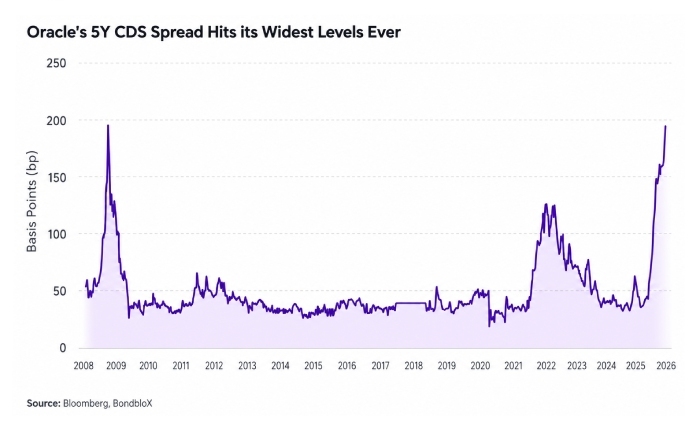
The bond market, however, is becoming even more concerned, with the cost of insuring Oracle’s debt now at a record high.
Why Oracle’s credit risk is climbing
One way investors measure a company’s financial risk is through credit default swaps (CDS), which are essentially insurance against a company failing to repay its debt.
The more expensive that insurance becomes, the greater the concern about the company’s financial health.
Oracle’s five-year CDS spread has climbed from 1.44% at the start of the year to 2.15%, its highest level on record.
Few investors expect Oracle to default. But the sharp increase in insurance costs reflects growing concern over how much debt the company is taking on.
Growth versus cash flow
Stock and bond investors often come to very different conclusions about the same company.
That’s because they don’t judge companies in the same way. Shareholders focus on future growth, while lenders focus on one question: Will Oracle generate enough cash to comfortably repay what it owes?
This time, however, both groups appear to agree that Oracle’s situation is universally bad.
📌 Bottom line: Oracle’s debt problem has become so serious that even stock investors are jumping ship.
KOSPI: The victim of its own (leveraged) success?
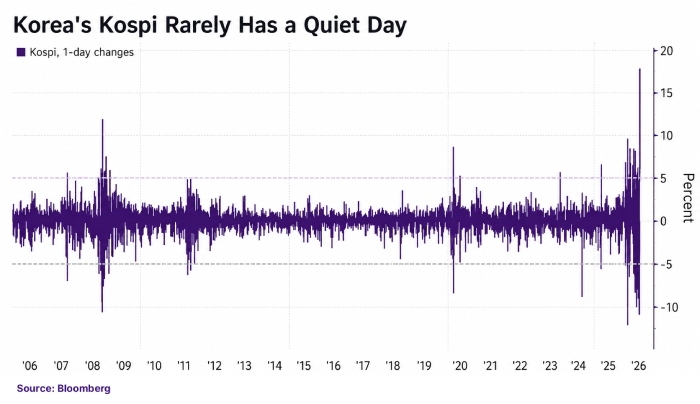
The KOSPI is having the most volatile year in its history.
The index has moved at least 5% in a single session 32 times this year, or roughly once every four trading days. That is the highest frequency since the benchmark launched in the 1980s.
Too much of a good thing
At one point this year, Samsung, SK Hynix, and leveraged ETFs tied to the two companies accounted for more than 70% of all trading in the Korean market.
As investors crowded into the same AI winners, the KOSPI surged more than 270% in the 18 months leading up to its June peak above 9,300.
The frenzy briefly made South Korea the world’s fifth-largest stock market, with a valuation exceeding $5 trillion. But it took only a few concerns to send the Korean market crashing.
Investors started questioning whether Chinese AI companies could narrow the technology gap after Moonshot released low-cost AI models reminiscent of DeepSeek’s disruption in early 2025.
Meanwhile, the blockbuster market debut of Chinese memory-chip maker CXMT raised fresh concerns about future competition for South Korea’s chip giants.
📌 Bottom line: The KOSPI’s rally became dangerously dependent on the AI memory theme. If investors start banking on efficiency gains from China, South Korean stocks are in for another roller coaster.