Real reason investors hoard cash

Morning Observers,
If this is a bubble, why are investors hoarding the most cash since 1990?
On one hand, individual investors are bending over backward to cash in on AI. Citadel Securities says retail options trading now dwarfs the meme-stock mania of 2021.
On the other hand, household cash as a share of financial assets is now at its highest level since 1990.
So what’s going on? The answer is that cash is no longer just “money on the sidelines.”
For the first time in more than a decade, cash actually pays. T-bills and money-market funds now offer 3-4% yields. And while that’s not the kind of return that will make you rich, after a decade of zero rates, cash suddenly feels like a real asset class again.
And for now, that asset class is becoming increasingly compelling against money-losing bonds.
The classic 60/40 portfolio was built on the idea that bonds offset stock risk. Then bonds crashed 13% in the 2022 bear market, reminding investors that even the safest bonds can still get crushed when rates pick up.
So a lot of investors are quietly replacing bonds with cash until interest rates settle down.
The third reason is demographics.
Millions of baby boomers are already retired. Millions more are hitting retirement age. If you're living off an income from a portfolio, all you want is principal stability. And with inflation still a risk, bond funds no longer feel all that stable.
That makes 3-4% yielding cash a much more compelling form of portfolio ballast.
So this is not a simple story of greed or fear. There is one demographic gambling on AI options like there’s no tomorrow. And there is another demographic quietly replacing bonds with cash.
That’s how you get a market where investors are sitting on the biggest cash pile in decades while making some of the most aggressive bets on record.
- Dan Runkevicius, Editor
|
Five things to know before opening bell
🛢️ Oil is back above $80 a barrel
Oil prices surged on Wednesday after President Trump said the Iran ceasefire was “over” and fighting resumed. Iran has again moved to close the Strait of Hormuz following the latest U.S. attack, renewing fears of supply disruptions through one of the world’s most important shipping routes.
🥇 Gold selloff intensifies
Gold prices tumbled on Wednesday due to a stronger U.S. dollar and renewed inflation fears. Gold fell nearly 3%, while silver was hit even harder, sliding almost 6% to below $58 per troy ounce.
🤖 Chip stocks remain under pressure
The selloff in AI and semiconductor stocks continues. Shares of Marvell, Intel, AMD, Qualcomm, and Nvidia all moved lower, weighing on the broader tech market. The Nasdaq Composite fell as much as 1.1% before reversing losses later in the session, while the S&P 500 closed down 0.3%.
🇳🇿 New Zealand joins the rate-hike trend
The Reserve Bank of New Zealand raised its benchmark interest rate by 25 basis points to 2.5%, citing persistent inflation. Policymakers signaled that more hikes are likely, though the timing remains uncertain. Most economists now expect one or two additional increases this year, bringing the official cash rate closer to 3%.
🇨🇳 Alibaba jumps 11% as China trade gains traction
Alibaba shares jumped more than 11%, marking their biggest one-day gain since September. Investors are growing more optimistic ahead of the company’s earnings, and there's a broader rotation back into Chinese internet stocks.
SpaceX’s biggest impact on the Nasdaq hasn’t happened yet
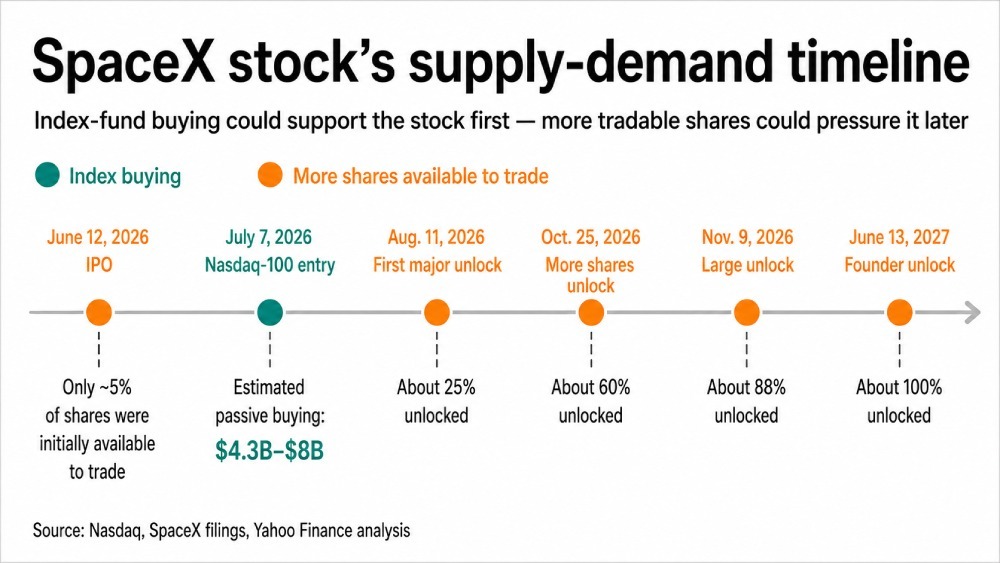
On July 7, SpaceX became the fastest company ever to join the Nasdaq 100, less than a month after going public.
So far, Elon Musk’s rocket-and-AI company has not been big enough to move the index. The bigger story begins when the stock faces its first real wave of insider selling.
A stock built for big swings
When SpaceX joined the Nasdaq, it was already one of the market’s most turbulent stocks.
Options markets expect SpaceX to swing roughly 3.5 times as much as the average company in the Invesco QQQ Trust, which tracks the Nasdaq 100.
That makes it a natural magnet for traders — and a very unusual addition to an index dominated by mature technology companies.
Its 1% weighting should keep its effect on the Nasdaq relatively modest for now. But every dollar flowing into index funds like QQQ is now automatically buying SpaceX, regardless of valuation or market sentiment.
The real catalyst is the lockup
The next major test comes when insider lockup periods begin expiring.
As more shares become eligible for sale, early investors, employees, and executives will gradually have the opportunity to cash out after years of holding private stock.
If history is any indication, lockup expirations often mark the moment early investors start heading for the exit.
Someone has to buy those shares. Passive funds will do it automatically, while retail investors, still caught up in the excitement surrounding the IPO, could end up providing much of the remaining demand.
For individual stock buyers, that could prove to be a difficult trade.
Industry research shows IPOs have historically underperformed the broader market over the following three to five years, suggesting many of the biggest gains are captured before newly public companies become widely owned.
📌 Bottom line: The irony is that index funds and passive investors could become liquidity providers for the biggest insider exit in IPO history.