Real reason Alphabet crashed

Morning Observers,
There were two numbers from yesterday's Alphabet earnings that might matter more than the profit miss or negative cash flow.
Google's cloud revenue jumped a record 103% from a year ago, while its search revenue growth slowed to 12% from 17% in the previous quarter and 19% the quarter before that.
This dichotomy is at the heart of a paradox that Alphabet shareholders are trying to reconcile.
A few years ago, the biggest question weighing on Google was whether OpenAI would threaten its search moat. And that was a valid concern considering how bad Gemini was out of the gate.
Then Google got its act together and caught up with ChatGPT and other leading LLMs, at least to the extent that fulfills its search purpose.
Once Gemini-powered AI search got so good that people increasingly stopped clicking on blue links, investors raised another question: If Google wins AI, can it still make as much money?
Search is Google's cash cow, and it enjoyed a near-monopoly for decades. But now, not only is it being eaten away by LLMs, Google itself is cannibalizing it with AI search.
For much of 2025, Google banged the drum that AI search was monetizing at "approximately the same rate" as traditional search. But so far, the results point to the opposite.
Yesterday was the second quarter in a row in which Google's search growth slowed. (Google said FX exacerbated the drop, though.)
So while Google is successfully defending its search moat by adopting AI, those queries make less money, at least for now.
In Pichai's defense, he rightly compared this transition to the shift to mobile, saying he's focused first on building the best user experience, then on monetizing it.
That may be the right long-term strategy, and considering how much data Google has and how entrenched it is in everyone's digital lives, there's little doubt that this company has all the reasons to lead consumer-facing AI.
But this is not 2023, and shareholders want proof now.
P.S. Alphabet's record cloud growth and an earnings beat from Microsoft show that AI adoption isn't yet slowing down.
- Dan Runkevicius, Editor

🏦 Fed stays put, signals more hikes ahead
The Fed left interest rates unchanged on Wednesday despite officials acknowledging that "inflation remains elevated." They want an "accumulation of more information" before deciding whether to raise rates again, though markets are already pricing in another increase in December.
🇨🇦 Bank of Canada raises rates to 2.5%
As widely expected, the Bank of Canada raised its benchmark interest rate by 25 basis points to 2.5% on Wednesday, warning that additional hikes may follow. Policymakers also raised their 2027 inflation forecast to 3.1%, up sharply from the 2% projected in July.
📉 Japan's U.S. Treasury purchases collapse by 99%
Japan, the largest foreign holder of Treasuries, made just $389 million in net Treasury purchases through August, down 99% from a year earlier, according to Treasury Department data. Countries and regions closely aligned with Washington bought a combined $174.3 billion in Treasurys during the first eight months of 2026, down more than 60% and the lowest for that period since 2021.
📈 Non-AI stocks are beating the S&P 500
The S&P 500 excluding AI-related stocks has outperformed the broader index by 6.4 percentage points so far in October, putting it on track for its strongest relative monthly performance on record. The reversal follows September's 5.1-percentage-point underperformance, the second-worst on record.
💰 SK Hynix plans $45 billion more in shareholder returns
South Korean chipmaker SK Hynix announced plans to return $45 billion more to shareholders after quarterly operating profit surged sevenfold. The company reported 83.3 trillion won ($62 billion) in operating profit for the September quarter, beating analyst forecasts.
When will AI bring the promised deflation?
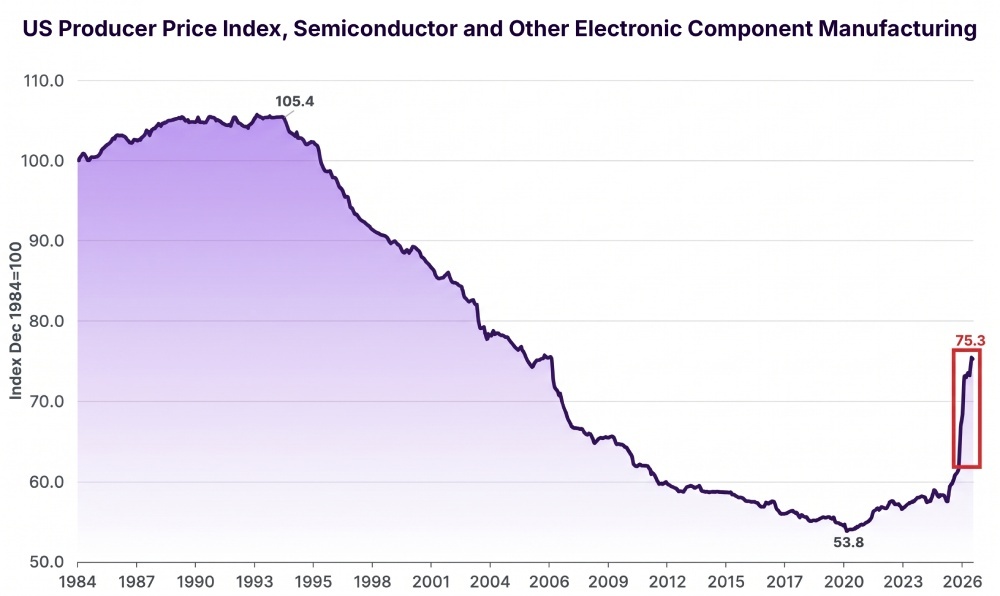
The AI revolution was supposed to make the world more productive by boosting productivity and automating routine cognitive tasks. Yet one of its most important inputs - semiconductors - is reversing decades of decline in producer prices.
The AI (price) boom
According to Federal Reserve and BLS data, the Producer Price Index (PPI) for semiconductor and other electronic component manufacturing surged 26% year over year in September, its fourth-largest annual increase on record.
It also marked the sixth consecutive month of annual price increases of at least 25%.
Since July 2025, the index has climbed 31%, a remarkable reversal for an industry where producer prices declined every year from 1994 through 2021.
When technology costs more than the labor it replaces
The cost of AI is becoming a problem for companies trying to save money by replacing workers with technology.
Forbes has documented the paradox of businesses cutting jobs to invest in AI systems that can end up costing more than the labor they replace.
Consumers are also competing with the AI industry for increasingly expensive electronic components.
"We are in the midst of a huge AI-related buildout, which requires inputs like chips that also go into consumer goods," said BofA Securities economist Stephen Juneau.
"So now consumers are competing for these goods with businesses, which is crowding out demand."
📌 Bottom line: AI's promised productivity savings could take years to materialize, while the costs of building it are already showing up in producer prices.
Americans have run out of screen time
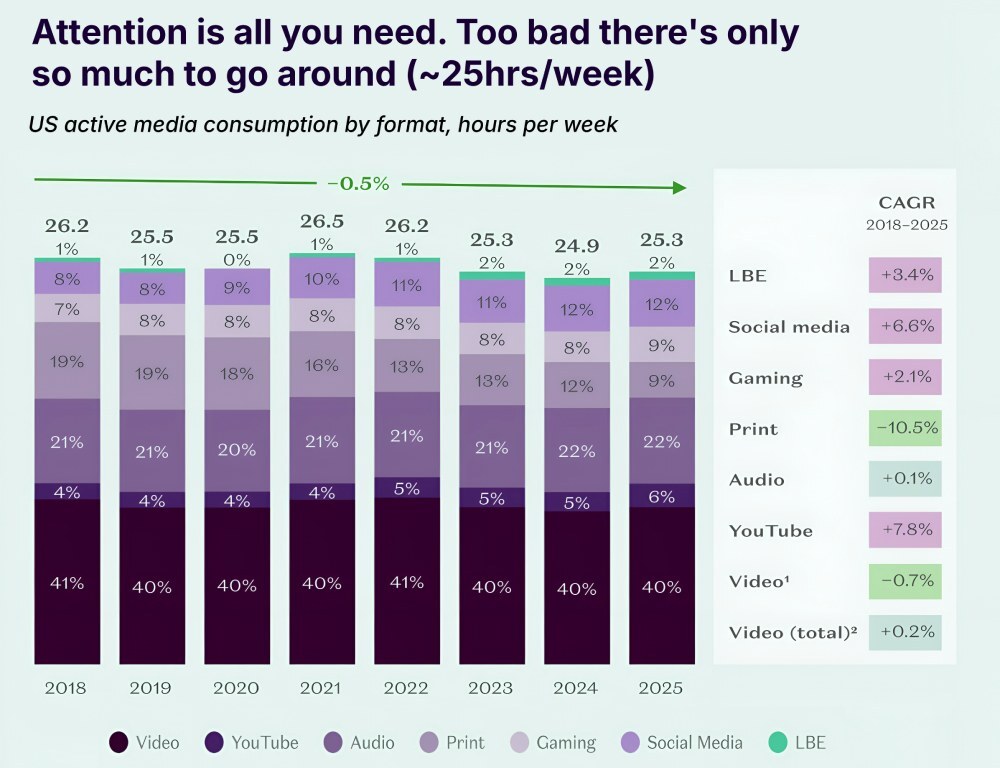
Americans appear to have hit their limit for active media consumption at roughly 25 hours a week. As streaming services fight over viewers, YouTube keeps gaining ground, capturing an increasingly large share of Americans' attention.
The screen time ceiling
According to Boston Consulting Group data, Americans spent 25.3 hours per week actively consuming media in 2025, down from 26.2 hours in 2018. Total consumption declined at an annualized rate of 0.5%.
The bigger story is where those hours are going.
YouTube consumption grew at an annualized rate of 7.8%, outpacing social media (6.6%) and gaming (2.1%). By comparison, non-YouTube video consumption declined 0.7% annually, while print plunged 10.5%.
YouTube's share of weekly media consumption rose from 4% to 6%, while social media increased from 8% to 12%. Combined, the two categories now account for 18% of active media consumption, up from 12% in 2018.
YouTube is becoming a bigger business
The shift in viewing habits is showing up in parent company Alphabet's financial results.
YouTube's annual advertising revenue climbed from $31.5 billion in 2023 to $40.4 billion in 2025. In the third quarter of 2026, advertising revenue rose 9% year over year to $11.2 billion
YouTube's business is also much larger than advertising alone.
Including subscriptions, the platform generated more than $60 billion in revenue in 2025, making it a major contributor to Alphabet's bottom line.
📌 Bottom line: YouTube is winning the attention game as Americans hit the limit of how much screen time they can physically handle.