⚙️ Nvidia's 'balance sheet as a service' play


Morning Observers,
Nvidia is successfully diversifying its customer base at the cost of providing its "balance sheet as a service."
Yesterday's earnings delivered another stellar quarter for Nvidia.
The company beat Wall Street's forecasts almost across the board. Revenue doubled, data center sales more than doubled, and Nvidia expects to grow another 70% next year.
Nvidia also pushed back against one of the biggest bearish arguments against the company.
At the start of the AI boom, hyperscalers made up the vast majority of demand for its chips. They were effectively the only companies with strong enough balance sheets to buy chips at scale.
That is beginning to change.
Last quarter, Nvidia generated about $49 billion from hyperscalers and another $40 billion from what it calls "ACIE," which includes neocloud providers, enterprises, industrial customers, and other projects.
That's already close to a 50/50 split. More important, ACIE grew nearly twice as fast, meaning hyperscalers could lose their majority share as soon as next quarter.
But there's a problem with this diversification.
Companies like Microsoft, Amazon, or Google can finance new data centers from their own massive cash flows. Most neocloud providers can't.
They may have plenty of customers willing to rent their GPUs, but they don’t have the balance sheets or long credit histories needed to borrow tens of billions of dollars at economically reasonable rates.
That's where Nvidia comes in with its brokered plan to finance up to $500 billion worth of these GPUs.
As I explained a few weeks ago, one way to finance these projects is to put the new compute capacity inside a special-purpose vehicle (SPV).
The SPV borrows the money, buys the GPUs, rents out the compute, and uses those rental payments to service the debt.
What ultimately supports the loan is not a pile of rapidly depreciating chips but contractually committed revenue from the incremental GPUs isolated inside the SPV.
That structure is perfect when Microsoft or another hyperscaler is behind those contractually binding payments. But many smaller neocloud providers don’t offer creditors the same peace of mind.
Nvidia has now revealed how it plans to solve that problem.
Under the new structure, Nvidia will become a cloud customer itself and make a take-or-pay commitment. This gives lenders some revenue floor and enough confidence to finance the project.
So Nvidia isn't simply eliminating its customer concentration risk. It is rather replacing some of it with credit risk by offering what Morgan Stanley called “balance sheet as a service.”
- Dan Runkevicius, Editor

🔥 Fed’s favorite inflation gauge stays hot
The Fed’s preferred inflation gauge remains well above target. The Personal Consumption Expenditures price index rose 0.2% in July, while annual PCE inflation came in at 3.7% and core inflation at 3.3%, both well above the Fed’s 2% goal. The numbers raise the stakes for Fed Chair Kevin Warsh’s debut Jackson Hole speech.
⚠️ Jackson Hole is a “key risk event”
Bank of America warns that Jackson Hole could be a major test for bonds and the dollar. The bank expects Warsh to use his speech to soothe the bond market, warning that failure to do so could send long-term yields higher and undermine the Treasury’s efforts to keep borrowing costs in check.
💰 Meta’s $18 billion settlement may be less painful than it looks
Meta Platforms agreed to pay $18 billion to settle claims brought by 48 state attorneys general over alleged harms its platforms caused teenagers. While the price tag is staggering, analyst Shay Boloor offered some perspective: Meta could be generating as much as $340 million in profit per day by 2028. At that pace, the entire settlement would equal roughly 49 days of profit.
🚀 UBS sees AMD revenue topping $200 billion
UBS thinks Advanced Micro Devices could grow its revenue more than fivefold to $227 billion by 2030 while expanding margins to 45%. That's another piece of evidence of how much is priced into the AI boom. AMD shares are already up more than 115% this year, but UBS sees 50% more gains from today's levels.
🤖 Nvidia’s record quarter
Nvidia once again blew past Wall Street’s expectations, offering investors some reassurance that the AI spending boom still has room to run. The chip giant reported record quarterly revenue of $96.2 billion and net income of $59.7 billion, while forecasting $108 billion in sales for the current quarter.
Here's how Bessent’s bond fix could backfire
Less than a week after doubling its long-dated bond buybacks, the Treasury is mulling over using the $950 billion General Account (TGA) to fund purchases.
While this attempt could give Washington even more firepower to rein in rising bond yields, one economist thinks it could leave Washington more exposed to them.
Trading long-term debt for short-term risk
Peter Schiff called the plan "reckless," arguing it could "substantially shorten the average maturity of the national debt."
The Treasury can spend cash from the TGA to buy longer-dated bonds. But if it later replenishes that cash by issuing Treasury bills, it effectively replaces longer-term debt with borrowing that matures much sooner.
More short-term debt means more of Washington's borrowing costs reset as bills mature and are refinanced. That leaves the Treasury more exposed to the federal funds rate than longer-term debt would.
"It's a recipe for massive QE and runaway inflation," Schiff cautioned.
The bond market is asking a bigger question
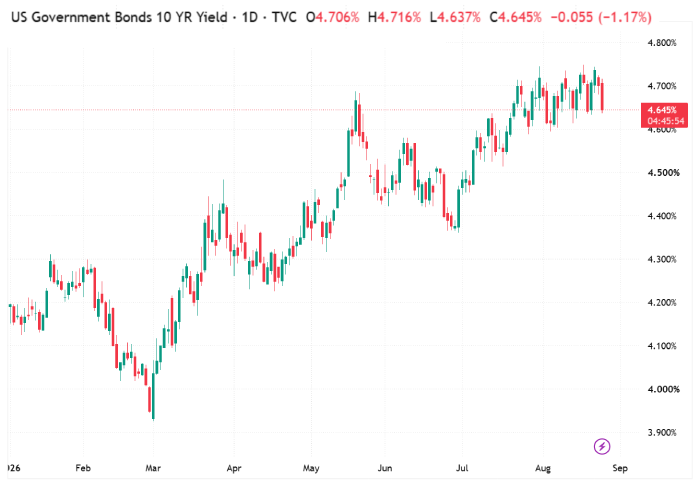
The Treasury is intervening after long-term borrowing costs surged to levels not seen in nearly two decades.
The 30-year yield recently reached 5.34%, its highest since 2007, while the 10-year returned to around 4.7% even after the Treasury announced larger buybacks.
While the rebound suggests the Treasury can influence demand for bonds without removing fiscal concerns, the longevity of that effect is largely in question.
Buybacks can change which bonds the Treasury has outstanding, but they can't change how much Washington ultimately needs to borrow.
📌 Bottom line: Using the TGA could help suppress long-term yields now while shifting more refinancing risk toward shorter maturities. If deficits remain large, the Treasury may end up making federal finances more sensitive to interest rates.
Is the “debasement trade” starting to crowd out AI?
AI has been the biggest trade on Wall Street this year. But recent Treasury shenanigans have analysts watching the rise of the so-called "debasement trade."
Gold and Bitcoin break into the top 10
The debasement trade is slowly showing up in the ETF market.
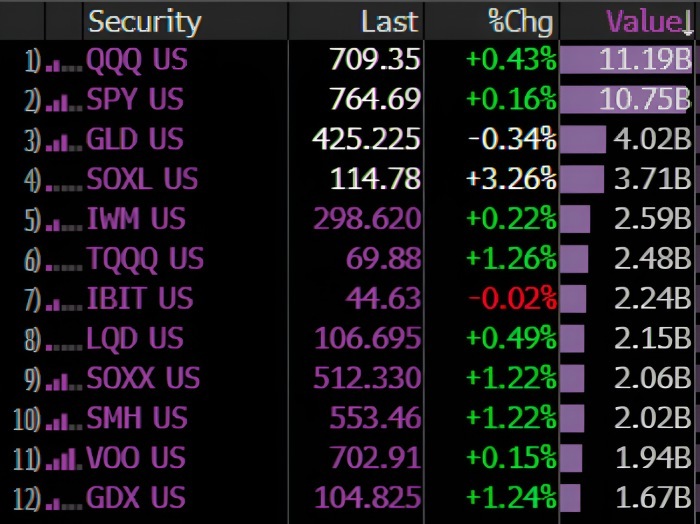
This week, SPDR Gold Shares (GLD) and iShares Bitcoin Trust ETF (IBIT) climbed into the top 10 most-traded ETFs, according to Bloomberg ETF analyst Eric Balchunas.
In the process, they displaced semiconductor ETFs that had dominated the list through much of the summer.
Balchunas called it "another sign the debasement trade is starting to replace AI mania."
Gold has surged roughly 15% over the past three weeks to more than $4,700 an ounce, while Bitcoin is up more than 23% since the Treasury expanded its long-term bond buybacks.
The signal matters more than the size
At the same time, chipmakers have pulled back. The Philadelphia Semiconductor Index is down about 20% from its June high, despite still being up 61% this year.
21Shares' Stephen Coltman says the size of the Treasury's latest bond purchases is still small, but the signal is much bigger, potentially strengthening the case for the debasement trade.
If investors believe Washington is becoming more willing to suppress long-term yields, that raises the risk of a weaker dollar and gives gold and Bitcoin a stronger case.
📌 Bottom line: The dollar isn't being abandoned, and AI is not over. But gold and Bitcoin knocking semiconductor ETFs out of the most-traded rankings is an early sign that investors may be starting to rotate toward assets that benefit from a weaker dollar.