Nvidia without Jensen Huang. Generational buy or massive mistake?


Morning Observers,
For 33 years, Jensen Huang was the face of Nvidia. He co-founded the company and helped turn it into the world’s dominant AI chipmaker.
On Thursday, he called it quits.
Huang resigned as CEO following revelations about two extramarital affairs, including one with Alice Huang, a former executive at Megaspeed, a Singapore-based cloud company and Nvidia partner.
U.S. intelligence officials suspect Alice Huang of passing information to Beijing, although the allegations remain unproven. Megaspeed has also faced scrutiny over possible violations of U.S. chip export restrictions.
The scandal has sent Nvidia shares tumbling. The stock is down 27% over the past month, pulling the company’s market capitalization below $4 trillion for the first time since 2025.
Retail investors are buying the dip.
According to Vanda Research, individual investors scooped up $11 million worth of Nvidia shares in the first 30 minutes of Thursday’s session, a record opening half-hour for the company.
Others aren’t convinced.
“Jensen Huang and the Nvidia board just made a massive mistake,” The Kobeissi Letter wrote, criticizing the decision to part ways with a CEO who has no obvious successor.
ShapeShift founder Erik Voorhees went further, calling Huang’s departure a “coup” and arguing there was “absolutely zero” evidence that Alice Huang was a Chinese spy.
The question now is whether Nvidia can maintain its dominance without the man who built it. CFO Colette Kress has taken over as interim CEO, but replacing Huang’s experience won’t be easy.
Meanwhile, Huang walks away a centibillionaire, even after forfeiting $108 million in unvested stock compensation.
Let’s get to it.
- Sam Bourgi, Interim Editor

⚖️ Justice Department investigates Alice Huang
The Justice Department is investigating Alice Huang over alleged ties to Chinese intelligence, Bloomberg reported Thursday. Huang, who had an affair with former Nvidia CEO Jensen Huang, is being investigated in connection with a case that may involve existing chip-smuggling prosecutions in the U.S. and Asia. The exact scope of the investigation remains unclear.
🏦 Bankers push for higher Anthropic IPO valuation
Bankers working on Anthropic’s IPO are reportedly seeking a valuation of at least $1.5 trillion, up from the recently reported figure of around $1.4 trillion, according to the Financial Times. The target remains below earlier estimates of $2 trillion to $2.2 trillion, as concerns about AI stock valuations weigh on investor demand.
📊 Strategy removed from MSCI indexes
Shares of Michael Saylor’s Strategy, formerly MicroStrategy, fell Thursday after the Bitcoin treasury company was removed from MSCI’s global equity indexes. Analysts warn the decision could force billions of dollars in stock sales, adding to Strategy’s losses during the Bitcoin bear market.
🏚️ Existing home sales collapse to 2010 levels
U.S. existing home sales, which account for nearly 90% of the housing market, fell 5.5% in October and 8.8% year-over-year to an annual rate of 3.75 million, according to the National Association of Realtors. The last time sales were this low was in August 2010, in the aftermath of the subprime mortgage crisis. High mortgage rates and elevated home prices continue to keep prospective buyers on the sidelines.
💲 U.S. dollar hits 19-month high
The U.S. Dollar Index climbed above 103, its highest level in 19 months, as elevated inflation fueled expectations of at least three Federal Reserve rate hikes through next spring. The dollar strengthened sharply against the Japanese yen, euro, and Canadian dollar.
Tariffs are now adding to Washington’s deficit
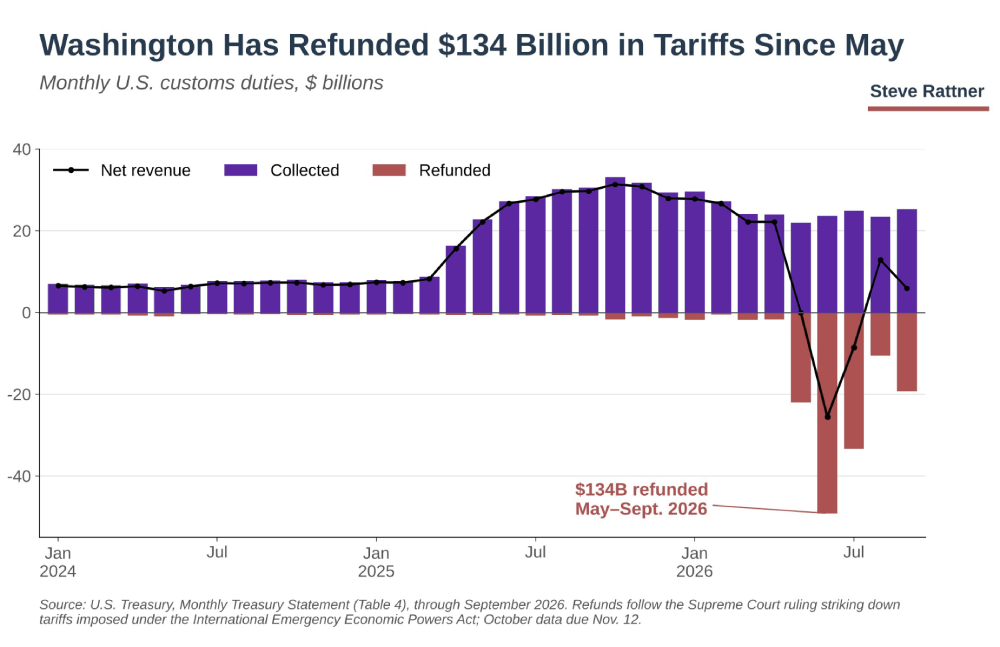
Tariffs were supposed to fill Washington’s coffers and reduce the need for other taxes.
For a while, they did. But refunds have now exceeded new tariff collections, turning what was supposed to be a source of revenue into a drain on the Treasury.
Tariff refunds bite
According to Treasury data analyzed by Steve Rattner, the U.S. government refunded $134 billion in tariffs between May and September 2026 after a Supreme Court ruling struck down tariffs imposed under the International Emergency Economic Powers Act.
The refunds amounted to 113% of new tariff collections during that period, leaving the Treasury with a net loss of $15 billion.
Washington continued collecting more than $20 billion a month in tariffs, but the refunds pushed net customs revenue below zero across several months.
Don’t expect tariffs to disappear
The irony is that even a Democratic sweep of Congress may not bring an end to tariffs.
As Jeffrey Kucik explained in The Hill, tariffs on close trading partners such as Canada could be reduced, but restrictions on China are another matter.
Chinese imports face several overlapping tariffs, including duties ranging from 7.5% to 100%. Washington has also expanded restrictions on exports of advanced technology to China.
These measures fall outside the Supreme Court ruling, so they could remain in place regardless of what happens to the tariff refunds.
📌 Bottom line: Tariff refunds have wiped out five months of customs revenue gains, but Washington’s trade restrictions remain largely intact. The government may have to give back billions without abandoning the tariffs that are still in place.
Gold’s unlikely post-midterm advantage
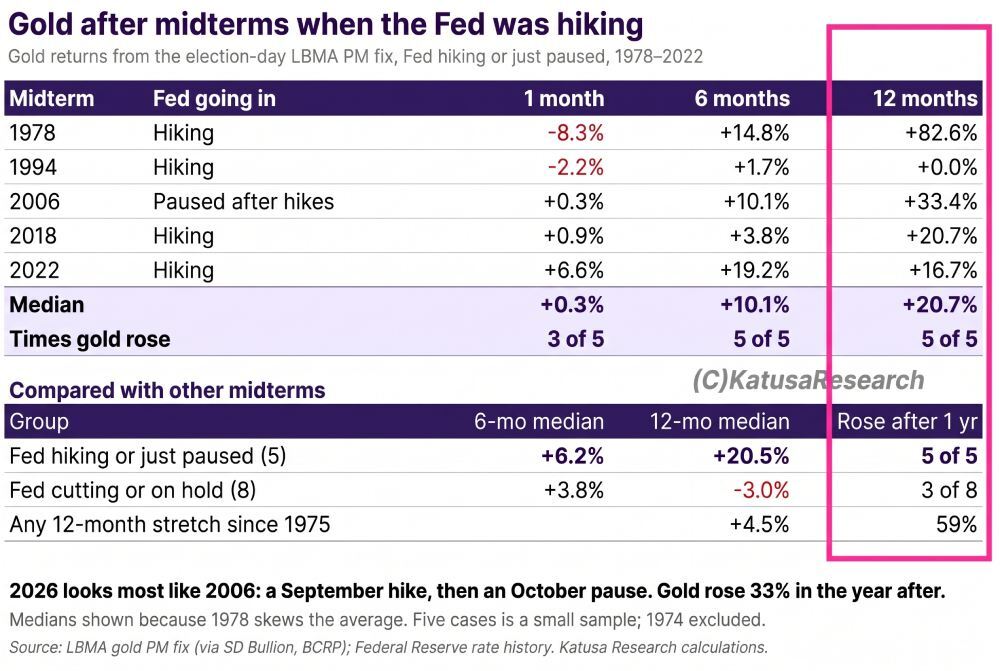
Gold prices have experienced a stunning reversal over the past ten months and are back below $3,900 a troy ounce. But history suggests the combination of midterm elections and Federal Reserve rate hikes could favor the yellow metal over the next 12 months.
Gold’s historical outperformance
According to Katusa Research, gold rose over the following 12 months in all five midterm election cycles since 1978 when the Fed was raising interest rates or had recently paused, delivering a median return of 20.7%.
The strongest comparison may be 2006, when the Fed paused after a series of rate hikes. Gold gained 33.4% over the following year.
The findings are unusual because higher interest rates generally make gold less attractive compared with investments that pay interest.
Central bank accumulation continues
Central banks haven’t stopped buying gold despite its recent decline.
According to the World Gold Council, central banks added a net 321 metric tons to their reserves in the third quarter. Purchases so far this year are 6% higher than during the same period in 2025, with China and Poland among the largest buyers.
📌 Bottom line: The challenge for gold is that the Fed may not be finished raising rates. Goldman Sachs expects three more hikes through next March, which could test whether the historical pattern identified by Katusa Research holds up this time.