No more Fed spoilers



Morning Observers,
For years, the Federal Reserve guided markets toward its next move. Now, it’s leaving them to guess.
Just a week ago, CME Group’s FedWatch Tool put the odds of a July 29 rate hike below 10%. By Wednesday, those odds had jumped to 34%. Bloomberg’s World Interest Rate Probability (WIRP) showed a similar move, climbing from 9% to 36%.
The shift likely reflects oil’s sudden rebound. Since hitting an early-July low, crude prices have climbed 33% as the Iran war reignited, reviving fears that inflation may not have peaked after all.
Under Jerome Powell’s Fed, that kind of uncertainty rarely lasted. Through speeches, interviews, and carefully timed remarks, Fed officials usually nudged markets toward the likely outcome well before the meeting.
Not anymore.
The new Fed leadership under Kevin Warsh has made it clear that “forward guidance” — the practice of signaling future policy decisions — is no longer a priority. As Jim Bianco of Bianco Research put it, markets shouldn’t expect any “leaks” to reporters ahead of the decision.
The result is something Wall Street hasn’t had to deal with in years: genuine uncertainty. With little major economic data due before July 29, investors may simply have to wait for the answer instead of trying to decode the Fed.
Powell’s Fed had its flaws, but it rarely left markets treating a rate decision like a near coin toss.
Let’s dive in.
— Sam Bourgi, Interim Editor
|
|


🚀 SpaceX doubles down on AI infrastructure
Elon Musk’s SpaceX is planning a major data center expansion in Texas that would significantly increase its AI computing capacity beyond its existing Memphis-area hub, according to reports. The move highlights the company’s growing ambitions to monetize AI after signing computing deals with Anthropic in May and Google in June.
📊 Corporate earnings are on pace for a historic quarter
S&P 500 companies are expected to deliver 26% profit growth in the second quarter, according to Bloomberg, marking the strongest earnings growth ever outside of recoveries from major recessions. The outlook suggests corporate profitability remains resilient despite weaker economic growth and an ongoing energy crisis. In Europe, MSCI Europe companies are also on track to beat expectations with 12% earnings growth.
🇯🇵 Yen makes a new 40-year low
Investors are losing faith in the Bank of Japan’s ability to prop up the yen, with the currency falling to fresh 40-year lows against the U.S. dollar. It comes after the yen failed to get a lift when crude oil prices tumbled 45% over May and June. And seemingly “yen-positive” proposals from Tokyo, like the recent announcement encouraging Japanese pension funds to invest in domestic financial assets, have also failed to boost the currency.
🛢️ Oil’s slow march back to $100
Brent crude is moving closer to the $100-a-barrel mark after reaching an intraday high of $95.47 on Wednesday, as the resumption of the Iran war renewed concerns about supply bottlenecks through the Strait of Hormuz. After briefly falling below $70 a barrel in early July, oil has now rebounded more than 33%, marking a dramatic turnaround.
🪙 Gold just became a contrarian bet again
Gold is now viewed as the most undervalued since March 2023 by institutional investors, according to Bank of America’s latest Global Fund Manager Survey. It marks a sharp reversal after gold spent much of the past year being viewed as one of the market’s most crowded trades. Extreme shifts in institutional sentiment don’t guarantee a rally, but they often suggest expectations have become overly pessimistic — a setup contrarian investors tend to watch closely.
International markets, not Wall Street, have a concentration problem
For decades, investors have been told to diversify internationally to reduce concentration risk.
In reality, the biggest concentration risk isn’t owning U.S. stocks… it’s leaving them.
The U.S. may be dominated by the Magnificent Seven, but compared with most major markets, it’s still remarkably diversified. That helps explain why capital continues to flow into U.S. markets despite higher valuations.
The diversification trade isn’t what investors think
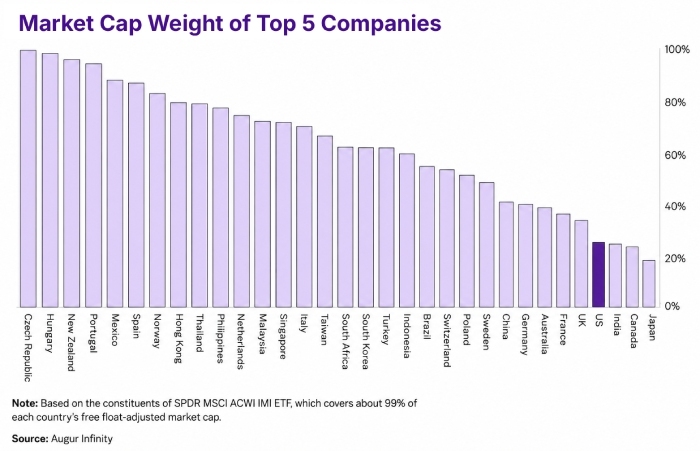
According to Augur Infinity, the five largest U.S. companies account for roughly 23% of America’s total market capitalization. That’s elevated, but it still ranks as the fourth-lowest concentration among major markets.
In countries such as Norway, Spain, Portugal, Mexico, Hungary, New Zealand, and Czechia, the top five companies account for more than 80% of the market.
That’s the flaw in the conventional diversification playbook. Buying international ETFs doesn’t necessarily reduce concentration risk — it often shifts it from a handful of U.S. tech companies to an even smaller group of banks, miners, energy producers, or national champions.
Maybe America’s premium is justified
Investors often argue U.S. stocks are expensive… but valuation isn’t the only thing they’re buying.
Investors are buying the world’s deepest stock market, where thousands of listed companies create far more independent sources of returns than almost anywhere else. Most overseas markets simply don’t have that breadth. When one or two sectors dominate an entire country’s index, company-specific risk starts looking a lot like country risk.
📌 Bottom line: If international markets remain highly concentrated, investors may need to rethink what diversification actually means. The next debate shouldn’t be whether the U.S. deserves a premium… it should be whether much of the rest of the world deserves a discount.
The 30-year Treasury just hit its longest danger streak since 2007
A 5% yield on the 30-year Treasury has become an increasingly important threshold for bond markets. The problem is that it’s no longer looking like a temporary spike.
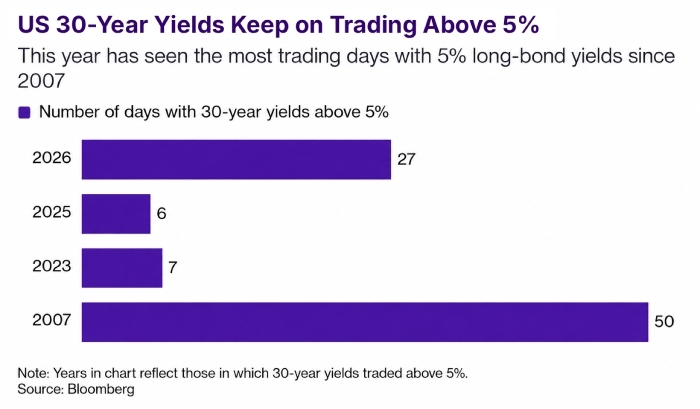
The 30-year Treasury has now traded above 5% for 27 consecutive sessions as of Wednesday, its longest streak since the global financial crisis began in 2007, according to Bloomberg.
While markets can shrug off a temporary spike, a yield that stays elevated for a month is much harder to dismiss.
5% isn’t what it used to be
The 30-year Treasury bond spent 50 trading sessions above 5% during 2007. This year has already surpassed half that total.
What’s changed is the backdrop. In 2007, the Fed’s policy rate was 150 basis points higher than it is today. Yet investors are still demanding roughly the same return to lend Washington money for three decades.
That’s a sign investors are looking beyond the Fed and focusing more on inflation, deficits, and the long-term outlook for the U.S. economy.
Investors want a bigger cushion
BlackRock recently warned that long-dated Treasurys aren’t the reliable safe haven they once were because long-term interest rates have become much harder to predict.
The Wall Street Journal made a similar point this week: investors aren’t questioning whether the U.S. will repay its debt… they’re questioning how much purchasing power those payments will have after decades of inflation, deficits, and fiscal expansion.
That’s a very different kind of risk, and it’s one that falls disproportionately on the longest bonds.
📌 Bottom line: The longer the 30-year Treasury stays above 5%, the harder it becomes for stocks and the economy to ignore it. Higher financing costs eventually ripple through everything from home loans to federal interest payments.