No hikes in 2027?

Morning Observers,
New York Fed President John Williams thinks the Fed can hike one more time this year, then stop.
Williams says inflation is already coming down despite the extra demand from AI investment, and that it should move even lower next year when the effects of tariffs and higher energy prices fade.
This goes against what investors are pricing in.
Markets expect a December hike, followed by two more in 2027. And some of Williams' colleagues, including Cleveland Fed President Beth Hammack, think rates may need to go higher to rein in inflation.
The disagreement comes down to whether today's inflation is just a result of a few shocks or a sign of a bigger problem.
Williams says the economy isn't overheating and sees no sign that higher energy costs, tariffs, or the AI build-out are becoming sticky. But he also admits AI demand is running ahead of supply, and that imbalance could stick around for a while.
So the Fed has a tricky call: keep raising rates to make sure inflation comes down, or wait for the shocks to fade and risk letting higher prices settle in.
For now, futures markets expect no hike this month and a 25 bp hike in December.
- Dan Runkevicius, Editor

📈 Stock trading is moving beyond Wall Street hours
Investors are increasingly trading tokenized stocks outside regular U.S. market hours. Blockchain data shows that more than 70% of tokenized stock trading volume on BNB Chain occurs outside traditional market hours, compared with 63% on Solana. The data points to growing demand for round-the-clock market access, even as traditional exchanges continue to operate on fixed schedules.
🤖 AMD sees $200 billion CPU market
AMD CEO Lisa Su expects the market for server CPUs to grow by 50% annually, surpassing $200 billion by 2030. Su has raised her forecast three times in nine months as AI agents drive demand for server processors. For AMD, that could mean more room to grow after its stock has already rallied 180% this year.
📊 S&P 500 records mask slowing earnings growth
The S&P 500 is flirting with record highs again, but corporate earnings growth may be losing steam. According to Bank of America, 10 of the index's 11 sectors are expected to report slower earnings growth in Q3 compared with the previous quarter. Lucas Paolini of Pictet Asset Management offered a similar view, saying, "We see early signs that earnings momentum may be peaking."
🏥 UnitedHealth's turnaround gains momentum
UnitedHealth Group raised its full-year profit outlook after reporting better-than-expected third-quarter earnings, offering further evidence of a recovery following a disastrous 2025. The stock has climbed nearly 22% over the past six months but remains down nearly 40% from its 2024 peak.
🎢 Six Flags plunges after fatal roller coaster accident
Six Flags stock plunged more than 16% on Tuesday, hitting its lowest level since 2009 after a man died on a roller coaster at its Georgia amusement park. The accident comes as the company faces lawsuits alleging brain injuries linked to its X2 roller coaster in California, which closed over the summer. Six Flags shares have now lost more than 80% of their value since their 2022 peak.
Microsoft could make billions policing its AI rivals
Microsoft could end up making billions from AI agents it didn't even build.
CEO Satya Nadella recently advocated for tighter controls over what AI agents can access and do. Luckily enough, Microsoft already sells security software for that very purpose.
Who's watching the AI agents?
AI agents are programs that can perform tasks with limited human supervision, from processing invoices and handling customer requests to accessing company records and updating business software.
Nadella argued that companies need to "separate the supply of intelligence from the authority over it."
In other words, companies shouldn't automatically trust AI agents with sensitive information just because they've authorized them to perform certain tasks.
Nadella believes businesses need independent safeguards to control what agents can access.
Another way to cash in on AI
Microsoft already sells security and access-management software through Entra, Defender, and Purview, which manage access permissions and cybersecurity.
As a result, Microsoft could make money twice from AI, once by selling its own products through Copilot and Azure, and again by providing security software for agents developed by competitors, such as Google and Anthropic.
For MSFT shareholders, the appeal is that Microsoft could benefit from AI agent growth regardless of which company's models become most popular.
With the agentic AI market projected to reach $139 billion to $373 billion by 2035, even a small share of that spending could generate billions in additional revenue for Microsoft.
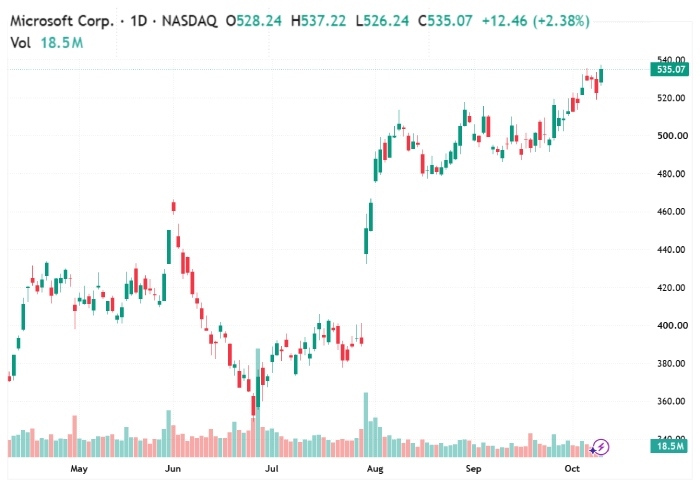
📌 Bottom line: Microsoft stock has badly lagged the S&P 500, as well as the tech sector, over the past year. If it becomes the "toll collector" of the AI economy, the market could be quick to reprice it.
Just 42 AI stocks explain most of your gains
Wall Street has spent years debating whether AI stocks are in a historic bubble. But that may have been the wrong debate all along.
The bigger concern is how much of the stock market's earnings growth and corporate investment now depends on those same companies.
The historic gap
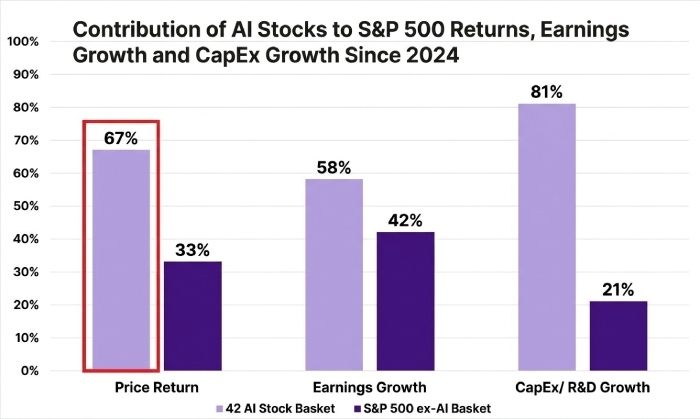
According to Bloomberg and JPMorgan data, a basket of just 42 AI-related stocks has accounted for 67% of the S&P 500's price gains since the start of 2024.
Over the same period, those companies generated 58% of the index's earnings growth and a staggering 81% of its increase in capital expenditures and R&D spending.
In other words, just 42 companies are responsible for most of the market's gains, profit growth, and new investment.
A caveat about earnings
The earnings figures come with an important caveat. While stock prices are easy to track, corporate profits can be more complicated. Especially when AI is involved.
Michael Burry, the investor made famous by The Big Short, has argued that major AI companies are overstating profits by extending the estimated useful lives of their computing equipment, which cuts depreciation expenses.
By his estimate, companies could understate depreciation expenses by more than $175 billion.
📌 Bottom line: Questions about S&P 500 diversification have been around for years, but the AI boom has made them harder to dismiss. Investors who bought into the index since 2024 have effectively been making a much bigger bet on AI than they may realize.