Liberation Day, Reloaded?

Morning Observers,
The biggest market themes of the past 16 months are suddenly colliding again… and nowhere is that clearer than in the bond market.
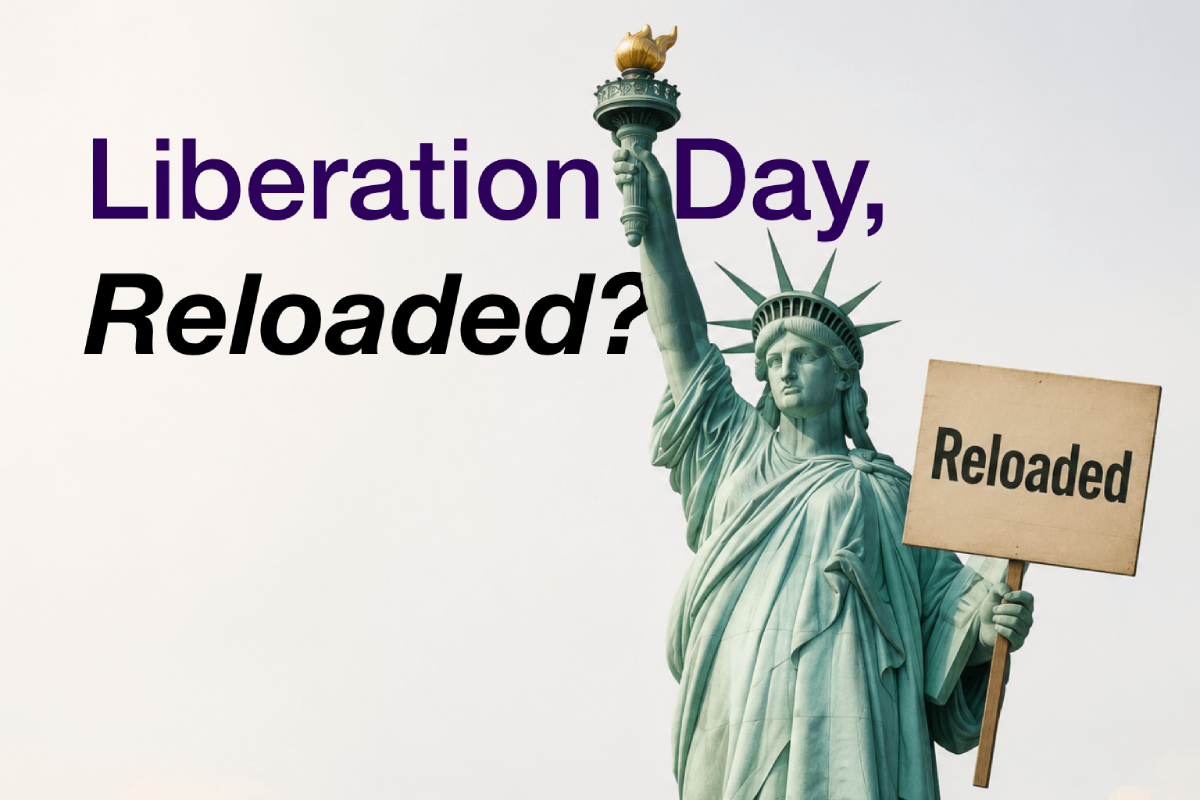
The yield on the 10-year U.S. Treasury climbed above 4.7% on Thursday, surpassing the highs reached after President Trump’s “Liberation Day” tariff announcement in April 2025. Two-year Treasury yields, the part of the market most sensitive to Federal Reserve policy, also climbed to their highest level since early 2025.
The trigger is one investors know well. Oil has surged above $100 a barrel as tensions with Iran escalate, reviving fears of another inflation shock just as investors had grown more confident the Fed was finished raising rates. Swap markets now see a roughly one-in-three chance of a surprise rate hike next week… and are fully pricing one by September.
Whether those expectations prove correct is another question.
Real-time inflation data from Truflation still puts U.S. inflation at just 2.08%, suggesting markets may be reacting more to the risk of inflation than inflation itself. A rate hike as soon as next week’s Fed meeting would be a genuine surprise, especially with no major economic data due before policymakers convene.
Then again, this is no longer the Fed investors grew accustomed to.
Chair Kevin Warsh has abandoned the era of heavily telegraphed policy moves, making surprises far more plausible than they were just a few months ago. June’s FOMC minutes only reinforced that message, revealing a committee far more divided on interest rates than markets may have appreciated.
Buckle up.
— Sam Bourgi, Interim Editor
|
|


📊 U.S. stocks dwarf the real economy
The U.S. stock market has become increasingly disconnected from the country’s underlying corporate assets. In 2025, the ratio of U.S. stocks to corporate net assets reached 2.4 times, compared with roughly 1.0 across most other major economies, according to new research from McKinsey. The firm found the U.S. now accounts for nearly half of the world’s equity value, including private companies, the highest share since at least the early 1990s.
🛢️ Goldman’s $120 a barrel oil forecast gains credibility
Oil prices climbed above $100 a barrel for the first time in two months after Houthi militants claimed attacks on commercial vessels in the Red Sea, raising concerns over global supply disruptions. Goldman Sachs warned crude could reach $120 a barrel this year unless exports through the Strait of Hormuz normalize, though the forecast does not yet account for the latest Red Sea attacks.
📉 IBM’s troubles deepen with sales forecast cut
IBM lowered its full-year sales forecast, including for its key software business, as weak demand for its mainframe business weighed on results. Revenue in its infrastructure division fell 7%, shaving more than five percentage points off the company’s overall growth. The cut adds to IBM’s recent troubles after a shareholder letter warning of weaker demand triggered a 25% plunge in its stock.
⛽ Fuel prices keep pressure on airlines
American Airlines cut its 2026 earnings outlook for the second time in three months, warning that persistently high fuel costs continue to weigh on profitability. The pressure is likely to spread across the industry, squeezing margins at rivals including United Airlines and Delta Air Lines as renewed conflict in the Middle East drives oil prices higher.
💵 U.S. dollar approaches 2026 high
The U.S. Dollar Index (DXY) rose 0.4% on Thursday, approaching its highest level of the year as investors increased bets on Federal Reserve rate hikes and sought the safety of the greenback. Gold moved in the opposite direction, falling 2% to around $4,050 a troy ounce as a stronger dollar reduced demand for the precious metal.
Google’s paper profits mask a cash-flow problem
On the surface, Alphabet looked unstoppable in the second quarter. Revenue jumped 24%, Google Cloud grew 82%, and earnings crushed expectations.
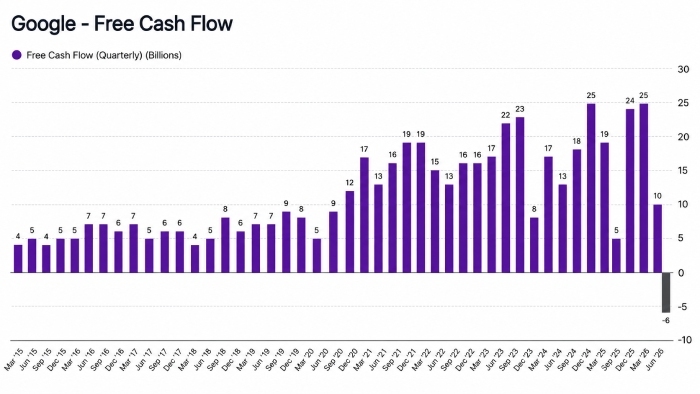
But beneath the blockbuster headline was a very different story. A large share of Alphabet’s earnings came from paper gains on its Anthropic investment, while its free cash flow turned negative for the first time.
Surface gains
Alphabet generated nearly $39 billion in operating cash flow during the quarter, but spent $44.9 billion on capital expenditure, largely to build AI infrastructure. The result was the company’s first-ever quarter of negative free cash flow.
The headline earnings per share (EPS) figure also deserves a closer look. A sizeable chunk of Alphabet’s $9.11 EPS came from an unrealized gain on its Anthropic investment after the AI startup’s valuation ballooned from $350 billion to $965 billion. Strip out that paper gain, and operating earnings look far less spectacular.
Management also raised its AI spending forecast again, suggesting that today’s cash-flow pressure is unlikely to disappear anytime soon.
The AI bill is coming due
Alphabet spent years funding growth while returning billions to shareholders through buybacks. That was arguably its biggest competitive advantage — not Search or Cloud, but its ability to generate enough cash to invest aggressively while still rewarding investors.
This quarter, that equation changed. AI is turning Alphabet into a far more capital-intensive business, meaning investors are relying less on today’s cash generation and more on future AI profits. The spending is certain. Whether the returns justify it is far less clear.
📌 Bottom line: If AI becomes as profitable as management expects, today’s spending will look visionary. If returns disappoint, investors may discover that even the world’s best cash-generating business isn’t immune to the rising cost of staying ahead.
China’s best investment has been bad news
China’s economy has spent much of the past five years battling a property crisis, weak consumer spending, and slowing growth. Yet one asset has quietly thrived: government bonds.
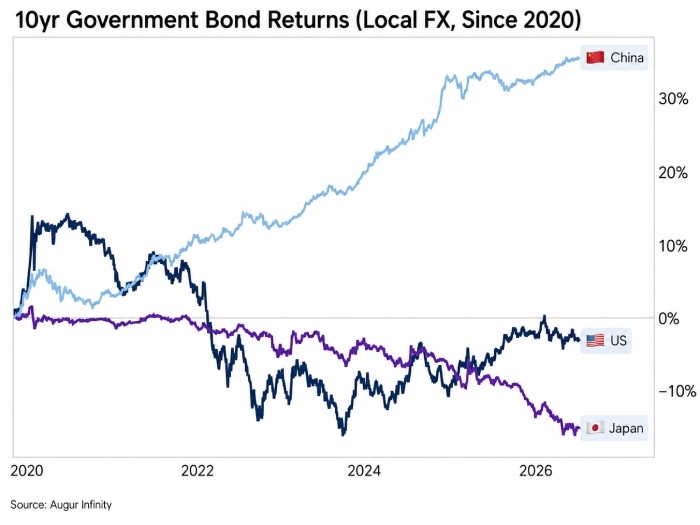
It’s an unusual outcome. While higher interest rates crushed bond markets in the U.S. and Japan, Chinese government bonds have become one of the world’s best-performing major fixed-income markets.
The winners from weaker growth
Chinese 10-year government bonds have returned more than 35% in local currency terms since 2020, according to Augur Infinity. By comparison, U.S. Treasurys remain slightly negative over the same period, while Japanese government bonds have lost around 15%.
While most major economies spent the past few years fighting inflation, China was battling the opposite problem.
Weak consumer demand and a prolonged property downturn kept inflation subdued, allowing the People’s Bank of China to cut interest rates even as other central banks raised them.
Chinese investors also piled into government debt as local property and stock markets struggled, pushing bond prices even higher.
Success built on weakness
The irony is that China’s best-performing asset has been a reflection of one of its biggest economic challenges. Bond investors have prospered not because the economy has been booming, but because it has been weak enough to keep interest rates falling.
That also means future returns may be harder to come by. If Beijing succeeds in reviving growth and inflation, bond prices could come under pressure as interest rates eventually begin to rise.
📌 Bottom line: While China has so far succeeded in cooling its property downturn, growth remains weak, with GDP expanding just 4.3% in the second quarter. That should continue to support government bonds, although any sustained economic recovery would likely reduce their appeal.