Japanese bonds made history

Morning Observers,
In today's auction, Japan sold roughly $4.4 billion of 20-year JGBs, and demand was extraordinary. The bid-to-cover ratio came in at a record 5.84 for this maturity.
This is not a one-off event.
According to Japan Securities Dealers Association data, Japanese investors bought nearly as much in bonds from April through August this year as they did during the entire last fiscal year.
There's a notable increase in demand across all maturities, but medium-term bonds are getting the most attention.
The FT also calculated that Japan's largest banks and insurers bought the most JGBs with maturities of two years or more since early 2023. At the same time, they have been net sellers of foreign debt.
There are two important things driving Japanese investors back into domestic bonds.
For the first time in years, Japanese bonds are now beating inflation. The 10-year JGB yield surpassed 10-year breakeven inflation in 2025 and now offers a real yield of roughly 0.9%. So more conservative investors now have options.
Second, Treasurys have long been one of the favorite places for Japanese investors to park money for income. But now their own bonds are simply better value.
Adjusted for hedging costs, the 10-year JGB yields roughly 0.8 percentage points more than an equivalent Treasury.
The interesting part is that Japanese investors could already earn more at home since 2022. But it's the combination of that differential and positive real yields that was probably the factor that ultimately swayed them.
And this auction may be a sign of what's to come.
A few wider implications. Japan is the largest foreign holder of Treasurys. So higher demand for Japanese bonds means lower demand for Treasurys.
Then higher JGB yields can become a fiscal problem for Takaichi's government, but that's more of a problem for tomorrow.
Masayuki Nakajima of Mizuho Bank made a good point the other day. Higher yields aren't that problematic for now because the government's debt has an average remaining maturity of roughly 9.5 years.
That buys Takaichi some time.
- Dan Runkevicius, Editor

😮 "Black Monday" never arrived
Investors were bracing for a "Black Monday" selloff in semiconductor stocks. Instead, Wall Street bounced back. The Nasdaq 100 added roughly $650 billion in market value yesterday. The Philadelphia Semiconductor Index also snapped an eight-day losing streak. So for all the fear around AI valuations, investors are still buying the dip.
🏦 Bank stocks suffer their worst stretch since 2008
The KBW Bank Index, which tracks major U.S. banking stocks, is coming off its worst weekly losing streak since the 2008 financial crisis. The index fell another 1% last week and is now roughly 13% below its August record. Banks are getting squeezed by two big worries: AI potentially disrupting parts of financial services, and expectations for more Fed rate hikes.
🏠 Rising mortgage rates hammer homebuilder stocks
Homebuilder stocks fell Monday after the NAHB Homebuilder Sentiment Index dropped to its lowest level since 2012. The iShares U.S. Home Construction ETF fell 1.7%, with most of its holdings trading lower. Weak housing demand is also forcing builders to sweeten the deal. Some 43% cut home prices in October, while mortgage rates are inching toward 7.5%.
🇫🇷 French bonds take another hit as unrest spreads
French government bonds continue their descent after a weekend of violent protests. France's 10-year government bond yield rose to 4.86%, which means France is paying more to borrow than Germany despite both countries using the same currency. One explanation is that part of that differential is pricing in the risk of a Frexit.
🚀 Musk promises SpaceX shares to every American child
Elon Musk says he will give one SpaceX share to every child in America next year. With roughly 72 million Americans under 18, the proposed giveaway could exceed $10 billion in value. Musk hasn't explained yet how the shares would actually be distributed.
Is Situational Awareness founder the unluckiest trader alive?

Leopold Aschenbrenner may have the worst luck of any hedge fund manager betting on the AI boom.
After Situational Awareness plunged 67% in July, forcing it to liquidate much of its publicly traded holdings, the former OpenAI researcher reportedly jumped back into the market in September.
And he's already getting hammered again.
Back for another beating
Situational Awareness reportedly returned to the market in early September, spending hundreds of millions of dollars on options tied to AI infrastructure companies.
Since Sept. 8, several of those bets have fallen hard:
- CoreWeave (CRWV): -37%
- SK Hynix (SKNY): -25%
- Sandisk (SNDK): -23%
- Roundhill Memory ETF (DRAM): -23%
- Bloom Energy (BE): -18%
The trades involved $315 million in call-option premiums, representing an estimated $1.1 billion in stock-equivalent exposure. The buyer was never conclusively identified, although Aschenbrenner was suspected to be behind them.
Bad trader or just bad luck?
The irony is that Aschenbrenner could be right about the long-term AI boom and still lose a fortune betting on it.
Many of his picks have soared over the past year, making the timing of his losses all the more remarkable.
Options add another complication: They expire. Even if the underlying companies eventually recover, an investor can still lose everything they paid for the options if that recovery comes too late.
📌 Bottom line: If Aschenbrenner was behind the reported $315 million in options purchases, he could lose the entire premium if those bets expire worthless.
The S&P 500 is one SpaceX away from a 19th-century milestone
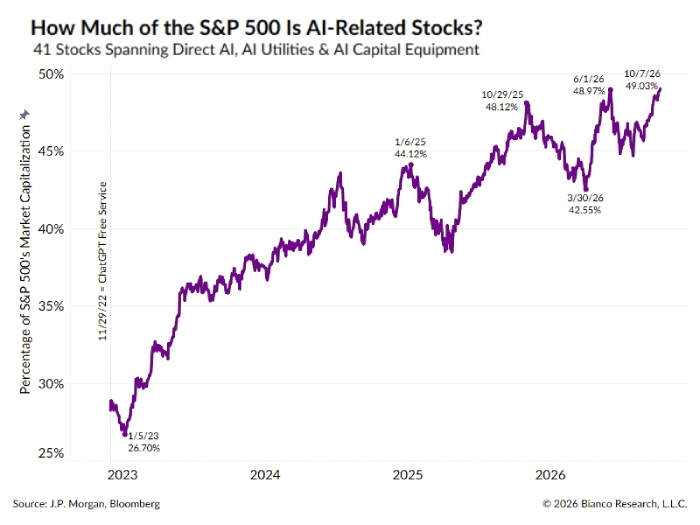
AI-related stocks make up 49% of the S&P 500, according to JPMorgan. Newly public companies like SpaceX could push that share above 50% next year, taking the index past a threshold it hasn't crossed since the 19th century.
Could SpaceX push AI past 50%?
Since going public over the summer, SpaceX's market capitalization has swelled to $2.1 trillion.
Jim Bianco of Bianco Research estimates that adding SpaceX to the S&P 500 would push AI-related stocks to 51% of the index. If OpenAI and Anthropic eventually go public and join the index, that share could climb to 55%.
"The last time a single theme was >50% of the SPX was the railroads in the 19th century," Bianco wrote.
SpaceX's inclusion is far from guaranteed. The company won't be eligible until at least June 2027, and it must meet the S&P 500's profitability requirements before it can be considered.
A concentrated bet
An investor who owns an S&P 500 index fund and also buys Nvidia (NVDA), Microsoft (MSFT), or other major AI stocks is doubling down on companies already heavily represented in the index.
The recent selloff shows how quickly those overlapping investments can fall together.
According to Reuters, the Nasdaq just had its worst week since June, while semiconductor stocks recorded their longest losing streak since 2008.
📌 Bottom line: An investor with $100,000 in an S&P 500 index fund already has $49,000 of exposure to companies JPMorgan classifies as AI-related.