🤔 Is this real reason Fed held rates?


Morning Observers,
Warsh offered a revealing explanation yesterday for why the Fed left rates on hold while inflation remains above target.
Long-term yields had already risen, he said, effectively tightening financial conditions without the Fed having to raise its own benchmark rate.
In other words, Warsh is spinning the narrative that the bond market can do the Fed's dirty work.
The catch is that long-term yields are not rising because investors suddenly have greater confidence in the Fed’s ability to fight inflation.
After the decision, two-year Treasury yields fell, while the 30-year yield surged to 5.23%, which is its highest level in 19 years.
That means investors are simply demanding more compensation for the risk that inflation remains higher over the long term.
This fear resulted in one of the most dramatic post-Fed steepenings of the yield curve since at least the mid-1990s.
That is a very different kind of tightening from a normal Fed rate hike.
And one possible explanation, or at least one very convenient consequence, is that it helps keep the government’s interest bill in check.
Washington has increasingly financed its deficits with short-term Treasury bills, which now account for roughly 22% of marketable federal debt.
Because bill yields closely track the Fed’s policy rate, holding that rate down allows the Treasury to refinance a growing share of its debt at lower cost.
The risk is that a Fed hike could quickly ramp up Washington’s interest costs because the Treasury would have to roll over that debt at higher rates.
So, in a way, this federal financing strategy makes a Fed hike even more inconvenient for Washington.
Meanwhile, keeping inflation higher allows the government to inflate away the rest of its debt.
The average interest rate across the national debt is currently about 3.4%, while consumer prices are rising at 3.5%, and headline PCE inflation is running above 4%.
That means the government is borrowing at roughly zero, or even slightly negative, rates in real terms.
- Dan Runkevicius, Editor

🏦 “Historic” Fed meeting ends with no cut
The Fed left interest rates on hold, but the bigger story was how uncertain investors were heading into the meeting. Ahead of the decision, markets saw roughly a 30% chance of a rate hike and a 70% chance of no change, ending a streak of more than 99% consensus before Fed meetings that had lasted since the pandemic. The split shows investors are far less certain about where interest rates go next.
📈 JPMorgan’s “buy signal” points to more upside for stocks
JPMorgan’s in-house buy signal is flashing green, with the bank’s tactical positioning monitor indicating “material upside” for U.S. stocks due to a weaker U.S. dollar and strong earnings. The bank did warn that semiconductor stocks remain crowded and that the U.S.-Iran war could still weigh on markets.
💾 SanDisk loses more than half its value
SanDisk stock has fallen 58% since late June after another steep drop this week, wiping out roughly $220 billion in market value. Investors are worried that Chinese memory maker CXMT’s blockbuster debut could lead to tougher competition in the memory chip industry.
🌍 Global investors’ stock allocations hit a record high
Global investors now have a record share of their money invested in stocks, according to data from Haver Analytics and Goldman Sachs. Households, pension funds, insurers, and investment managers across major developed markets have about 65% of their portfolios in stocks, about 8 percentage points higher than during the peak of the dot-com boom.
🛢️ U.S. oil stockpiles see a larger-than-expected drop
U.S. crude oil inventories fell by 7.2 million barrels last week, far more than the 600,000 economists had expected, according to EIA data. The decline came as exports increased and imports slowed, leaving less oil in storage. At the same time, the Strategic Petroleum Reserve also shrank, highlighting how the resumption of the Iran war continues to affect U.S. energy supplies.
U.S. corporate earnings: Positive surprise or low expectations?
Wall Street is celebrating another blockbuster earnings season, with most S&P 500 companies beating forecasts. But that’s becoming the norm rather than the exception.
When nine companies out of every ten clear expectations, the surprise says less about business strength and more about where analysts set the bar in the first place.
The beat rate is almost meaningless
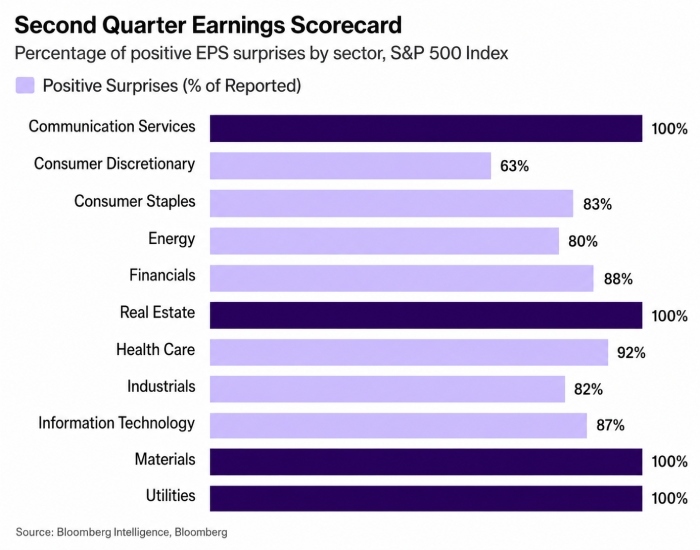
Bloomberg Intelligence data shows that between 63% and 100% of reporting S&P 500 companies in every major sector have beaten earnings estimates this quarter.
Communication services, materials, real estate, and utilities have all posted perfect records so far.
To be fair, corporate America is making money. S&P 500 net profit margins have climbed to roughly 15.7%, the highest level since at least 2009.
But earnings growth and earnings surprises are two different things. A company can “beat” simply because expectations were lowered enough beforehand.
Companies know how to play the game
As market analyst Ricky Ho recently noted, analysts often cut earnings forecasts in the weeks leading up to reporting season, making it easier for companies to come in ahead of expectations.
According to Ho, the more important question isn’t whether a company beat estimates, but whether sales, margins, and forecasts are improving in a meaningful way.
Many companies also help shape those expectations by issuing cautious forecasts months in advance, only to outperform them later.
American Airlines, IBM, Albertsons, and Humana all lowered outlooks this year before reporting, a pattern that has become increasingly common.
Ford followed a version of that script, cutting or withdrawing forecasts before later raising them again as results improved.
📌 Bottom line: Wall Street’s beat rate is becoming a less useful measure, making revenue growth and margins far more important.