Is this 1995 or 1999?

Morning Observers,
"Far more money has been lost by investors preparing for corrections… than in corrections themselves."
This famous quote from Peter Lynch has been making the rounds lately, so why don't we look at an example that's very relevant today: the dot-com bubble
Imagine the S&P 500 has doubled in a little over five years. And this rally came right after the index more than tripled over the prior decade.
Wall Street was euphoric, and so were valuations. Buffett's favorite metric, the Shiller P/E, hit its highest level in 65 years.
And all of this took place during one of the most aggressive easing cycles in decades.
In just a few years, the Fed took rates from 10% to 3%, and cheap money swept up the market.
Skeptics began warning about valuations. "Crazy for Internet companies, Wall Street investors drove Netscape stock to the sky. But will the bubble burst?" TIME, August 21, 1995
Even then-Fed chair Alan Greenspan stepped in with his now-famous warning about "irrational exuberance."
But here's the twist. All of this happened not in 1999 or 2000. It was 1995-1996.
For all the warnings, it was just the beginning of the dot-com boom. And by the time the bubble actually popped, the S&P 500 had doubled again.
If you'd invested a lump sum in the S&P 500 at the Greenspan warning and then sold at the bottom, you still would've made more money than those who didn't invest.
Now if you took it up a notch and blindly bought the biggest internet companies, your returns would've been staggering even between 2000-2002.
I'm deliberately picking the worst possible exit points to show that even terrible market timing beats sitting on the sidelines trying to call "the top."
This example carries an important lesson: being early is no less dangerous than being wrong.
So it's not that the market is too dumb to see the risks like AI circular financing, historically high valuations, inflation, and higher competition from bonds.
It's just that nobody really knows where we are in the cycle. And getting it wrong either way can be just as costly.
- Dan Runkevicius, Editor

☕ Starbucks mulls Chipotle takeover
Starbucks is weighing a potential takeover of Chipotle. The deal would bring together two of America's biggest restaurant chains, with roughly $50 billion in combined annual sales. Starbucks CEO Brian Niccol used to run Chipotle. Now he could find himself acquiring his former employer.
🪙 IMF puts tokenization market at $65 billion
The International Monetary Fund estimates tokenized assets now make up a $65 billion market, but warns the technology could introduce new financial risks. The report came as Securitize launched tokenized stock trading for eligible U.S. investors on Thursday, offering blockchain-based versions of 12 stocks, including Apple, Microsoft, and Nvidia.
🛢️ Oil stays elevated despite Trump's Iran pledge
Stocks fell Thursday while oil prices stayed elevated, even after President Trump said he wouldn't attack Iran before the Nov. 3 midterm elections. Meanwhile, prediction markets on Polymarket show growing odds of Democrats taking control of both chambers of Congress, suggesting the Iran war remains unpopular with Americans.
📈 Retail investors remain ultra bullish on stocks
Rising bond yields and the threat of further military escalation in the Middle East haven't shaken investors' appetite for stocks. According to the AAII asset allocation survey, stocks made up 71.8% of individual investor portfolios in September, up 0.7 percentage points from August. That's the highest allocation since December 2017 and the second-highest reading since July 2000.
🤖 Google brings Gemini deeper into the workplace
Google introduced a Gemini-powered workplace agent that works across Gmail, Drive, Docs, and Calendar, expanding its push into corporate AI. The launch puts Google in more direct competition with Microsoft, OpenAI, and Anthropic as companies look to automate routine tasks.
Ray Dalio's take on how the AI bubble could burst
Billionaire investor Ray Dalio is warning about an AI bubble again, but his latest argument has nothing to do with whether the technology lives up to the hype.
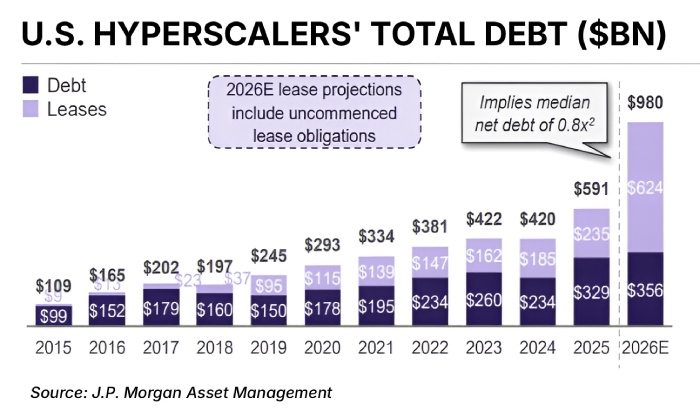
The Bridgewater Associates founder thinks the boom could run into trouble because debt becomes more expensive and investors sitting on paper gains need actual cash.
A debt-financed boom... and bust
Speaking at the Forbes Global CEO Conference in Singapore, Dalio said the bubble could also burst when investors with large paper gains start realizing their profits or are forced to sell to pay taxes.
Investors can be worth billions on paper, but spending or paying taxes on that wealth requires selling some of those assets for cash.
"Everybody says 'I'm worth a billion dollars' but OK, try to spend that," Dalio said. "In order to spend that you have to sell wealth in order to get money — and so the bubble usually pricks at that.
The tax component of Dalio's warning shouldn't be overlooked. Governments are looking for ways to tax more of the wealth generated by the AI boom, including a recent proposal in Canada that would raise taxes on large fortunes and high-income earners.
Dalio is not alone
Dalio's warning aligns with recent comments from Pimco co-founder Bill Gross, who called AI financing one of the biggest risks facing the economy.
Gross estimates hyperscalers could spend more than $1 trillion on AI next year, with much of it "funded by debt alone now that positive cash flow has disappeared."
📌 Bottom line: Higher yields are a triple whammy for stocks. They increase competition for capital, make debt servicing more expensive, and make life more expensive for those sitting on paper gains.
Bond Armageddon has hit France the hardest
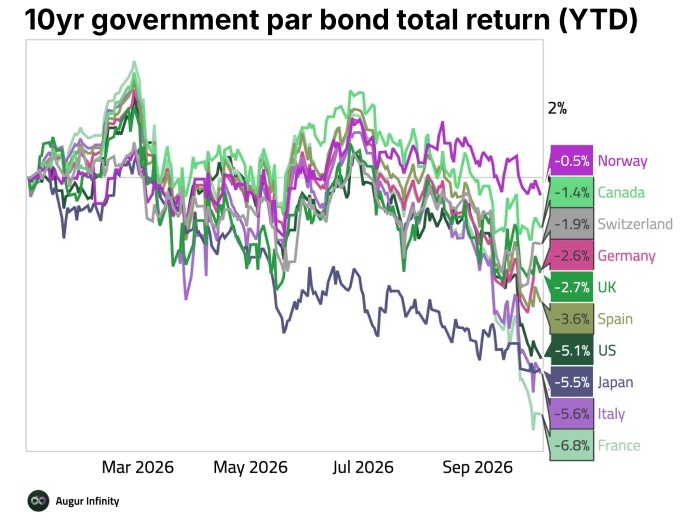
Japanese and U.S. bonds have dominated headlines this year, but French bonds have taken an even bigger hit.
The country's 10-year government bonds have delivered the worst returns among 10 major developed markets, even underperforming Italy, long seen as one of Europe's more vulnerable borrowers.
France's bonds lead the losses
French 10-year government bonds, known as OATs, are down 6.8% this year on a total-return basis, including coupon income and price changes, according to Augur Infinity data.
That's worse than Italy (-5.6%), Japan (-5.5%), and the U.S. (-5.1%). Even U.K. bonds are down just 2.7%, despite a sharp rise in government borrowing costs this year.
A budget no one wants to fix
France is dealing with many of the same problems pushing borrowing costs higher elsewhere: persistent deficits and mounting public debt, which is approaching 120% of GDP.
Its political deadlock makes those problems harder to address.
The government wants to find roughly €54 billion in savings in its proposed 2027 budget, but a divided parliament and next year's presidential election have complicated efforts to cut spending.
Meanwhile, France is expected to issue a record €340 billion in bonds next year, much of it to refinance maturing debt at higher interest rates.
📌 Bottom line: France's bond selloff is yet another warning about the painful trade-offs facing heavily indebted governments.