Is the bottom in?

Morning Observers,
The AI and dot-com booms have a lot in common, but there's one difference that doesn't get talked about enough.
The dot-com bubble popped and the S&P 500 rolled over when internet stock valuations peaked. The AI boom is unraveling after tech has already given back its entire AI premium.
On forward earnings, tech is back to its 2019 valuation. That was before Covid pushed much of the brick-and-mortar economy online and AI opened the door to a whole new set of applications.
Chipmakers are some of the most cyclical companies in this boom, but they're also the cheapest they've ever been. Some grocers trade at more than three times Nvidia's earnings multiple.
Of course, forward P/E has its own limitations, and the biggest one is that the "E" is still somebody's best guess. In fact, analysts have never gone into a bear market with earnings estimates that were too low. Not once.
And the bigger the crash, the further off those estimates were.
There's a lot of earnings growth and margin expansion priced in for next year, and that's hard to reconcile with the sell-off that's happening right now. So is the market missing the forest for the trees, or is it front-running the biggest earnings overshoot in recent memory?
For what it's worth, there have been a few cautious bottom calls in institutional notes over the past few days.
Happy Thanksgiving!
- Dan Runkevicius, Editor

📉 Commodity disinflation is accelerating
Commodity prices continue to fall even as official inflation readings reach multi-year highs. The Bloomberg Commodity Index is on track for its sixth consecutive weekly decline. The index, which tracks 25 futures contracts across energy, agriculture, and metals, is down 14% from its September peak. The decline contrasts with Wednesday's core PCE report, which showed annual core inflation of 3.8% in October, the second-highest reading since April 2023.
💳 Spending is outpacing income again
Americans' spending has grown much faster than their income this year as inflation has picked up. According to data from the Bureau of Economic Analysis, personal spending rose 6.4% year over year in October, compared with just 4.8% growth in personal income. Americans are also carrying more credit card debt than ever, with balances reaching a record $1.29 trillion in the third quarter, according to the New York Fed.
↩️ Anthropic finally returns to its IPO price
Anthropic's stock snapped a three-day losing streak on Wednesday, returning to its IPO price of $83. The stock gained 17% in its Nasdaq debut last Thursday, but those gains quickly fizzled as AI stocks sold off and concerns grew about insider selling at the Claude developer. CEO Dario Amodei and six other co-founders sold $1.96 billion worth of ANT stock as part of the IPO.
⚠️ Big Tech's low valuations are partly due to one-off investment gains
Economist Dean Baker argues that investment gains have inflated Big Tech's profits. Half of Amazon's profits in the first nine months of 2026 came from gains on its Anthropic investments, while investment gains accounted for a third of Alphabet's earnings over the past year. Baker estimates that without these gains, Amazon's price-to-earnings ratio would be closer to 40 than to 21, and Alphabet's would be closer to 20 than to 15.
💵 Dividend stocks are outperforming tech
While the Nasdaq 100 briefly entered a bear market on Wednesday and the S&P 500 Index fell 1%, dividend-paying stocks bucked the downtrend. The S&P 500 Dividend Aristocrats Index, which tracks companies that have raised their dividends for at least 25 consecutive years, rose 1%. The index includes established businesses in consumer staples, industrials, and other sectors largely overshadowed by the AI boom.
Why are foreign central banks pulling billions from the Fed?
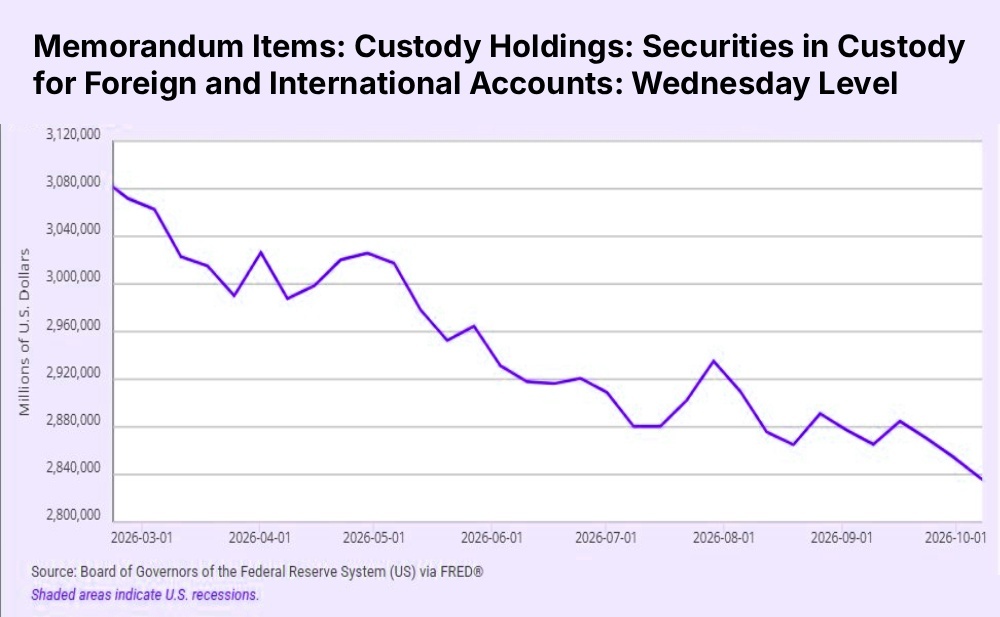
Foreign central banks have been moving billions of dollars in securities out of accounts held at the Fed since the Iran war began. Some see the shift as another sign of de-dollarization, but the explanation may be more nuanced.
A $240 billion exodus
According to Fed data, the value of securities held in Fed custody accounts for foreign officials and international institutions has fallen by $240 billion since late February.
These aren't ordinary investment accounts. Foreign central banks use them to safeguard dollar reserves, which they can draw on to support their currencies during periods of economic stress.
The decline raises an important question: Are central banks selling U.S. debt to raise dollars or simply moving their securities elsewhere?
If they're selling, that could drive Treasury yields higher, making it more expensive for Washington to borrow. If the securities are being transferred to other custodians, foreign governments may still own them.
The Treasury Department's own figures are less encouraging. Foreign official institutions' holdings of U.S. Treasuries fell from $4.01 trillion in February to $3.67 trillion in September.
The Iran war connection
Some analysts have interpreted the decline as a sign of waning confidence in U.S. debt.
Others say the oil crisis has increased demand for dollars, especially in energy-importing countries, where central banks may need to offload reserves to prop up their currencies.
"The longer this war drags on, the more countries are forced to sell dollar reserves to defend their currencies," analyst Lukas Ekwueme wrote.
📌 Bottom line: If foreign central banks are selling Treasuries to support their currencies, the Iran war could be pushing up Washington's borrowing costs just as its military spending rises.
One economist blames the Fed for this correction
There are plenty of theories about why the stock market is crashing.
Some blame overvalued AI stocks or the ongoing Iran war. Others point to the controversy surrounding Nvidia's Jensen Huang or the Democratic sweep of Congress and its potential impact on data center expansion.
But Brookings Institution senior fellow Robin Brooks blames the Federal Reserve.
The Fed is adding fuel to the fire
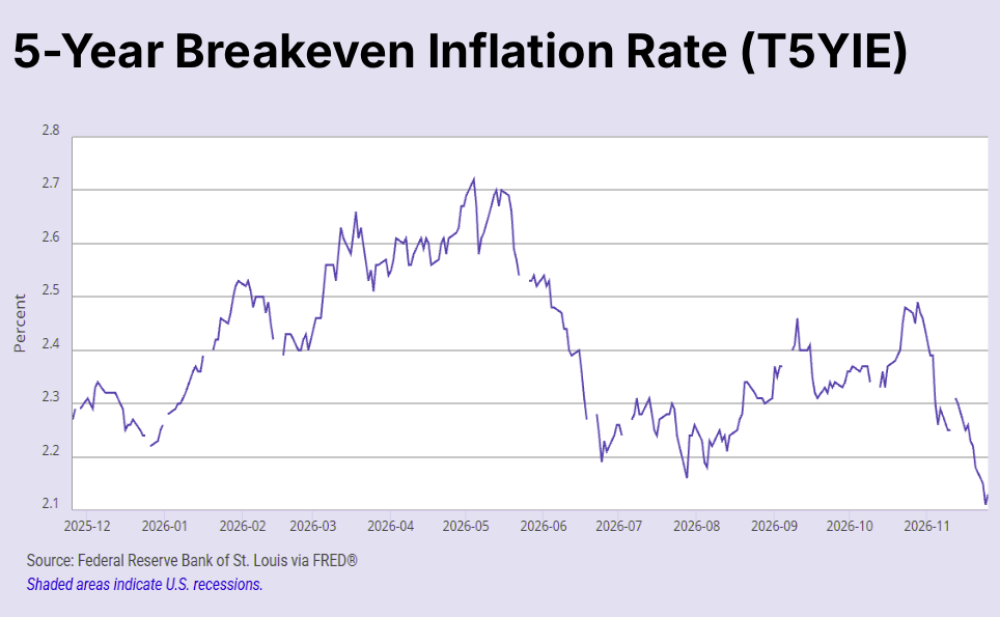
In a recent Substack post, Brooks argued that the Fed is worsening the market sell-off by signaling further rate hikes even as inflation expectations decline.
Fed Governor Chris Waller, for example, said a 50-basis-point rate hike may be warranted in December to bring inflation back toward the Fed's 2% target.
Meanwhile, data from Haver Analytics show that Brent crude prices and two-year inflation expectations have fallen, yet markets continue to expect higher interest rates.
The result is a rise in real interest rates (nominal interest rates minus expected inflation). In effect, borrowing has become more expensive in inflation-adjusted terms, even without another Fed rate hike.
"There's no doubt in my mind that the Fed is causing this meltdown," Brooks wrote.
Hike, pause, then cut
Even Wall Street's interest rate forecasts suggest the Fed may have to reverse course within a year.
For example, Citigroup argues that financial markets are already signaling that interest rates are "unusually high" and will eventually need to come down.
Citi expects just one more quarter-point rate hike in December, followed by a pause in early 2027 and cuts beginning in the second half of the year.
It's an unusual forecast for a central bank that's supposedly still fighting inflation.
The last time the Fed fought rising prices, it raised interest rates 11 times between March 2022 and July 2023, for a total increase of 5.25 percentage points.
📌 Bottom line: If Brooks is right, the Fed is making monetary policy more restrictive even before its next rate hike. And if Citi's forecast holds, investors may have to wait until the second half of 2027 for rate cuts.