Is SpaceX pump and dump?

Morning Observers,
Is SpaceX going to be an institutional pump and dump?
As of today, the IPO is oversubscribed by 3.5x-4x. That means institutional investors have pledged to invest four times more than SpaceX is raising before it even lists.
Now the catch is that the offering is very small relative to the company’s size.
SpaceX is issuing 556 million shares at $135, which would translate to $75 billion at a valuation of around $1.75 trillion.
That means SpaceX’s IPO float is just over 4.3%, or put another way, the company is selling only a tiny fraction of itself.
Although the IPO float has been in decline, this is still on the extreme low side. In the 1980s, the average IPO float in the U.S. was around 30%. Now it’s around 15%–20%, which is still up to five times higher than SpaceX.
Ok, so SpaceX is selling a teeny-tiny slice of its company at an insane valuation, and there’s much more institutional demand than it can fulfill. What happens next?
What sets the price of a company once it goes public is the marginal buyer, or how much the last buyer is willing to pay in the trading session.
If there’s a lot of unfulfilled institutional demand, some of it can become the marginal buyer willing to pay up, propping up the stock.
Everyone knows SpaceX's value is bonkers for a company that’s losing billions and whose main positioning in IPO docs is a tech that hasn’t been validated yet (AI space compute).
So there’s only so much institutional investors can willingly pay for this stock.
But then you have ETFs and mutual funds. A few days after the IPO, the marginal buyer will become active and passive fund managers who have to follow their algos or benchmarks and buy SpaceX whether they like it or not.
By Alphaville’s Toby Nangle estimates, SpaceX could attract $14 billion between the IPO and July 3.
Now despite Musk’s cult-like following, individual investors seem surprisingly bearish on SpaceX, and you guys are a pretty good example.
In one of the recent polls, 70% of you said you think the stock will be lower a year from now.
You are not alone. I get a lot of newsletters from finfluencers who cater to very speculative investors. They hype all kinds of stuff, but SpaceX seems to be where even they draw the line. Same story on WallStreetBets.
But what happens if SpaceX goes through the roof after the IPO because it has a lot of institutional marginal buyers lined up? All the headlines could quickly flip the sentiment and start sucking in individual investors
That feedback loop could be enough to shore up SpaceX until the lockup period expires and insiders can cash out.
Is that possible? Technically, yes. Will it happen? Your bet is as good as mine.
- Dan Runkevicius, Editor
Five things to know before opening bell
📊 It’s CPI day
One of the most watched numbers drops today, and markets are looking for a reality check. Forecasts point to another step higher in headline inflation, while core inflation is expected to stay relatively tame. The bigger question is whether inflation is starting to spread beyond energy, which would make the Fed’s job messier.
🪙 Gold and silver extend losses
Precious metals continued their slide as demand for the U.S. dollar remained strong. Gold fell below $4,200 a troy ounce, its lowest level of the year, while silver dropped below $67 a troy ounce, also marking a 2026 low.
💸 Americans are feeling more squeezed
Nearly half of Americans said their financial situation was worse in May than a year earlier, the highest share since January 2023, according to a New York Fed survey. Meanwhile, the share of households expecting their finances to improve over the next year fell to its lowest level since October 2022.
🛡️ Investors rotate into defensive sectors
U.S. stocks finished broadly lower Tuesday as investors shifted away from technology and into more defensive areas of the market. The S&P 500 fell 0.3%, with the technology sector down 1.8%, while real estate, consumer staples, utilities, and healthcare stocks outperformed, suggesting investors are growing more cautious.
🤖 Apple previews AI-enhanced Siri
Apple unveiled an AI-enhanced version of Siri powered by generative AI and developed in collaboration with Google. The upgraded voice assistant is expected to launch broadly this fall, but will not be available on iPhones or iPads in the European Union because of Apple’s ongoing antitrust dispute with regulators. Apple’s stock initially rose following the announcement before reversing into the red.
Profits and pay gap keeps growing
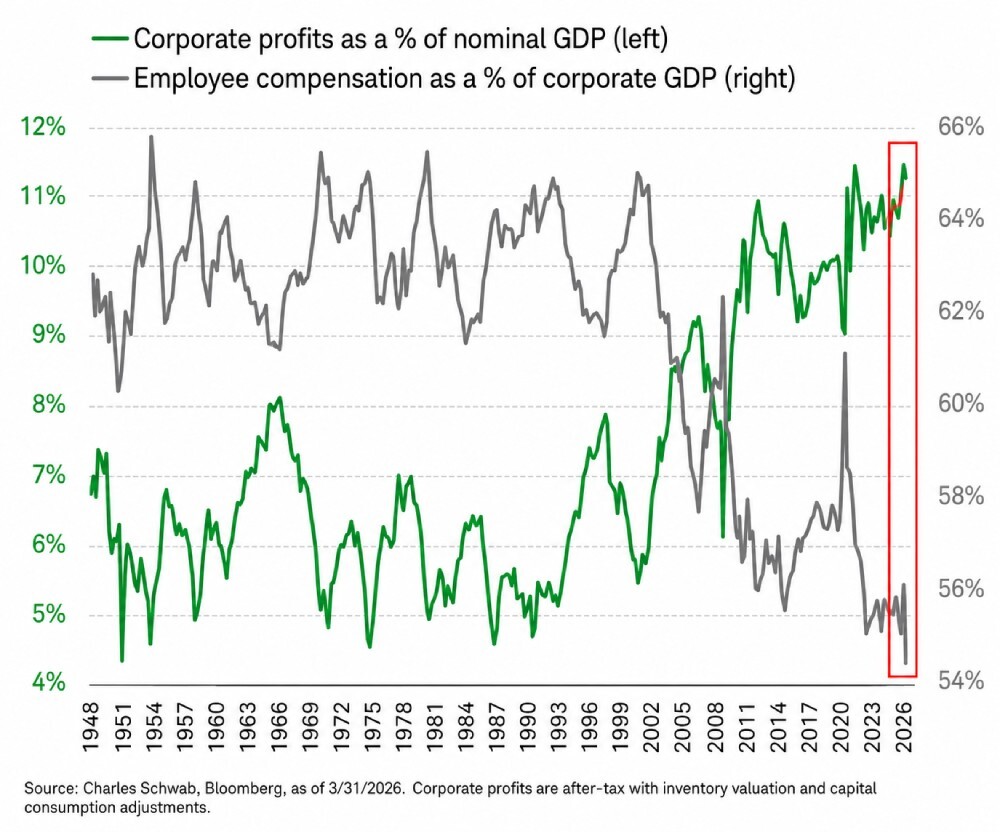
Record corporate profits are often treated as proof that the economy is doing well. The problem is that workers aren’t getting their piece of the pie they used to.
Workers are getting fewer of the gains
According to Charles Schwab data, workers are now receiving roughly 54% of the income generated by corporations, the lowest level since records began in 1948. That’s down from nearly 65% in the early 2000s.
The remaining 46% represents corporate income that isn’t paid as wages, including profits, interest, taxes, and depreciation.
At the same time, corporate profits as a share of GDP have doubled since 2001, reaching roughly 11.5%, a new all-time high.
In other words, corporations are earning more profits than ever before relative to the size of the economy, while workers are taking home a smaller share of it.
The shareholder effect
That’s not to say profits aren’t distributed. They are... just to different beneficiaries.
A 2022 study by the Economic Policy Institute found CEO pay has surged 1,460% since 1978, with CEOs now earning roughly 399 times more than the average worker.
Even the top 0.1% of earners saw their pay rise by a smaller 385% over the same period.
Meanwhile, worker pay has risen over time, just not nearly as fast as profits, executive compensation, or the stock market.
At the same time, companies have spent years returning more cash to shareholders through buybacks and dividends instead of to workers. The Chicago Fed calls this “shareholder primacy,” an approach that puts investor returns ahead of wages and long-term investment.
📌 Bottom line: Record corporate profits don’t automatically translate to fatter wallets for the average American. That’s one reason stocks can keep hitting new highs while so many Americans still feel like they’re falling behind.
The largest IPOs are typically the worst investments
Every investor wants to own the next great company. The problem is that by the time it reaches the stock market, venture capitalists have already captured most of its growth.
The public gets the leftovers SpaceX will likely become the largest IPO in history this week, but the largest IPOs have rarely produced the best returns.
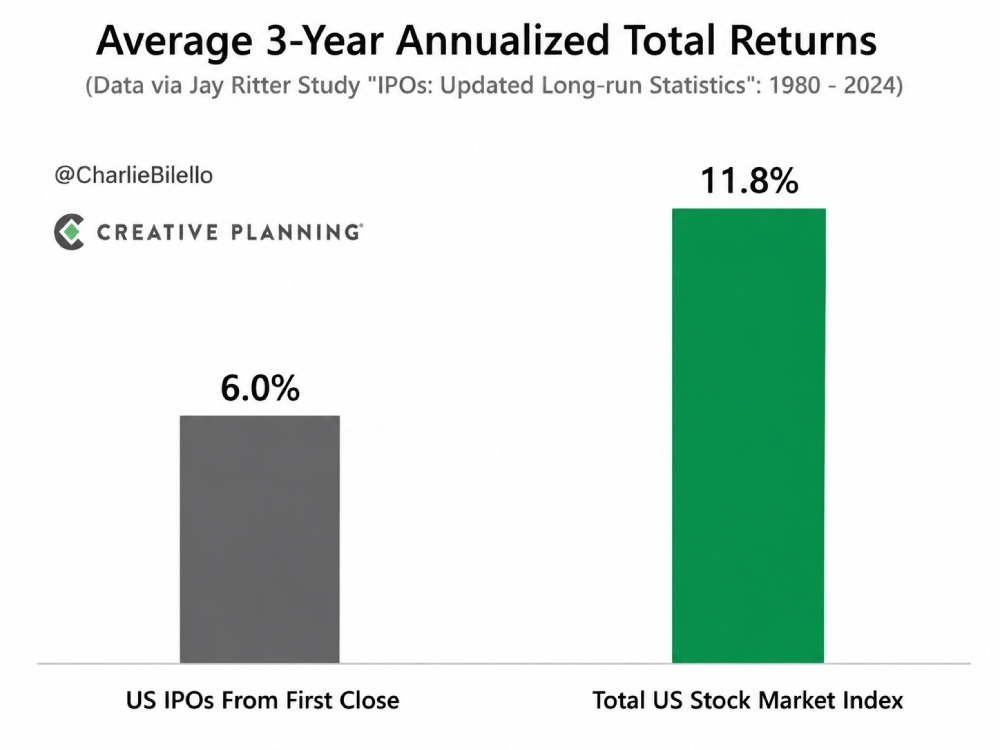
According to Jay Ritter’s long-run IPO data, U.S. IPOs have generated average annualized returns of just 6% during their first three years as public companies, compared with 11.8% for the broader U.S. stock market.
That means investors have historically been better off simply owning the S&P 500 than chasing the latest market darling.
One reason is that companies stay private far longer than they used to. Instead of listing early, they raise billions from venture capital and private equity funds, allowing early investors to capture years of explosive growth before the public ever gets a chance.
Hamilton Lane estimates that $1 invested in private equity in 2015 grew to $3.96 by 2024, outperforming the S&P 500 ($3.51) and the MSCI World Index ($2.61).
Bain & Company reached a similar conclusion, finding that private equity outperformed public markets across its 24-year study period.
📌 Bottom line: If there's one thing we can take away from recent IPO data, it's that the best companies are no longer coming of age on public markets